Marketing & SEO
How to Rank in AI Overviews: 7 Steps to Get Cited
How to rank in AI Overviews: 7 practical steps to get your site cited by Google's AI answers and Perplexity, with real data. Start here.

By Mohamed Ezz CEO & Founder Jul 20, 2026
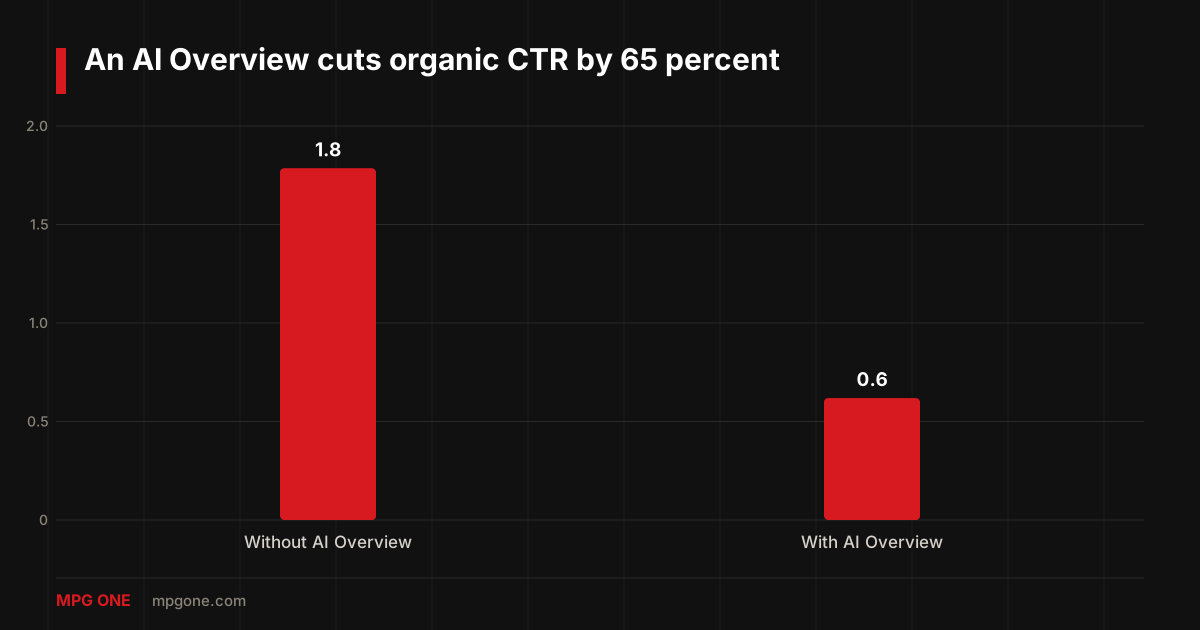
Here's the uncomfortable math: on queries where an AI Overview appears, organic click-through rates drop from 1.76% to 0.61%, a 61% decline, according to Seer Interactive data reported by Search Engine Land. And in early 2026, 68% of Google searches ended without any click at all, per SparkToro's zero-click study. If you want search traffic in this era, learning how to rank in AI Overviews is no longer optional.
Short answer up front: AI Overviews cite pages that answer the question directly, near the top, in extractable form, from sites with real topical authority. The 7 steps below are how you become that page. After nearly 20 years in digital marketing, this is the biggest shift in how search traffic gets allocated that I've seen, bigger than mobile, bigger than featured snippets.
My Main Points:
- Getting cited inside the AI answer is the new position one: cited brands earn about 35% more organic clicks than uncited ones.
- AI Overviews reward extractable answers: a direct 2 to 3 sentence answer right under a question-shaped heading.
- Most citations go to pages already in the top 10, so classic SEO still buys your ticket to the game.
- You cannot manage what you don't measure: track which of your keywords trigger AI answers and who gets cited.
- When a competitor is cited instead of you, the fix is specific, not generic: study the exact pages the AI chose.
In this guide I'll walk through the 7 steps in the order I apply them to client sites. If you want the wider context on where Google is heading, read our analysis of Google AI Mode and organic SEO first.
Why citations now beat rankings
The data is blunt. When an AI Overview sits on top of the results, the classic blue links underneath lose more than half their clicks.
But the clicks don't vanish evenly. Brands cited inside the AI answer earn roughly 35% more organic clicks than uncited brands on the same queries, according to aggregated AI Overview research. The traffic concentrates on whoever the AI trusts. Your job is to be that source.
Step 1: Put the answer in the first two sentences
AI systems extract answers; they don't read essays. For every question your page targets, write a direct 2 to 3 sentence answer immediately under the heading, then expand below it.
Test it yourself: if you pasted only the heading and the two sentences under it into a chat, would that be a complete answer? If yes, it is extractable. If the reader needs your fourth paragraph, the AI will cite someone else.
Step 2: Use question-shaped headings that match real queries
AI Overviews trigger overwhelmingly on question and long-tail queries. Mine the "People Also Ask" boxes, your Search Console query report, and question keyword tools, then make your H2s and H3s match the phrasing people actually use.
One page should own one question cluster. Ten thin pages answering one question each lose to one strong page answering the ten related questions a real person asks in sequence.
Step 3: Ship structured data, especially FAQ and article schema
Schema markup doesn't guarantee a citation, but it removes ambiguity about what your page contains. FAQPage, Article, and HowTo schema make your answers machine-legible, and machine-legible content is cheaper for AI systems to trust and extract.
The FAQ section on this very page ships as FAQPage JSON-LD. That is not decoration; it is the interface AI systems parse.
Step 4: Build topical authority, not one-off posts
AI Overviews cite sources that look like authorities on the whole topic, not sites with one lucky page. Build clusters: a pillar page, supporting articles, and internal links between them with descriptive anchors.
Classic signals still gate entry here. Most citations go to pages already ranking in the top 10, which means crawlability, site speed, and links still matter: our data on whether backlinks matter in SEO applies unchanged to the AI era.
Step 5: Give the AI something worth citing: fresh, verifiable facts
AI answers love specifics: numbers, dates, prices, test results, named sources. A page that says "prices vary" gets summarized; a page that says "the entry plan costs $129 per month as of July 2026" gets cited, because the AI needs an attributable source for that claim.
Publish original data when you can: your own tests, statistics roundups with sources, verified price comparisons. Our SEO statistics archive earns citations for exactly this reason.
Step 6: Track who the AI actually cites for your keywords
You cannot fix what you cannot see. For each priority keyword, you need to know three things: does an AI answer appear, does it cite your domain, and if not, who does it cite?
Manually, that is an hour of searching per week. Automatically, it is a tracker's job: PageCue (our tool, from $3 per month) checks Google AI Overviews and Perplexity weekly for your priority keywords, alerts you by email or Slack when a competitor takes a citation you had, and keeps the history so you can see trends. Whichever tool you use, start measuring before you start optimizing.
Step 7: Reverse-engineer the exact pages that got cited
When the AI cites a competitor instead of you, the reason lives in their page, not in a best-practices checklist. Read the cited page next to yours and ask: do they answer faster, do they carry data you lack, do they cover a subquestion you skipped, are they fresher?
This is tedious by hand, which is why we automated it: PageCue's Citation Gap analysis fetches the exact pages the AI cited, compares them against yours, and returns severity-ranked findings with concrete fixes. Do it by hand or do it with a tool, but do this step: it turns generic AEO advice into a specific to-do list for one page.
FAQ
Can you optimize for AI Overviews?
Yes. AI Overviews cite sources, and studies show cited pages share patterns: direct answers near the top, question-shaped headings, structured data, and topical authority. You cannot buy a citation, but you can earn one.
Do you have to rank on page one to appear in an AI Overview?
Not always, but it helps. Research shows most AI Overview citations come from pages ranking in the top 10, yet a meaningful share come from deeper positions when the page answers the exact question best.
How do I know if AI Overviews cite my site?
Manually, you search your keywords and read every AI answer. Automatically, a tool like PageCue checks Google AI Overviews and Perplexity weekly for your priority keywords and alerts you when a competitor takes your citation.
Is answer engine optimization different from SEO?
It is an extension, not a replacement. The fundamentals still decide who is eligible: crawlable pages, topical authority, real expertise. AEO adds a layer on top: extractable answers, question coverage, and citation tracking.
Do AI Overview citations actually drive traffic?
Yes. Research across 2025 and 2026 shows brands cited inside AI Overviews earn around 35% more organic clicks than uncited brands on the same queries. The citation is the new position one.
Final thoughts
Ranking in AI Overviews is not magic and not luck: extractable answers, question coverage, structured data, topical authority, citable facts, and measurement. Most of your competitors are doing none of the six, which is exactly why the next twelve months are the cheap window to become the source your niche's AI answers rely on.
If you'd rather have a team run answer engine optimization end to end, from content to citation tracking, that is what our marketing and SEO services are for. And if you want the budget toolkit to do it yourself, start with our guide to affordable SEO tools.
Helpful next steps
Turn the idea into something useful
When this topic becomes part of a real website, workflow, campaign, or AI system, these MPG ONE pages are the natural places to continue.
Connect technical SEO, content strategy, campaigns, analytics, and conversion-focused pages.
Chrome extensionsUse MPG ONE browser tools for backlink checks, on-page SEO, AEO checks, and productivity workflows.
Generative AI development servicesBuild generative AI workflows for content, documents, knowledge, and brand-safe operations.
AI development servicesBuild private AI assistants, workflow automation, knowledge systems, and reporting layers.
AI agent development servicesDesign tool-using AI agents with memory, retrieval, permissions, and human review.