Statistics
SEO Statistics and Key Trends from 2010 to 2026
Sourced SEO statistics from 2010 to 2026: organic CTR, zero click searches (68% in 2026), mobile share, and every major Google algorithm update in one place.

By Valentina Morelli General Manager | Head of Accounts Jun 19, 2024
Last updated: October 10, 2026. This page collects the SEO statistics that actually have sources behind them: how search, devices, click behavior and Google's algorithm changed from 2010 to 2026. Every table names where the number comes from.
Google algorithm milestones that defined SEO (2010 to 2026)
| Year | Update | What changed |
|---|---|---|
| 2010 | Caffeine | Faster indexing infrastructure; fresher results |
| 2011 | Panda | Devalued thin and low quality content sitewide |
| 2012 | Penguin | Targeted manipulative link building and over optimized anchors |
| 2013 | Hummingbird | Rewrote the core engine around meaning, not keywords |
| 2014 | Pigeon & HTTPS boost | Local results overhaul; HTTPS becomes a ranking signal |
| 2015 | Mobilegeddon & RankBrain | Mobile friendliness as a signal; first machine learning ranking component |
| 2017 | Mobile first indexing announced | Google starts ranking from the mobile version of pages |
| 2018 | Medic core update | Major reweighting of E-A-T, hitting health and finance sites hardest |
| 2019 | BERT | Language model understanding of queries (~10% of searches affected at launch) |
| 2021 | Page Experience / Core Web Vitals | Speed and stability metrics become ranking signals |
| 2022 | Helpful Content system | Site wide classifier demoting content written for rankings, not people |
| 2024 | March 2024 core + spam updates | One of the largest quality crackdowns ever; scaled AI content targeted |
| 2024 | AI Overviews launch (May) | AI generated answers on top of results in the US, expanding globally |
| 2025 to 2026 | Continuous core updates & AI Mode | Rolling core updates; conversational AI Mode expands, reshaping click behavior |
Source: Google Search Central announcements and industry documentation of confirmed updates.
Mobile's takeover of search (2010 to 2026)
Mobile's share of global web traffic grew from 2.82% in 2010 to 52.54% in 2026 so far, while desktop fell from 97.18% to 45.91%, per StatCounter (yearly averages; 2026* = January to September):
| Year | Desktop | Mobile | Tablet |
|---|---|---|---|
| 2010 | 97.18% | 2.82% | 0.00% |
| 2011 | 93.89% | 6.11% | 0.00% |
| 2012 | 87.95% | 10.74% | 1.31% |
| 2013 | 79.21% | 16.20% | 4.59% |
| 2014 | 66.66% | 27.06% | 6.28% |
| 2015 | 59.09% | 35.20% | 5.72% |
| 2016 | 51.29% | 43.67% | 5.03% |
| 2017 | 43.74% | 51.59% | 4.67% |
| 2018 | 45.19% | 50.80% | 4.01% |
| 2019 | 46.00% | 50.44% | 3.56% |
| 2020 | 45.59% | 51.66% | 2.75% |
| 2021 | 42.30% | 55.02% | 2.68% |
| 2022 | 39.38% | 58.38% | 2.25% |
| 2023 | 42.85% | 55.22% | 1.92% |
| 2024 | 36.99% | 60.97% | 2.04% |
| 2025 | 39.79% | 58.63% | 1.58% |
| 2026* | 45.91% | 52.54% | 1.55% |
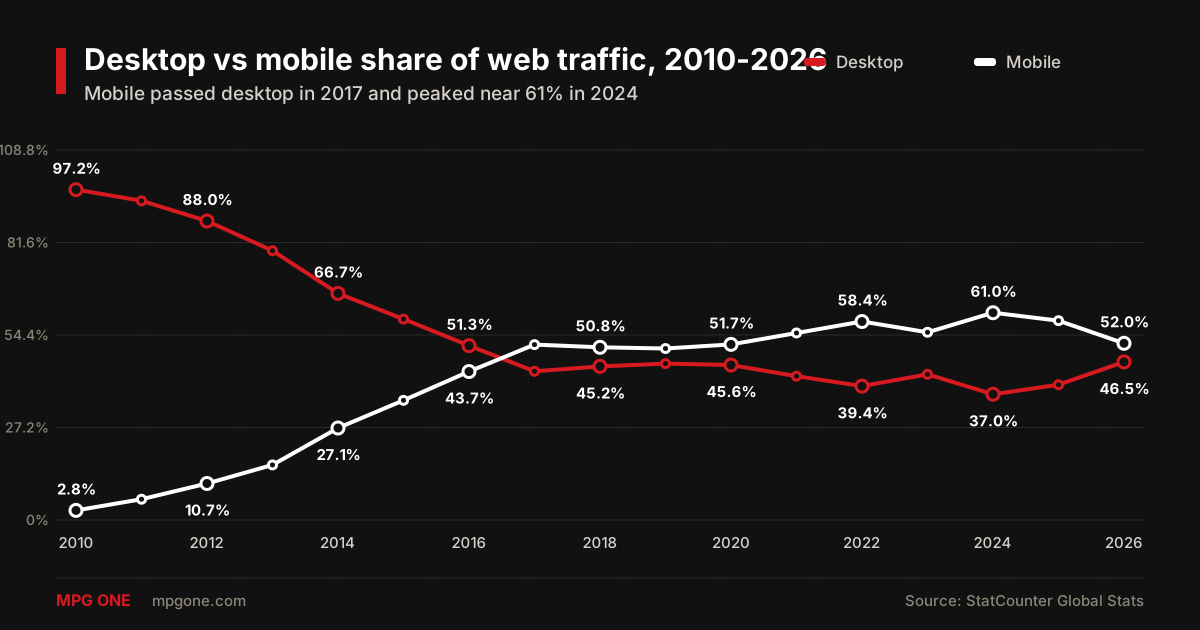
Mobile overtook desktop in 2017 (51.59% vs 43.74%) and peaked at 60.97% in 2024. This single shift drove mobile first indexing, Core Web Vitals, and most of modern technical SEO.
Click behavior: CTR and zero click searches
- The #1 organic result on Google has an average CTR of 27.6%, and the top 3 results get 54.4% of all clicks, according to Backlinko's analysis of about 4 million search results (page last updated April 2025, still Backlinko's latest CTR study).
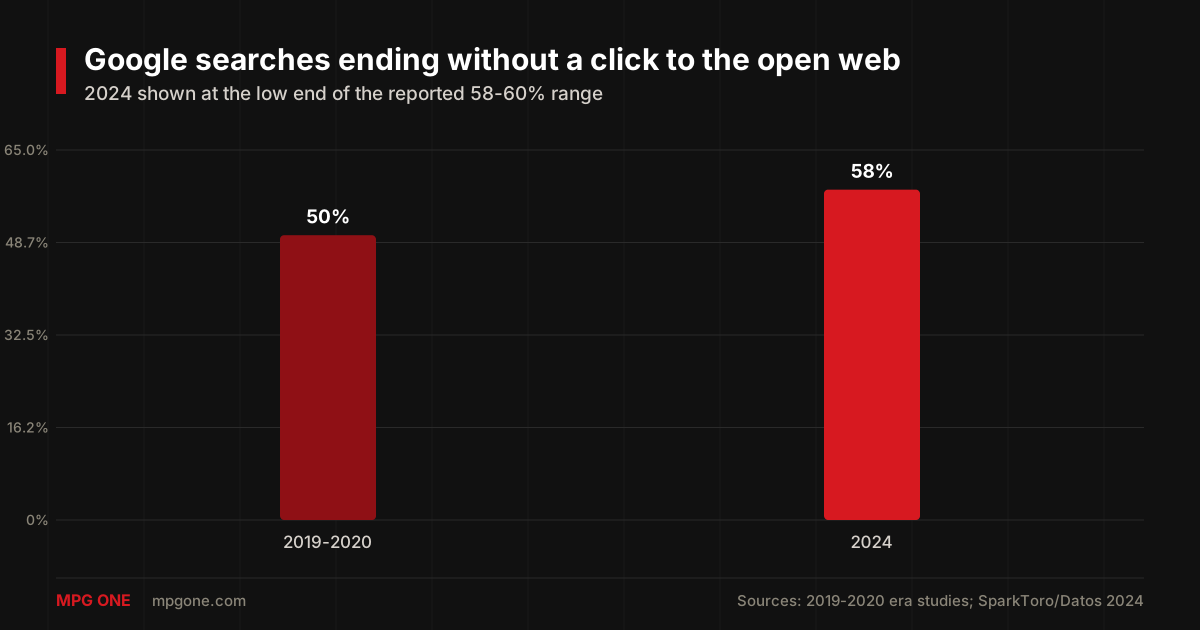
- 68.0% of US Google searches ended without any click from January to April 2026, and only 231 of every 1,000 US searches sent a click to the open web, according to SparkToro's June 2026 study using Similarweb panel data. The UK was even higher at 69.5%, Germany lowest at 62.1%.
- That is up from 58.5% in the US and 59.7% in the EU in 2024, per the SparkToro and Datos 2024 study, and from just over 50% in June 2019, when SparkToro's Jumpshot based study first saw zero click searches pass half of all searches. The 2026 study uses a different data panel than 2024, so read the jump as a direction, not an exact delta.
- Since AI Overviews launched in May 2024, multiple industry trackers have measured lower organic CTR on informational queries where an AI answer appears; reported appearance rates vary widely by tracker and query set, so treat any single number with caution.
The search market backdrop
- Google's worldwide yearly share has stayed between 89.81% and 92.63% across the entire 2010 to 2026 period; it fell to 89.92% in 2025, its lowest year since 2014, and averages 90.42% in 2026 so far (StatCounter; full tables in our search engine market share statistics).
- Bing reached its all time worldwide high, 4.85% in 2026 so far and 5.29% in September 2026, after integrating AI assistance. In the US it averages 9.53% in 2026, its best year since 2014 (StatCounter).
- AI assistants like ChatGPT and Perplexity are not measured as search engines by traffic trackers, but their rise coincides with the zero click acceleration above.
What the 2010→2026 arc means
- 2010 to 2015: SEO was keywords and links; Panda and Penguin killed the easy versions of both.
- 2016 to 2020: mobile and machine learning took over; intent replaced keyword matching.
- 2021 to 2023: experience signals (Core Web Vitals, E-E-A-T, Helpful Content) reweighted quality site wide.
- 2024 to 2026: the AI answer era: fewer clicks per search, brutal quality classifiers, and growing value in being the cited source rather than just a ranked page.
Sources
- StatCounter Global Stats, device and search engine share
- Google Search Central, confirmed algorithm update announcements
- Backlinko, organic CTR study (last updated April 2025)
- SparkToro / Similarweb, zero click search study (2026) and SparkToro / Datos (2024)
Helpful next steps
Turn the idea into something useful
When this topic becomes part of a real website, workflow, campaign, or AI system, these MPG ONE pages are the natural places to continue.
Use MPG ONE browser tools for backlink checks, on-page SEO, AEO checks, and productivity workflows.
Marketing and SEO servicesConnect technical SEO, content strategy, campaigns, analytics, and conversion-focused pages.
Generative AI development servicesBuild generative AI workflows for content, documents, knowledge, and brand-safe operations.
AI development servicesBuild private AI assistants, workflow automation, knowledge systems, and reporting layers.
Custom AI solutionsCreate a custom AI system around your data, tools, permissions, and operating model.