AI
Claude vs Grok: Fable 5 & Opus 4.8 vs Grok 4.5 Tested
Claude vs Grok, tested: Fable 5 and Opus 4.8 against Grok 4.5 with our own API battery, DeepSWE data, real pricing, and a verdict for each job. See who wins.

By Mohamed Ezz CEO & Founder Jul 11, 2026
Here's the number that reframes the Claude vs Grok fight: our entire test run of 5 tasks on Grok 4.5, reasoning tokens included, cost $0.075. Seven and a half cents. The same battery's worth of work on Claude Fable 5 pricing would cost roughly 8x more per token, according to xAI's and Anthropic's published rates. The question isn't whether Claude's flagships are stronger. The question is whether they're stronger enough.
The short answer: Grok 4.5 scored 4.3 of 5 on our own battery. It was flawless on code, math, and instruction following, with one revealing failure on facts. Claude Fable 5 and Opus 4.8 hold verified engineering scores on DeepSWE that Grok hasn't posted yet, and they remain our picks for unattended work where trust is critical. But at $2/$6 per million tokens, Grok 4.5 is the new price floor for near frontier capability, and for many jobs that settles it.
My Main Points:
- Our API test: Grok 4.5 scored 4.3 of 5, perfect on bug hunting, implementation, math, and constrained writing
- Its one failure is instructive: it confidently asserted that newer models "do not exist" instead of hedging
- Grok 4.5 costs $2/$6 per 1M tokens: output is 4.2x cheaper than Opus 4.8 and 8.3x cheaper than Fable 5
- Grok 4.5 is not yet on DeepSWE; Claude's scores there (Fable 5: 70%, Opus 4.8: 59%) remain the verified engineering anchor
- Measured speed: all 5 tasks in 96 seconds at high reasoning effort
After nearly 20 years in AI development, my rule for model fights is: measure what you can, source what you can't, and never trust a single number. This post has all three. It includes our own API run on Grok 4.5 with saved transcripts and measured costs, DeepSWE data for the Claude side, and pricing from the vendors themselves. For how the Claude flagships compare against OpenAI's, read this alongside our Fable 5 vs GPT-5.6 Sol comparison; the two posts share a test methodology.
What Is Grok 4.5?
Grok 4.5 is xAI's flagship, released July 8, 2026, aimed at coding, agentic tool calling, and knowledge work. Specs: a 500K token context window, a configurable reasoning_effort parameter (low, medium, or high, with high as the default), and an OpenAI compatible API. Pricing is the headline: $2 per million input tokens, $6 per million output, $0.50 for cached input. Server side tools bill separately. Web search, X search, and code execution cost $5 per 1,000 calls, per OpenRouter's listing.
On third party evals, Grok 4.5 scores 54 on the Artificial Analysis Intelligence Index, ranking #4 overall and #1 on agentic tool use, with 83.3% on Terminal-Bench 2.1 and 64.7% on SWE-Bench Pro. It's a major step past the Grok 4 generation we covered last year.
The Claude Side: Fable 5 and Opus 4.8
Anthropic's top two are different tools for different jobs. Claude Fable 5 ($10/$50 per 1M, 1M context) is the frontier model: thinking that is always on, self verifying turns that can run for minutes, built for the hardest long horizon work. Claude Opus 4.8 ($5/$25, 1M context) is the workhorse flagship most Claude users actually run daily.
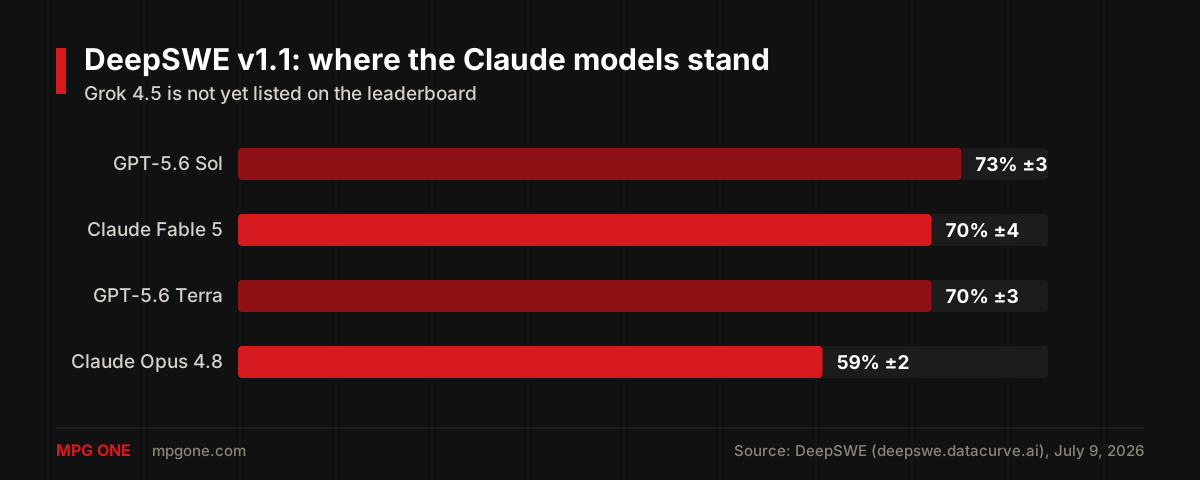
On DeepSWE v1.1, the contamination free, long horizon software engineering benchmark we treat as primary, Fable 5 passes 70%±4 of tasks at $21.63 per run, and Opus 4.8 passes 59%±2 at $13.22 per run (July 9, 2026).
Claude vs Grok Benchmarks: The Gap Problem
Here's the honest problem with this comparison: Grok 4.5 is not on DeepSWE yet. Its published numbers (Terminal-Bench, SWE-Bench Pro) come from benchmarks with known contamination and saturation issues, and its strongest claim, #1 agentic tool use, comes from an aggregate index. Comparing those against Claude's DeepSWE scores would be apples to oranges.
So we did what we always do when the leaderboard has a hole: ran our own battery. Five original, objectively gradable tasks. A Python bug hunt, an implementation from spec, a compounding churn calculation, a facts question with a citation requirement, and a constrained writing task. All called directly via the xAI API on grok-4.5 at high reasoning effort, one fresh request per task, first response only, graded against an answer key written before any model saw the tasks. The tasks and key are identical to the ones we used on GPT-5.6 in our Sol comparison, so the scores are directly comparable.
We Tested Grok 4.5: The Results
A note on the yardstick before the scores: we can't yet run Claude's flagships through this battery API to API (we'll add them when we can), so the measured baseline in the chart below is GPT-5.6 from our earlier test. Same five tasks, same answer key written in advance, which makes the two scores directly comparable. Think of GPT-5.6 here as the reference line, not the opponent.
Grok 4.5 scored 4.3 out of 5, against 4.8 for GPT-5.6 on the same battery. Four tasks were flawless. It found both bugs in the interval merging function and added an empty list guard the minimal fix didn't need. Its parse_duration implementation handled every edge case with all 8 test values correct. Its churn table was exact to ten decimal places, and it volunteered the closed form formula unprompted. The constrained writing task hit all five constraints cleanly.
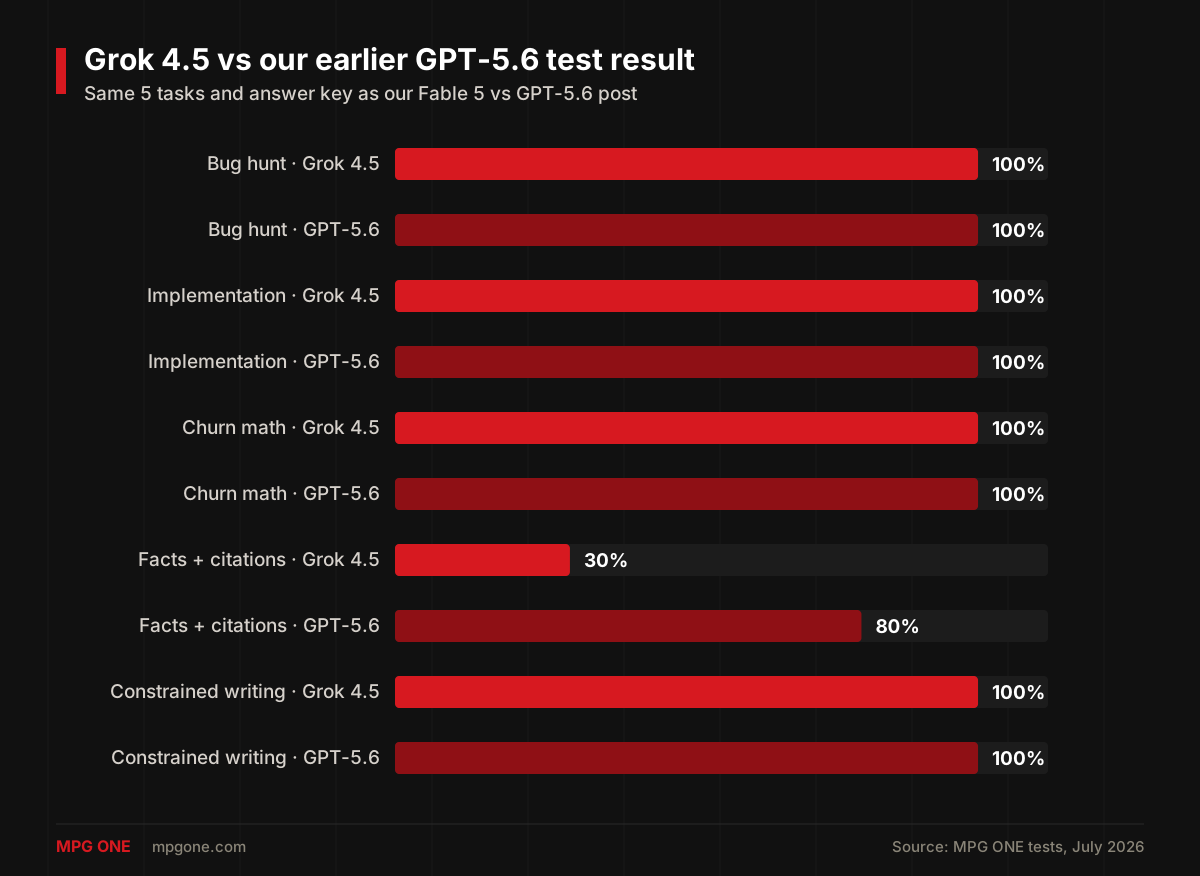
The failure is the most useful result. Asked for the launch prices of Claude Fable 5 and the GPT-5.6 family, models released after its training data, Grok didn't hedge. It asserted, in bold, that the models "do not exist" and that the question described a future that "has not occurred." Credit where due: it refused to invent prices, exactly as instructed. But instead of saying "I can't verify this," it confidently declared a false state of the world. We scored it 30%.
Two fairness caveats, disclosed in full: our GPT-5.6 run happened in the ChatGPT app (which may have had browsing available), while Grok ran via raw API with no web search tool enabled. So the facts task measured Grok's honesty under ignorance, not its knowledge. And Claude's flagships weren't run through this battery yet (we don't currently have API access on this machine); their column rests on DeepSWE. We'll extend the table when we close both gaps.
The efficiency numbers deserve their own paragraph: all five tasks completed in 96 seconds total (8 to 44 seconds each), consuming 10,810 reasoning tokens plus 1,273 output tokens, for a measured total of $0.0754. Cheap isn't a rounding error here; it's the product.
Pricing Reality
Grok 4.5's sticker sits far below both Claude flagships: $6 per million output tokens versus $25 for Opus 4.8 and $50 for Fable 5, with input at $2 versus $5 and $10 respectively, and cached input at $0.50.
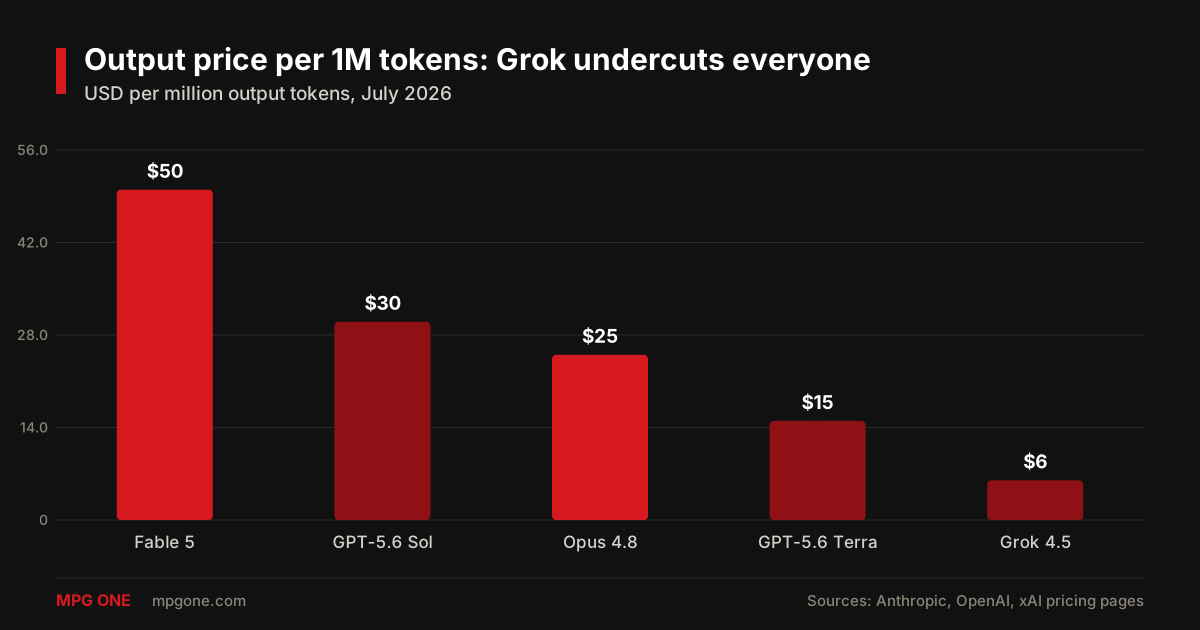
Two footnotes before you replatform on price alone. First, Grok's server side tools cost extra ($5 per 1,000 web search or code execution calls), so agentic workloads that lean on tools will bill above the token price. Second, cost per task depends on how many tokens a model burns, not just the rate: on DeepSWE, Fable 5 generates about 119K output tokens per task. We don't yet know Grok 4.5's burn rate on comparable long horizon work. Our short task run was frugal (about 2,400 total tokens per task), but short tasks don't predict long ones.
Which Model for Which Job?
Every row follows from measured or sourced numbers above.
| Job | Pick | Why (the numbers) |
|---|---|---|
| Hardest software engineering, verified quality | Fable 5 | DeepSWE 70%±4, the only model here with a top verified score on the primary benchmark |
| Everyday coding at flagship quality | Opus 4.8 | DeepSWE 59%±2 at half Fable 5's token price; 1M context |
| Well specified short coding tasks on a budget | Grok 4.5 | 4 of 4 on our code and math tasks, at $6/1M output, a fraction of either Claude |
| Agent pipelines at high volume with human review | Grok 4.5 | #1 agentic tool use (Artificial Analysis); cheapest tokens; watch the $5/1K tool call fees |
| Long unattended runs (hours, overnight) | Fable 5 | Thinking always on and self verification by design; Grok has no comparable long horizon evidence yet |
| Research, facts, anything post 2025 | Claude flagships, or Grok + web search | Grok's 30% on our facts task: confident false assertions without a search tool |
| Massive context work (whole repos) | Fable 5 / Opus 4.8 | 1M context versus Grok's 500K |
| Cost capped drafting, extraction, classification | Grok 4.5 | Our full battery: $0.075 measured; instruction following was flawless (5 of 5 constraints) |
That's the real Claude vs Grok answer: the routing logic mirrors what we told clients after the GPT-5.6 comparison. Don't pick a side, route by job. Grok 4.5 slots in as the budget tier that punches at flagship level on well specified tasks, the same role Terra plays in OpenAI's lineup, at even lower cost. The Claude flagships keep the jobs where verified long horizon quality and trustworthy claims matter more than the invoice. If you're building the agents that do the routing, our guide to AI agents with memory covers the architecture layer.
Curious what developer communities say beyond the benchmarks? We track the live threads in best AI for coding according to Reddit.
FAQ
Is Claude better than Grok?
Depends on the job. Grok 4.5 scored 4.3 of 5 on our API battery, flawless except for confidently denying the existence of newer models. Claude Fable 5 and Opus 4.8 hold verified DeepSWE scores (70% and 59%) Grok hasn't posted, but Grok costs 4x to 8x less per output token.
How much does Grok 4.5 cost?
$2 per million input tokens, $6 per million output, $0.50 cached input, 500K context. Our entire test of 5 tasks cost $0.075 including reasoning tokens.
Is Grok 4.5 good for coding?
Yes. It aced our bug hunt, implementation, and math tasks with clean, correct code, and xAI reports 83.3% on Terminal-Bench 2.1 and 64.7% on SWE-Bench Pro. It hasn't yet been listed on DeepSWE, the benchmark we treat as primary.
What is Grok 4.5's biggest weakness?
Overconfident wrongness. Asked about models newer than its training data, it asserted they don't exist rather than hedging. For facts workloads, enable web search or verify its claims.
Which model should I use for agents?
Grok 4.5 ranks #1 on agentic tool use (Artificial Analysis) at the lowest token price, strong for reviewed pipelines at high volume. For long unattended runs where trust beats cost, Claude Fable 5.
Final Thoughts
Claude vs Grok isn't a knockout either. It's a trade between price and proof. Grok 4.5 delivered flagship grade work on every well specified task we gave it, in seconds, for pennies, and its one failure was a trust failure, not a capability one. Claude's flagships carry the verified long horizon record and the 1M context, and they charge accordingly. Our routing: Grok for cheap, reviewed, well specified volume; Opus 4.8 for daily flagship coding; Fable 5 for the unattended and the unforgiving. We'll rerun the table when Grok lands on DeepSWE and when we close the Claude API gap in our own battery.
If you're wiring models like these into a real product, with routing layers, agent pipelines, and cost controls, that's our day job. See our AI agent development services and we'll help you put each model where it earns its keep.
Helpful next steps
Turn the idea into something useful
When this topic becomes part of a real website, workflow, campaign, or AI system, these MPG ONE pages are the natural places to continue.
Build private AI assistants, workflow automation, knowledge systems, and reporting layers.
Generative AI development servicesBuild generative AI workflows for content, documents, knowledge, and brand-safe operations.
AI agent development servicesDesign tool-using AI agents with memory, retrieval, permissions, and human review.
Custom AI solutionsCreate a custom AI system around your data, tools, permissions, and operating model.
MPG ONE coursesLearn practical AI systems, SEO growth workflows, and talent brand operations with MPG ONE training.