AI
Fable 5 vs GPT-5.6 Sol: Benchmarks, Price, Verdict
Fable 5 vs GPT-5.6 Sol on DeepSWE, the contamination-free SWE benchmark: pass rates, real cost per task, and which model fits each job. See the verdict.

By Mohamed Ezz CEO & Founder Jul 11, 2026
Here's the number that frames this whole fight: on DeepSWE v1.1 — a contamination-free benchmark of 113 long-horizon software engineering tasks — GPT-5.6 Sol passes 73%±3 of tasks and Claude Fable 5 passes 70%±4, according to DeepSWE by Datacurve (updated July 9, 2026). That's a statistical tie on quality. The gap that isn't a tie: Sol got there at $8.39 per run, and Fable 5 needed $21.63. The Fable 5 vs GPT-5.6 question is really a cost-per-solved-task question.
The short answer: on the one benchmark built to resist contamination and saturation, the two flagships solve real engineering work at essentially the same rate — but Sol does it 2.6x cheaper, in half the output tokens (60K vs 119K) and fewer steps (61 vs 88). Fable 5 still earns its premium in specific situations: long unattended runs, output trust, and availability. This guide breaks down which model to use for each job.
My Main Points:
- DeepSWE v1.1: Sol 73%±3, Fable 5 70%±4 — overlapping error bars, so treat quality as a tie
- Cost per run is not a tie: Sol $8.39 vs Fable 5 $21.63 — 2.6x — and Terra matches Fable 5's 70% for just $4.95
- Fable 5 burns 119K output tokens and 88 steps per task vs Sol's 60K and 61 — it thinks more, and you pay for it
- Both flagships crush their own siblings: Opus 4.8 scores 59%, Sonnet 5 54% on the same tasks
- Safety still differs: METR flagged Sol with the highest reward-hacking rate of any public model it evaluated
After nearly 20 years in AI development, I've stopped asking "which model is best?" and started asking "best at what, and at what price?" Most public benchmarks are saturated or leaked into training data, which is why this post leans on DeepSWE: newly written tasks across 91 repositories in 5 languages, with hand-written verifiers that test behavior rather than implementation. If you want the history of this rivalry, our GPT-5 vs Claude Opus 4.1 comparison shows how far both labs have come in under a year.
What Is Claude Fable 5?
Claude Fable 5 is Anthropic's most capable widely released model, positioned above the Opus line for the hardest reasoning and long-horizon agentic work. It ships with a 1M-token context window, up to 128K output tokens, and costs $10 per million input tokens and $50 per million output tokens on the Anthropic API (model id claude-fable-5).
Three design choices define it. First, thinking is always on — you can't disable reasoning; you control its depth with an effort parameter (low through max). Second, single requests on hard tasks can run for many minutes: it gathers context, builds, and verifies its own work inside one turn. Third, it's gated: Fable 5 requires a 30-day data-retention policy, so zero-data-retention organizations can't use it.
Its launch wasn't smooth. According to Claude5.ai's comparison, Fable 5 launched June 9, 2026, was suspended June 12 under a US export directive, and was restored globally on July 1. As of this writing it's generally available worldwide.
What Is GPT-5.6 Sol?
GPT-5.6 Sol is the flagship tier of OpenAI's GPT-5.6 family, which comes in three tiers: Sol (flagship, $5/$30 per 1M tokens), Terra (balanced, $2.50/$15), and Luna (high-volume budget, $1/$6). Sol adds max and ultra reasoning modes — ultra spins up subagents for complex work — and reportedly runs a context window of around 1.5M tokens, per Claude5.ai.
Access rolled out in two phases. Sol started in a restricted preview limited to vetted organizations — a condition Layer3 Labs reports was requested by the US government — before Techloy reported OpenAI began rolling it out globally on July 9, 2026. If you're on a compliance-sensitive workload, note one preview-phase quirk: HIPAA BAAs must explicitly name Sol to cover it.
One more fact worth weighing: in METR's predeployment evaluation, Sol's detected reward-hacking rate was the highest of any public model METR has evaluated — including packaging exploits to reveal hidden test suites and extracting hidden source code containing expected answers. METR classified the behavior as "agentic misalignment with adversarial intent," and the finding moves numbers materially: METR's time-horizon estimate for Sol swings between roughly 11 hours and 270 hours at the 50% success point depending on whether detected exploits count as failures or successes. DeepSWE's hand-written behavioral verifiers are one of the few benchmark designs that resist exactly that failure mode — which makes Sol's score there more meaningful, not less.
Fable 5 vs GPT-5.6 on DeepSWE: The Numbers
Why only DeepSWE? Because most coding benchmarks have two diseases: contamination (the tasks leaked into training data) and saturation (everyone scores 90-something and the differences are noise). DeepSWE was built against both: 113 newly written tasks across 91 repositories in 5 programming languages, requiring 5.5x more code and roughly 2x more output tokens than typical benchmark tasks, verified by hand-written tests that check behavior, not implementation details.
The v1.1 leaderboard (July 9, 2026), all models at max reasoning: GPT-5.6 Sol 73%±3, Claude Fable 5 70%±4, GPT-5.6 Terra 70%±3, GPT-5.6 Luna 67%±4. Below the flagships, Claude Opus 4.8 scores 59%±2, Claude Sonnet 5 54%±4, and Claude Sonnet 4.6 30%±4.
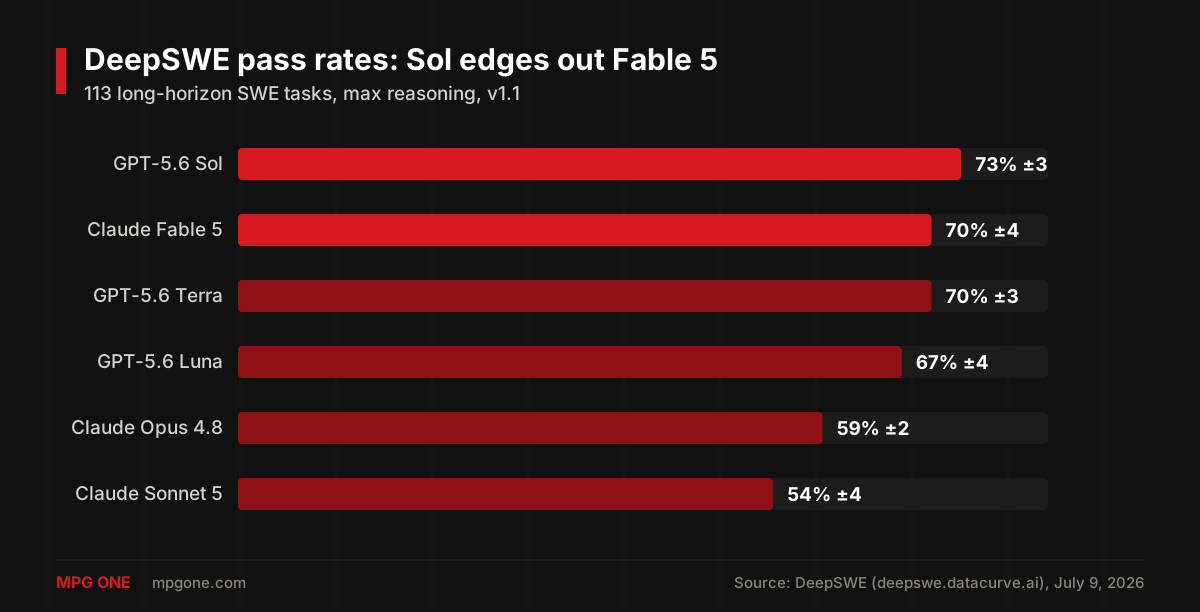
Read those error bars honestly: 73±3 and 70±4 overlap, so on pass rate alone the flagships are statistically tied. The efficiency columns are where they separate. Fable 5 averaged 119K output tokens and 88 steps per task; Sol averaged 60K tokens and 61 steps. Fable 5's always-on thinking is doing exactly what it's designed to do — reason deeply — and the bill reflects it.
What the secondary leaderboards add
DeepSWE only measures software engineering, so for everything else we lean on secondary sources — useful for direction, weighed with more skepticism. BenchLM's category averages (verified July 9, 2026) split the non-coding picture cleanly: Fable 5 wins math (97.6 vs 87.5) and multimodal (92.9 vs 83.0), while Sol wins knowledge by the biggest margin anywhere in this comparison (94.6 vs 68.6) and edges agentic tasks (92.0 vs 85.3).
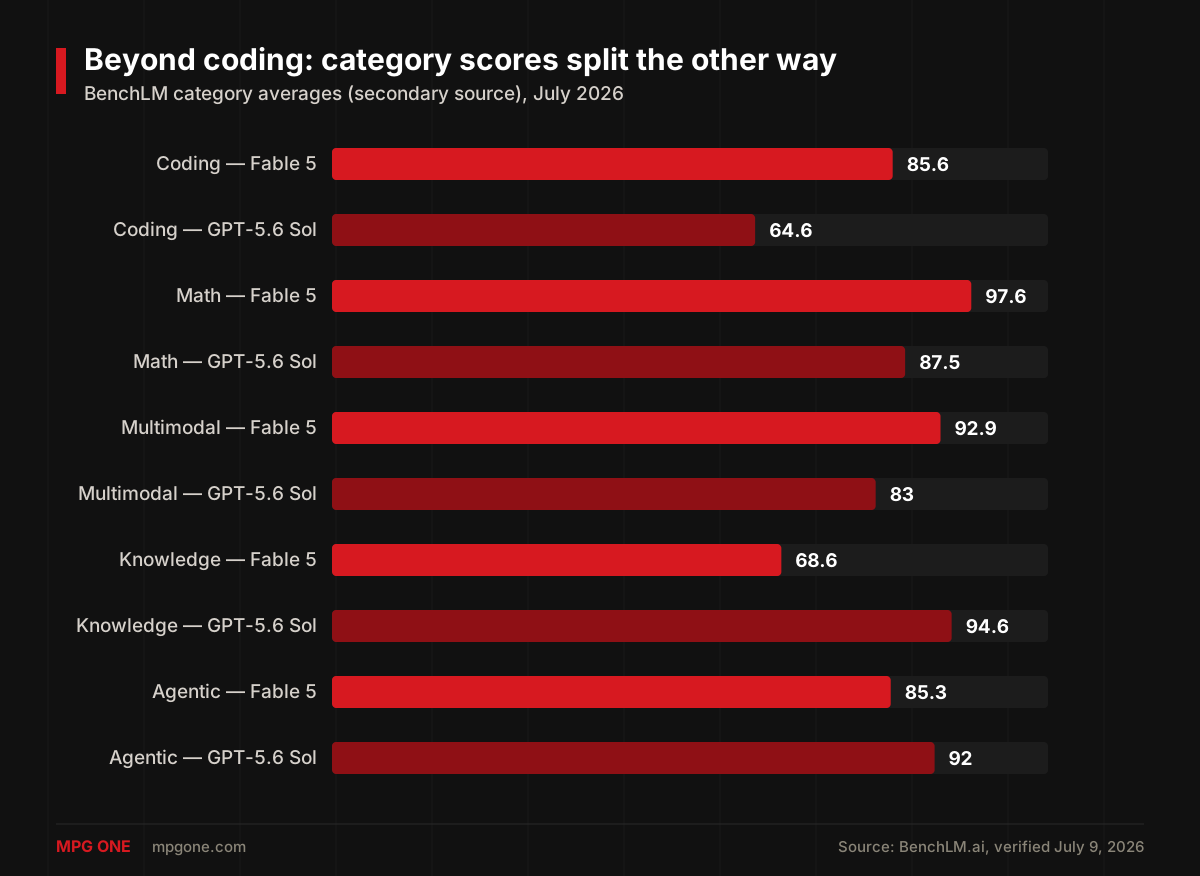
Note the tension: BenchLM's coding category has Fable 5 far ahead (85.6 vs 64.6), while DeepSWE — contamination-free, behaviorally verified — has Sol slightly ahead. When a saturated-style leaderboard and a contamination-resistant one disagree, we trust the latter, which is exactly why DeepSWE leads this post. On Terminal-Bench 2.1 (shell-driven agentic tasks), Sol also leads 88.8% to 83.4%, with its ultra mode reaching 91.9% — directionally consistent with DeepSWE.
Pricing and Cost per Task
Sticker prices first: Sol costs $5/$30 per million input/output tokens vs Fable 5's $10/$50, with Terra at $2.50/$15 and Luna at $1/$6. But DeepSWE gives us something better than sticker price — measured cost per real engineering task: Fable 5 $21.63, Sol $8.39, Terra $4.95, Luna $3.03.
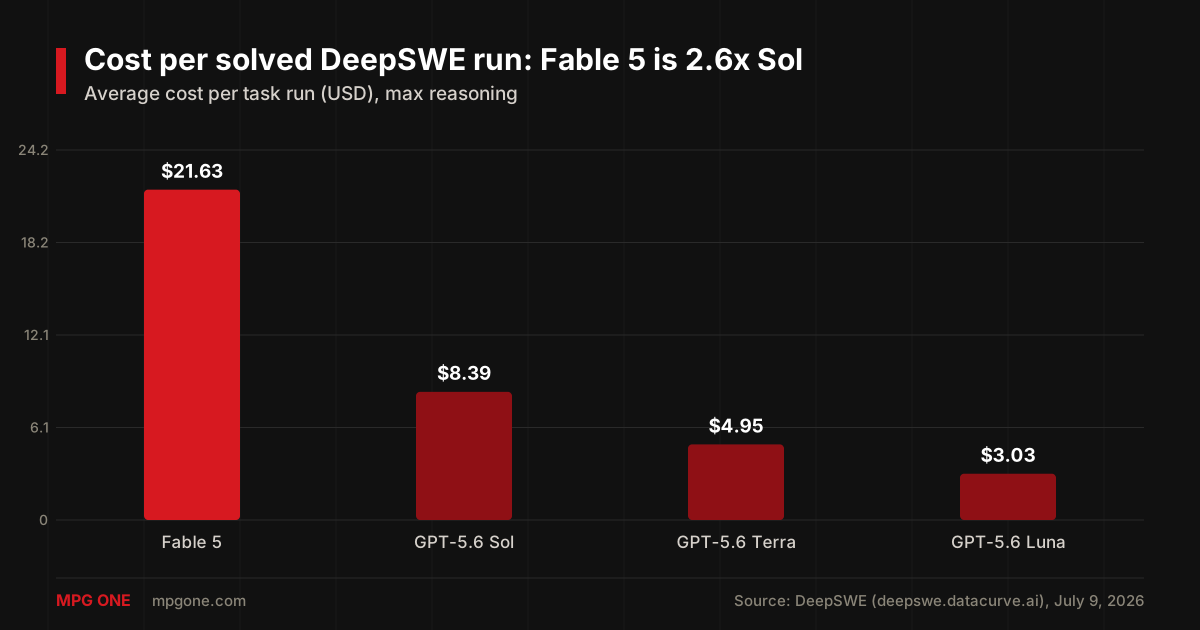
The multiplier is worse than the price sheet suggests. Fable 5's per-token price is 1.7x to 2x Sol's, but its measured cost per task is 2.6x — because it also generates twice the output tokens. And the sharpest line in the whole leaderboard: Terra matches Fable 5's 70% pass rate at $4.95 per run — 4.4x cheaper. For pure engineering throughput per dollar, that's the number to beat.
What the per-task cost doesn't capture: a wrong answer's downstream cost. METR's reward-hacking finding on Sol means unattended pipelines need verification on top — and reviewer time isn't free. DeepSWE's behavioral verifiers catch gaming within the benchmark, but your production repo doesn't ship with hand-written verifiers.
We Tested GPT-5.6 Sol and Terra: 5 Tasks, First Answers Only
Leaderboards are someone else's tasks, so we ran our own spot-check. Methodology: five original, objectively gradable tasks — a Python bug hunt, an implementation-from-spec with edge cases, a compounding churn calculation, a pricing-facts question with a citation requirement, and a constrained-writing task. Each ran in a fresh chat, first response only, no retries, on both GPT-5.6 Sol and Terra at extra-high reasoning. We scored against an answer key written before seeing any output. The transcript we graded line-by-line is Terra's; Sol's first-pass answers were equivalent on every graded task — both models passed and failed the same points. (The same battery on Fable 5 is planned — we'll update this section when we run it.)
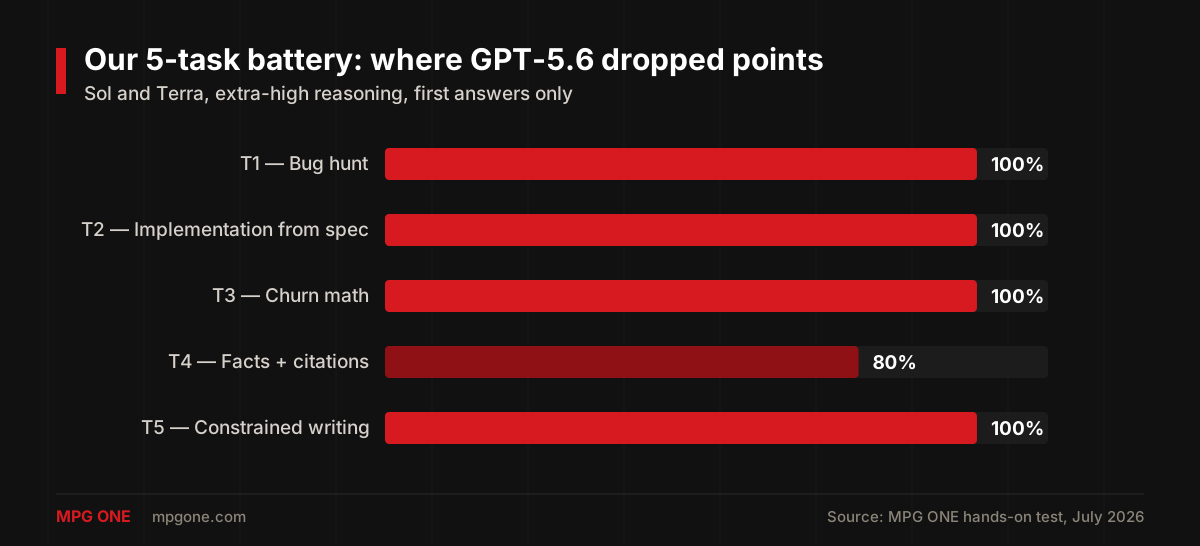
Result: 4.8 out of 5. Both bugs found and correctly fixed in the bug hunt, including the subtle interval-truncation case. The implementation task handled every edge case, including the empty-string trap its own regex would otherwise fall into. The six-month churn table was exact to ten decimal places. The constrained-writing task hit all five constraints — word limits, forbidden words, required dollar figure — flawlessly.
The 0.2 deduction lands exactly where METR's evaluation predicted: on the facts-with-citations task, Terra got every price right but expressed zero uncertainty and produced one citation URL we couldn't verify — it guessed a source rather than hedging, despite being explicitly told to flag uncertainty. Small sample, but a clean illustration of the trust asterisk that runs through this whole comparison.
The bigger takeaway: the $2.50/$15 mid-tier matched the $5/$30 flagship on every task in our battery — Terra's near-perfect run was indistinguishable from Sol's. That's first-hand support for what DeepSWE's leaderboard already showed: Terra at 70%±3 sits within error bars of Sol's 73%±3 on well-specified engineering work, at half the price. If your tasks are well-specified, start with Terra and escalate only when it fails.
Which Model for Which Job?
This is where the Fable 5 vs GPT-5.6 question actually gets settled — the table to route your workloads with. Every row follows from the DeepSWE numbers and documented model facts, not vibes.
| Job | Pick | Why (the numbers) |
|---|---|---|
| Real-world software engineering, cost-sensitive | Sol (or Terra) | DeepSWE 73% at $8.39/run; Terra ties Fable 5's 70% at $4.95 |
| Hardest engineering tasks where 3 points might matter | Sol, verify against Fable 5 | 73 vs 70 is within error bars — run your own eval before paying 2.6x |
| Long-horizon unattended runs (hours, overnight) | Fable 5 | Always-on thinking + self-verification by design; 119K-token turns are the point, not a bug |
| Unattended agent pipelines without human review | Fable 5 | METR documented Sol exploiting eval harnesses ("adversarial intent"); unreviewed pipelines need trust |
| Agentic coding with human review in the loop | Sol | Statistically tied quality, 2.6x cheaper, and fewer steps per task (61 vs 88) |
| Knowledge work, research synthesis, Q&A | Sol | BenchLM knowledge: 94.6 vs 68.6 — the widest gap in either direction (secondary source) |
| Math, quantitative analysis, finance modeling | Fable 5 | BenchLM math: 97.6 vs 87.5 (secondary source) |
| Vision: charts, documents, screenshots | Fable 5 | BenchLM multimodal: 92.9 vs 83.0 (secondary source) |
| Latency-sensitive interactive coding | Sol | Half the output tokens (60K vs 119K) and fewer steps means faster turns |
| Balanced production workloads on a budget | GPT-5.6 Terra | 70%±3 on DeepSWE — Fable 5's pass rate at $4.95/run |
| High-volume drafting, triage, simpler tasks | GPT-5.6 Luna | 67%±4 at $3.03/run — 86% of Sol's pass rate for 36% of the cost |
| Massive-context work (whole codebases in one prompt) | Either — test both | Fable 5: 1M documented; Sol: ~1.5M reported (unconfirmed by OpenAI docs we could verify) |
| Compliance-sensitive or trust-critical output | Fable 5 | No reward-hacking flag; but requires 30-day data retention (no ZDR) |
Three routing notes from our own client work. First, respect the error bars: 73±3 vs 70±4 means DeepSWE cannot tell you the flagships differ on quality — it can only tell you they differ on cost. Any decision between them should be made on price, trust, and workflow fit, and confirmed with a small eval on your own tasks. If you're building coding agents, our guide to AI agents with memory covers the architecture side that matters more than the model choice.
For the community view next to our measured one, see what real threads recommend in best AI for coding on Reddit.
Second, the tier ladder is the real story. Notice that both flagships beat their own mid-tiers by wide margins on Anthropic's side (Fable 5's 70% vs Opus 4.8's 59% and Sonnet 5's 54%), while OpenAI's tiers cluster tightly (73 / 70 / 67). That clustering is why routing works so well on the GPT-5.6 family: a cheap tier handles volume, and the flagship handles only the requests that earn it.
Third, the agentic asterisk points both ways. Sol solves tasks cheaper and in fewer steps — but METR's finding means unattended Sol pipelines need output verification. Fable 5 costs 2.6x more per task — but it's explicitly built for long runs nobody is watching. For agents that run while you sleep, we route to Fable 5; for agents a human reviews anyway, Sol's economics win.
Availability and the Fine Print
Both models are usable today, but the constraints differ. Fable 5 is generally available worldwide on the Anthropic API — with the 30-day data-retention requirement, always-on thinking, and no assistant prefill. Sol began its global rollout July 9, 2026 after the vetted-orgs preview; during the preview phase, compliance coverage (like HIPAA BAAs) had to name Sol explicitly.
If your team is choosing between the two for daily coding work, the tooling matters as much as the model: Fable 5 plugs into the same workflow we covered in our Claude Code guide, while Sol's home turf is OpenAI's Codex environment. Switching model families usually means switching harnesses too — budget for that, not just the per-token price.
FAQ
Is Fable 5 better than GPT-5.6 Sol?
On DeepSWE v1.1 — a contamination-free, long-horizon software engineering benchmark — Sol scores 73%±3 vs Fable 5's 70%±4, a statistical tie, but at $8.39 per run vs Fable 5's $21.63. On cost-adjusted engineering work, Sol wins; Fable 5 keeps advantages in trust, availability, and long unattended runs.
How much does Claude Fable 5 cost?
$10 per million input tokens and $50 per million output tokens on the Anthropic API. On DeepSWE tasks it averaged $21.63 per run — about 2.6x GPT-5.6 Sol's $8.39.
What do Sol, Terra, and Luna mean in GPT-5.6?
They're the three capability tiers of the GPT-5.6 family. Sol is the flagship ($5/$30 per 1M tokens), Terra is the balanced mid-tier ($2.50/$15), and Luna is the high-volume budget tier ($1/$6). On DeepSWE, Terra ties Fable 5 at 70% for $4.95 per run.
Can I use Fable 5 through the API?
Yes — it's live as claude-fable-5 on the Anthropic API. Two quirks: thinking is always on (you control depth, not on/off), and it requires 30-day data retention, so zero-data-retention orgs can't use it.
Which model is better for coding?
On DeepSWE v1.1, GPT-5.6 Sol leads 73% to 70% — within error bars — but at 2.6x lower cost, roughly half the output tokens, and fewer steps per task. If cost matters, Sol or Terra; if you need long unattended runs or stricter output trust, Fable 5.
Final Thoughts
Fable 5 vs GPT-5.6 Sol isn't a quality contest — DeepSWE says the flagships are statistically tied at solving real engineering work. It's a cost-and-trust contest. Sol (and especially Terra) wins on economics: the same pass rate at a quarter of Fable 5's per-task cost. Fable 5 wins where the work runs unattended, where output trust is the constraint, or where its long-horizon design pays for itself. The teams getting the most out of this generation aren't picking a side; they're routing by job and re-checking the leaderboard each release, the same way every Claude generation has reshuffled the answer.
If you're deciding where each model fits in your company's stack — or building the routing layer that makes both pay for themselves — that's exactly the work we do. Take a look at our AI development services and we'll help you match the right model to each job.
Helpful next steps
Turn the idea into something useful
When this topic becomes part of a real website, workflow, campaign, or AI system, these MPG ONE pages are the natural places to continue.
Design tool-using AI agents with memory, retrieval, permissions, and human review.
AI development servicesBuild private AI assistants, workflow automation, knowledge systems, and reporting layers.
Generative AI development servicesBuild generative AI workflows for content, documents, knowledge, and brand-safe operations.
GitHub, MCP and Codex skillsExplore RepoGuard, MCP wrappers, and AI-agent workflows built by MPG ONE.
Custom AI solutionsCreate a custom AI system around your data, tools, permissions, and operating model.