AI
Is Justdone AI Accurate? Real Test Results and Limits
Our 2026 JustDone AI retest: accuracy dropped to about 59 to 61% overall, the weakest of the three detectors we tested. Strong plagiarism checker, weak on short text.

By Mohamed Ezz CEO & Founder Aug 1, 2025
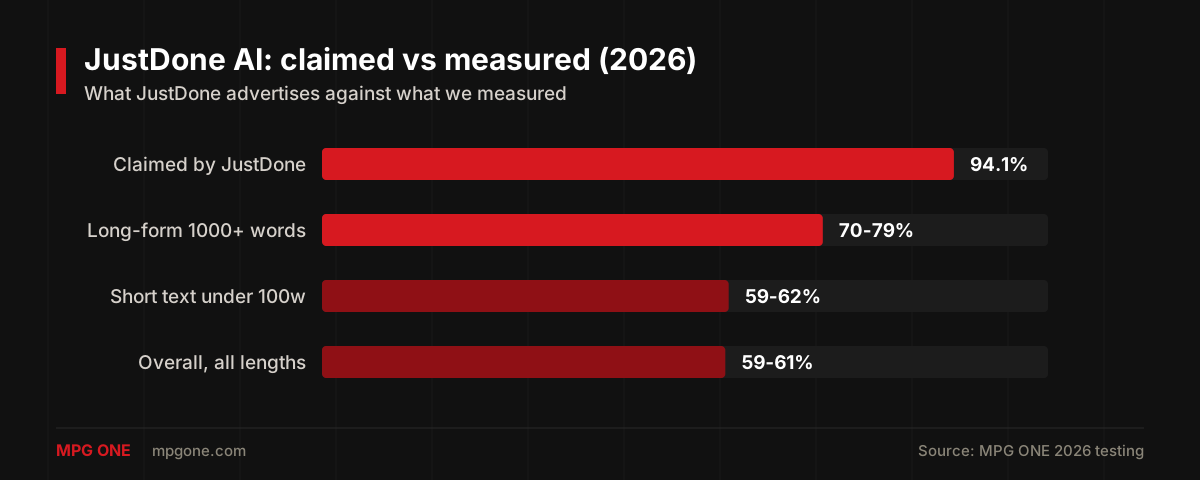
In our 2026 retest, JustDone AI's detector dropped to about 59 to 61% accuracy, down from the roughly 70% we measured before and far below the 94.1% it advertises. That makes it the weakest of the three detectors we tested. It is still far more reliable on long documents than on short ones, its plagiarism checker remains the strongest part of the suite, and its humanizer is the part most likely to cause problems if you rely on it. Here is the full breakdown.
Last tested: July 2026, against current-generation content. Detector accuracy shifts every time the tools retrain and every time a new AI model ships, which is exactly what this retest shows. Treat the figures as directional, confirm current pricing on the vendor site, and never treat a single detector score as proof.
Quick verdict
- Claimed accuracy: 94.1%. What we measured in 2026: about 59 to 61% overall.
- Best on: long-form content over 1000 words, where it reached about 70 to 79%.
- Weakest on: short paragraphs under 100 words, where it fell to around 59 to 62%.
- Plagiarism checker: still genuinely reliable and the strongest of its three tools.
- Bottom line: usable as one signal on long documents, unsafe as a sole judge of short text.
What JustDone AI actually is
JustDone bundles three separate tools that people often confuse: an AI content detector (does this text read as AI-written), a plagiarism checker (does this text match existing published sources), and an AI humanizer (rewrite AI text so detectors miss it). They solve different problems and they do not perform equally. Judging JustDone as one product is the first mistake most reviews make, so we tested each part on its own.
This review is part of our 2026 AI detector accuracy study, where we retested the three most-used detectors against current-generation models.
How we tested
We ran samples across three content lengths, short paragraphs under 100 words, medium articles of a few hundred words, and long-form pieces over 1000 words. Within each length we mixed pure AI output, lightly edited AI, heavily edited or paraphrased AI, and genuine human writing. For every sample we recorded whether JustDone flagged it correctly, whether it produced a false positive (human writing called AI) or a false negative (AI text missed), and how much its confidence score matched reality. We ran the same texts on the free and paid tiers.
Accuracy by content length
| Content type | Claimed | Our 2026 result |
|---|---|---|
| Short paragraphs (under 100 words) | 94.1% | ~59 to 62% |
| Long-form (1000+ words) | 94.1% | ~70 to 79% |
| Overall, all lengths | 94.1% | ~59 to 61% |
The pattern holds and has gotten worse: the more text JustDone has to work with, the better it does, but even at its best on long documents it is now well short of a usable verdict, and on short paragraphs it is barely better than a coin toss. Medium-length content sits between the two. If you are checking tweets, product blurbs, or single paragraphs, treat the result as a weak hint, not a decision.
How the AI detector works, and why it keeps slipping
Like most detectors, JustDone looks for the statistical fingerprints of machine-written text: predictable word choices, even sentence rhythm, and a lack of the small irregularities human writing carries. That approach has two structural weaknesses, and both are getting worse. First, newer AI models write with far more natural variation, so the fingerprint is faint. Second, any editing that adds human irregularity erodes the signal fast. The steady decline from 94.1% claimed to about 60% measured is the same arms race dragging every detector down, and JustDone is losing it faster than its competitors.
The plagiarism checker is the strong part
JustDone's plagiarism checker was again the most reliable tool in the suite. Plagiarism detection is a fundamentally easier and more deterministic problem than AI detection: it compares your text against a large index of existing content and reports genuine overlaps, rather than trying to infer how the text was produced. If your main concern is copied or unoriginal content rather than AI authorship, this is where JustDone earns its keep.
The humanizer, and the honesty problem it creates
JustDone's humanizer rewrites AI text to read as more human by varying sentence structure and adding natural imperfections. It often works, which is precisely the issue: a company selling both a detector and a tool to beat detectors is selling both sides of the same arms race. For anyone using JustDone to enforce a no-AI policy, the existence of an effective humanizer is a reminder that no detector result can be treated as proof of how text was written.
False positives and who gets hurt
At roughly 60% overall, JustDone gets a lot wrong in both directions, and the false positives, genuine human writing flagged as AI, are the ones that hurt real people. They cluster on short human text and plain, functional writing that lacks stylistic flourish, which describes a lot of legitimate student and professional work. If a false positive feeds an academic penalty or a hiring rejection, a detector this unreliable has no business being the deciding factor.
Free versus paid
The paid tier is meaningfully better than the free one. It adds a sentence-by-sentence breakdown, confidence scores per section, more stable results on mixed human and AI text, and higher daily limits. The free plan is the weakest version of the tool and not a fair basis for judging it. If you are going to rely on JustDone at all, rely on the paid tier, while remembering that even the paid tier is now the least accurate of the three detectors we tested.
Pricing
JustDone offers a limited free plan and paid monthly plans, typically with a short low-cost trial before the full monthly rate. Prices change regularly, so confirm the current numbers on their site before subscribing rather than trusting any figure quoted in a review, including this one.
How it compares
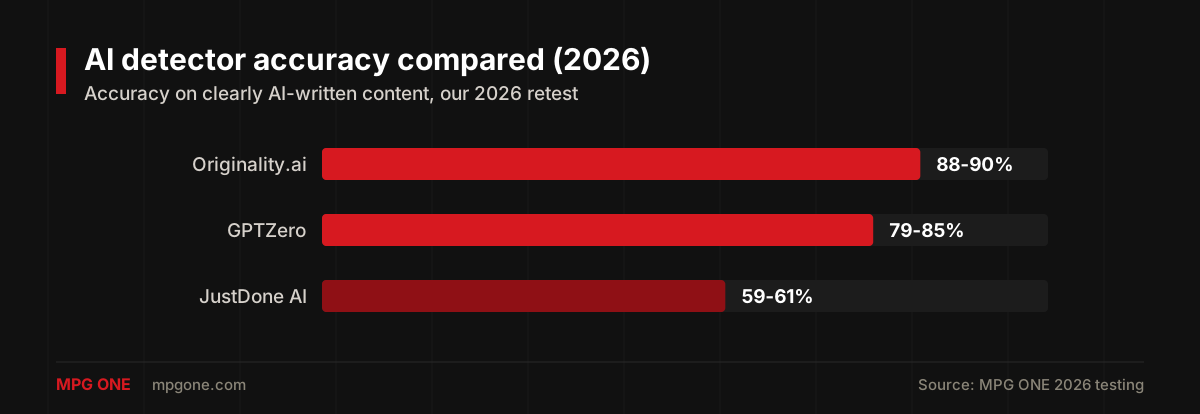
We ran the same 2026 testing on GPTZero and Originality.ai, and JustDone came last.
| Detector | Accuracy on clear AI (2026 retest) | Key weakness now | Best use |
|---|---|---|---|
| Originality.ai | ~88 to 90% | Over-sensitive: false-flags some 100% human writing | Publisher and agency quality control at scale |
| GPTZero | ~79 to 85% | Under-sensitive: misses newest models (Fable 5, GPT-5.6 Sol) | Fast first-pass screen for obvious AI |
| JustDone AI | ~59 to 61% | Weakest overall, unreliable on short text | Plagiarism checking and long-form sanity checks |
The 2026 picture across all three: Originality leads but errs by over-flagging humans, GPTZero errs by missing current models, and JustDone trails both. No detector is reliable enough to be the sole basis for a decision about a person. Run important text through two tools, and trust a human over any score.
What people say about JustDone
The common themes in user feedback are consistent with what we measured. People like the all-in-one bundle and the clean interface, and the plagiarism checker earns genuine praise. The recurring complaints are just as clear: a wide gap between the advertised 94.1% and the accuracy users actually experience, frustration with subscription and refund handling, and worry about false positives on real human writing. The humanizer draws a separate line of criticism, since selling a tool to defeat detectors alongside a detector strikes many users as working both sides of the same problem. Taken together, the sentiment matches our result: handy for a quick check, not something to stake a decision on.
The future of AI detection
Every number in this review points the same way, and it is worth saying plainly: after-the-fact AI detection is losing, and it is not coming back. Each new generation of model writes with more natural variation, which erases the statistical fingerprint detectors depend on. Our own retest of the newest models makes that concrete. The tools that were near 95% two years ago are drifting toward the low 80s and below, and pushing them to catch more AI only makes them flag more innocent humans.
The industry is already moving past pure detection toward provenance: proving where content came from rather than guessing after the fact. Expect more weight on content credentials and watermarking standards, on disclosure norms where AI assistance is declared rather than hunted, and on process-based proof such as document version history and draft trails. Detectors will likely survive as one weak signal in that mix, useful for a first-pass flag, but the era of treating a detector score as evidence is ending. Anyone building a policy on detection alone is building on sand.
Tips for using JustDone without getting burned
- Use it on long documents, where it is least unreliable, and ignore its verdict on anything under 100 words.
- Lean on the plagiarism checker, which is the strongest tool in the suite, more than the AI detector.
- Never let a roughly 60% accurate score be the deciding factor in an academic or hiring decision.
- If your own writing is flagged, keep your drafts and version history as proof of authorship.
- Confirm anything important with a second detector, and treat agreement between tools, not one score, as the signal.
FAQ
Is JustDone AI accurate in 2026?
In our 2026 retest it was about 59 to 61% accurate overall, down from around 70% before and far below its claimed 94.1%. It was most accurate on long documents (about 70 to 79%) and least accurate on short text (about 59 to 62%).
Is the JustDone plagiarism checker reliable?
Yes, more so than its AI detector. Plagiarism detection compares your text against existing sources, a more deterministic task, and it remained the strongest tool in the suite.
Does the JustDone humanizer work?
Often, which is the problem. It can rewrite AI text to pass detectors, including JustDone's own, which is why no detector result should be treated as proof of authorship.
Should I trust JustDone for academic decisions?
No. At roughly 60% accuracy with false positives on short human writing, it is far too unreliable to be the sole basis for an accusation or penalty.
Is the paid version worth it?
If you use JustDone at all, yes, since the paid tier is more stable than the free one. But even the paid version was the least accurate of the three detectors we tested in 2026.
Helpful next steps
Turn the idea into something useful
When this topic becomes part of a real website, workflow, campaign, or AI system, these MPG ONE pages are the natural places to continue.
Build generative AI workflows for content, documents, knowledge, and brand-safe operations.
AI development servicesBuild private AI assistants, workflow automation, knowledge systems, and reporting layers.
AI agent development servicesDesign tool-using AI agents with memory, retrieval, permissions, and human review.
Custom AI solutionsCreate a custom AI system around your data, tools, permissions, and operating model.
Start a projectSend MPG ONE the market, workflow, website, or product idea and get a practical first review.