AI
Is Originality AI Accurate? We Tested Everything 2026
Our 2026 Originality.ai retest: still the most accurate detector but down to 88 to 90% on clear AI, 85% on edited newest-model text, and now over-sensitive.

By Mohamed Ezz CEO & Founder Jul 31, 2025
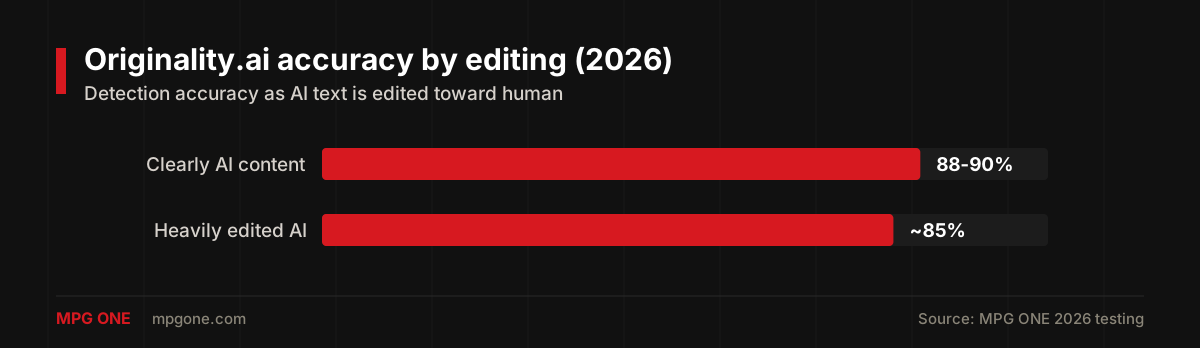
In our 2026 retest, Originality.ai was still the most accurate detector we tested, but its accuracy on clear AI content had dropped to about 88 to 90%, down from the 96% we measured before. On content heavily edited with the newest models (Fable 5 and GPT-5.6 Sol) and deliberately seeded with human-style mistakes to dodge detection, it fell to around 85%. And it has developed a new problem: it has become over-sensitive, which means it now sometimes flags writing that is 100% human as AI. Here is the full breakdown.
Last tested: July 2026, against current-generation models including Fable 5 and GPT-5.6 Sol, with some samples deliberately edited to evade detection. Detector accuracy shifts every time the tools retrain and every time a new model ships. Treat the figures as directional, confirm current pricing on the vendor site, and never treat a single detector score as proof.
Quick verdict
- Still the most accurate of the three detectors we tested, but declining.
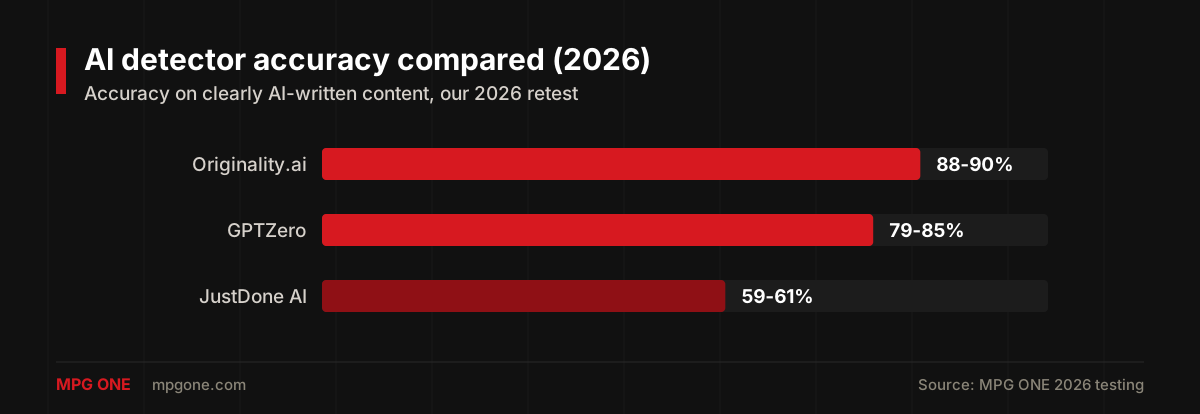
- Clear AI content: about 88 to 90%, down from 96% in earlier testing.
- Heavily edited newest-model content: around 85%, when text was rewritten with Fable 5 or GPT-5.6 Sol and seeded with human-style errors.
- New weakness: over-sensitivity. It now flags some genuinely human writing as AI.
- Best for: publishers and agencies checking writer submissions. More dangerous than ever for policing students.
The two findings that matter
This retest produced two results worth understanding together. First, Originality is still the strongest detector we tested, but the gap is closing as newer models produce more human-like writing, so its clear-AI accuracy slid from 96% to the 88 to 90% range. Second, and more important, it appears to have been tuned to be more aggressive in order to keep catching those newer models, and the cost of that aggression is over-sensitivity: it now labels some 100% human writing as AI. That is the classic detector trap. Turn up sensitivity to catch more AI and you catch more innocent humans too.
The over-sensitivity problem
An over-sensitive detector is arguably more dangerous than an inaccurate one, because its errors fall on real people who did nothing wrong. In our testing, genuinely human-written passages were sometimes flagged as AI, with no obvious pattern the writer could have avoided. For a content team, a false positive means a wasted second look. For a student or a freelancer accused on the strength of that score, it can mean a failed course or a lost contract over work they wrote themselves. This single behaviour is the strongest reason to never use Originality, or any detector, as the sole basis for an accusation.
This review is part of our 2026 AI detector accuracy study, where we retested the three most-used detectors against current-generation models.
How we tested
We ran clearly AI-generated text, lightly edited AI, and heavily edited AI through Originality.ai, using current models including Fable 5 and GPT-5.6 Sol. For the hardest category we deliberately rewrote AI text the way someone trying to beat a detector would: varying sentence structure and inserting small human-style mistakes. We also ran genuine, fully human writing to measure false positives, and we checked the plagiarism and fact-checking layers, since a large part of Originality's value is that it does more than detect AI.
Accuracy by content type
| Content type | Our 2026 result |
|---|---|
| Clearly AI-generated | ~88 to 90% |
| Heavily edited newest-model AI, with human-style mistakes | ~85% |
| Genuinely human writing | Mostly correct, but some false positives |
Even at the top of the market the same law holds: accuracy is highest on raw AI output and falls as a human edits the text toward their own voice, especially with the newest models. Originality degrades more gracefully than the others, but 85% on adversarially edited content means roughly one in seven such pieces is called wrong, and the over-sensitivity means some human pieces are miscalled too.
What Originality.ai does beyond AI detection
This is a real part of its value and often overlooked. The plagiarism checker compares text against a broad index of published content and, being a deterministic matching task, is more dependable than AI detection. The fact-checking layer flags claims and checks whether cited sources resolve, which is genuinely useful for catching AI-fabricated references, one of the most common and damaging failure modes of AI-written content. For teams, these two features can justify the tool on their own, independent of the AI score.
Language support
Originality supports many languages, but accuracy is highest in English and lower in others. If you publish across markets, weight its verdicts accordingly and lean harder on human review outside English, especially now that even its English accuracy has slipped.
How to use Originality well
- Use it to screen writer or freelancer submissions at scale, where a flag prompts a review rather than a punishment.
- Lean on the plagiarism and fact-checking layers, not just the AI score.
- Because it is now over-sensitive, treat a positive on suspected-human writing with real skepticism.
- For any high-stakes judgment about a person, confirm with a second tool and a human, and never act on a single score.
Pricing
Originality.ai uses a pay-as-you-go credit model alongside subscription options, aimed at teams that scan a lot of content. Confirm the current rate on their site, since credit pricing and plan structure change.
How it compares
We ran the same 2026 testing on JustDone and GPTZero, and the contrast is revealing. GPTZero has become under-sensitive, missing the newest models and reading their output as human. Originality has become over-sensitive, catching more AI but also flagging some real human writing. Both directions produce wrong calls, and both are getting harder as models improve. Originality remains the most accurate of the three, but the honest conclusion across all our testing is that no detector is reliable enough in 2026 to be the sole basis for a decision about a person. Run important text through two tools, and trust a human over any score.
| Detector | Accuracy on clear AI (2026 retest) | Key weakness now | Best use |
|---|---|---|---|
| Originality.ai | ~88 to 90% | Over-sensitive: false-flags some 100% human writing | Publisher and agency quality control at scale |
| GPTZero | ~79 to 85% | Under-sensitive: misses newest models (Fable 5, GPT-5.6 Sol) | Fast first-pass screen for obvious AI |
| JustDone AI | ~59 to 61% | Weakest overall, unreliable on short text | Plagiarism checking and long-form sanity checks |
The 2026 picture across all three: Originality leads but errs by over-flagging humans, GPTZero errs by missing current models, and JustDone trails both. No detector is reliable enough to be the sole basis for a decision about a person. Run important text through two tools, and trust a human over any score.
What people say about Originality.ai
Among content professionals, Originality has a strong reputation. SEO teams, agencies, and publishers rate it as the most dependable detector for screening freelance and commissioned work, and the plagiarism and fact-checking layers are frequently cited as the reason it is worth paying for. The rising complaint, which matches our own finding, is over-sensitivity: users report genuine human writing being flagged as AI, and that erodes trust fast. There is also a steady undercurrent of concern about the tool being used to accuse students, a use its own guidance discourages. The overall sentiment is respect for its accuracy on clear AI, tempered by growing unease about false positives.
The future of AI detection
Every number in this review points the same way, and it is worth saying plainly: after-the-fact AI detection is losing, and it is not coming back. Each new generation of model writes with more natural variation, which erases the statistical fingerprint detectors depend on. Our own retest of the newest models makes that concrete. The tools that were near 95% two years ago are drifting toward the low 80s and below, and pushing them to catch more AI only makes them flag more innocent humans.
The industry is already moving past pure detection toward provenance: proving where content came from rather than guessing after the fact. Expect more weight on content credentials and watermarking standards, on disclosure norms where AI assistance is declared rather than hunted, and on process-based proof such as document version history and draft trails. Detectors will likely survive as one weak signal in that mix, useful for a first-pass flag, but the era of treating a detector score as evidence is ending. Anyone building a policy on detection alone is building on sand.
Tips for using Originality.ai without getting burned
- Use it for its intended job: screening writer and freelancer submissions at scale, where a flag prompts a review.
- Get value from the plagiarism and fact-checking layers, not just the AI score.
- Because it is now over-sensitive, treat a positive on suspected-human writing with real skepticism.
- Weight its verdicts down outside English, where accuracy is lower.
- Never use it as the sole basis for accusing a person, and keep version history as proof of authorship.
FAQ
Is Originality.ai accurate in 2026?
It is still the most accurate detector we tested, but its clear-AI accuracy dropped to about 88 to 90% (from 96%), and to around 85% on heavily edited newest-model content. It has also become over-sensitive, flagging some human writing as AI.
Does Originality.ai catch the newest AI models?
Better than the other detectors we tested, but not perfectly. On content heavily edited with Fable 5 or GPT-5.6 Sol and seeded with human-style mistakes, accuracy fell to around 85%.
Does Originality.ai flag human writing as AI?
Yes, sometimes. In our 2026 testing it had become over-sensitive and occasionally labelled genuinely human, 100% human-written content as AI, which is why it must never be the sole basis for an accusation.
Is Originality.ai good for detecting student AI use?
No detector should be the sole basis for accusing a student, and Originality's over-sensitivity makes that even more true now. It is built for content teams, not academic policing. Use it as one signal, not as proof.
What is Originality.ai best for?
Publishers and agencies checking writer or freelancer submissions at scale, where high accuracy on clear AI plus plagiarism and fact-checking add up to real quality control.
Helpful next steps
Turn the idea into something useful
When this topic becomes part of a real website, workflow, campaign, or AI system, these MPG ONE pages are the natural places to continue.
Build generative AI workflows for content, documents, knowledge, and brand-safe operations.
AI development servicesBuild private AI assistants, workflow automation, knowledge systems, and reporting layers.
AI agent development servicesDesign tool-using AI agents with memory, retrieval, permissions, and human review.
Custom AI solutionsCreate a custom AI system around your data, tools, permissions, and operating model.
MPG ONE coursesLearn practical AI systems, SEO growth workflows, and talent brand operations with MPG ONE training.