AI
Is GPTZero Accurate? Our 2026 Test Results Here
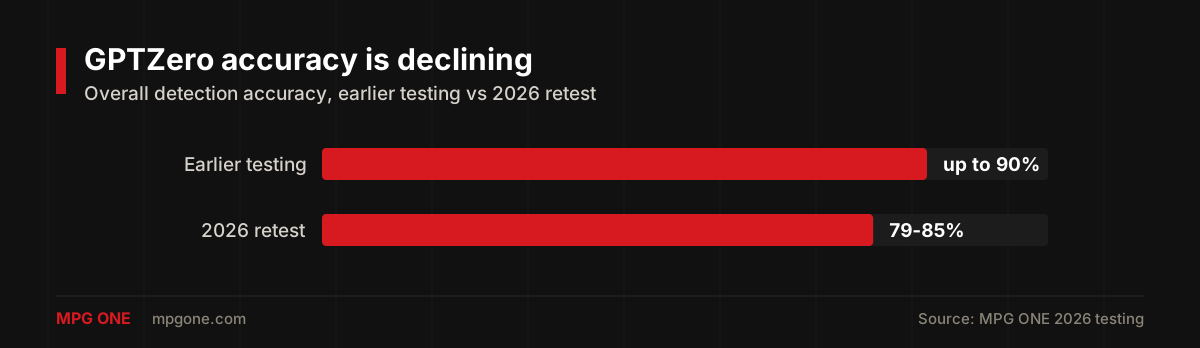
Our 2026 GPTZero retest: accuracy down to 79 to 85%, and the newest models (Fable 5, GPT-5.6 Sol) now pass as human. Weak on very short and very long text.

By Mohamed Ezz CEO & Founder Jul 23, 2025
In our latest 2026 retest, GPTZero's accuracy had slipped to roughly 79 to 85%, down from what we measured before, and the newest generation of AI models now passes straight through it. Text from current models like Fable 5 and GPT-5.6 Sol was frequently read as human. GPTZero is also unreliable at both ends of the length range, on very short content under 100 words and on long content over 1500 words. Here is the full picture: our results, how we tested, how GPTZero works, and how to read its scores without making a mistake that hurts someone.
Last tested: July 2026, against current-generation models. Detector accuracy shifts every time the tools retrain and every time a new AI model ships, which is exactly what this retest shows. Treat the figures as directional, confirm current pricing on the vendor site, and never treat any single detector score as proof.
Quick verdict
- Overall accuracy in our 2026 retest: about 79 to 85%, down from earlier testing.
- Newest models pass: output from current models such as Fable 5 and GPT-5.6 Sol was often labelled human.
- Weak on very short content: under 100 words there is not enough signal to be reliable.
- Weak on very long content: over 1500 words accuracy also falls off.
- Bottom line: a declining first-pass screen, and no longer a match for the latest models.
The headline: the newest models defeat it
The most important result of this retest is not the exact percentage, it is the direction. AI detection is an arms race, and the models are winning. When we ran text from the newest generation, including Fable 5 and GPT-5.6 Sol, GPTZero frequently read it as human. These models produce writing with more natural variation and less of the predictable, even rhythm that detectors rely on, so the statistical fingerprint GPTZero looks for is faint or absent. Any workflow that assumes GPTZero will catch current-model output is already out of date.
How GPTZero works, and why newer models beat it
GPTZero rests on two measurements. The first is perplexity, which is how surprised a language model is by the text: human writing tends to be less predictable and scores higher, AI writing tends to be smoother and scores lower. The second is burstiness, which is how much sentence length and structure vary: humans write in bursts of long and short sentences, while older AI produced more uniform rhythm. The problem is that the newest models have largely closed that gap. They vary their sentence structure, break patterns, and read less predictably, which pushes their perplexity and burstiness toward the human range and pushes GPTZero's accuracy down. The technique that worked against 2023-era models works far less well against 2026 ones.
This review is part of our 2026 AI detector accuracy study, where we retested the three most-used detectors against current-generation models.
How we tested
We ran multiple categories of text through GPTZero: output from current models (including Fable 5 and GPT-5.6 Sol), older AI output, lightly and heavily edited AI, and genuine human writing across casual, academic, and technical styles. We tested short samples under 100 words, mid-length pieces, and long pieces over 1500 words. For each we logged correct detections, false positives (human flagged as AI), and false negatives (AI missed), so we could see not just an average but where the tool breaks.
Where it works and where it fails
| Scenario | Result in our 2026 retest |
|---|---|
| Output from newest models (Fable 5, GPT-5.6 Sol) | Often missed, read as human |
| Older or plain AI output, mid-length | Best case, still catchable |
| Very short content (under 100 words) | Unreliable, too little signal |
| Long content (over 1500 words) | Accuracy falls off |
| Paraphrased or heavily edited AI | Frequently missed |
| Human academic or technical writing | Mostly correct, occasional false positive |
The uncomfortable summary is that GPTZero is now best at catching the easiest, oldest, most obvious AI use, and worst at catching exactly the current-model output most people are actually producing. Its useful window has narrowed.
The false positive problem, in detail
GPTZero still keeps a relatively low false positive rate, but a low average hides where the failures land. Because the tool rewards unpredictability and variation, it misfires on human writing that is naturally smooth and uniform: highly technical documentation, formulaic or template-driven text, writing by non-native English speakers, and content that follows a strict style guide. Those are common, legitimate ways to write. Combine a real false-positive risk on genuine human work with a growing false-negative rate on current-model AI, and the tool is being squeezed from both sides.
How to read a GPTZero score without causing harm
- Treat a high AI probability as a reason to look closer, never as a conclusion.
- Do not judge very short or very long samples; the mid-length band is where it is least unreliable.
- Assume current-model output can pass as human; a human result does not mean text was written by a person.
- Check whether the writing style (technical, formulaic, non-native) is a known false-positive trigger before acting.
- Confirm with a second detector and, above all, with a human conversation about the work.
Real-world uses
GPTZero is still useful as a fast first-pass screen for editors, educators, and content teams to flag submissions worth a closer human look, provided you understand it will miss the newest models. It becomes dangerous the moment its output is treated as evidence rather than a prompt. Schools that use it responsibly use it to start a conversation with a student, not to assign a grade.
Pricing
GPTZero has a free tier with limits and paid plans for higher volume and for classroom or team use. Pricing changes, so confirm the current rate on their site.
How it compares
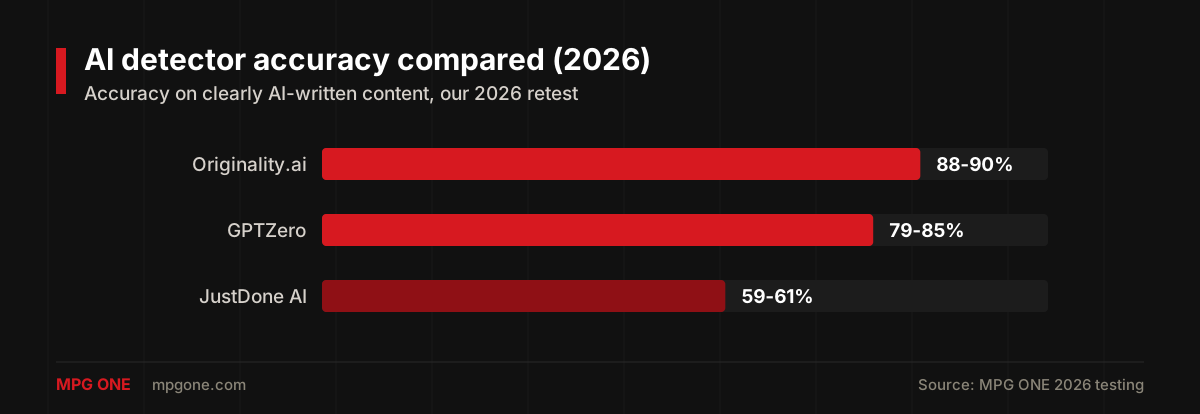
We tested the same way on JustDone and Originality.ai. Every detector is losing ground to newer models, not just GPTZero. If a decision matters, run the text through two detectors and treat agreement, not any single score, as the signal, and remember that agreement between two tools that both miss current-model output is not reassurance.
| Detector | Accuracy on clear AI (2026 retest) | Key weakness now | Best use |
|---|---|---|---|
| Originality.ai | ~88 to 90% | Over-sensitive: false-flags some 100% human writing | Publisher and agency quality control at scale |
| GPTZero | ~79 to 85% | Under-sensitive: misses newest models (Fable 5, GPT-5.6 Sol) | Fast first-pass screen for obvious AI |
| JustDone AI | ~59 to 61% | Weakest overall, unreliable on short text | Plagiarism checking and long-form sanity checks |
The 2026 picture across all three: Originality leads but errs by over-flagging humans, GPTZero errs by missing current models, and JustDone trails both. No detector is reliable enough to be the sole basis for a decision about a person. Run important text through two tools, and trust a human over any score.
What people say about GPTZero
GPTZero is one of the most widely used detectors in education, and that is exactly where the loudest conversation lives. The dominant theme is false positives on students: there is a long, well-documented history of genuine human work being flagged as AI, and of students left anxious about writing normally in case a tool misreads them. Many educators who adopted GPTZero early have since stepped back from treating its output as proof, using it only to start a conversation. On the other side, people value how fast and accessible it is for a first-pass check. Our finding that it now misses the newest models adds a second concern to the first: it can wrongly flag a human and wave through current-model AI in the same session.
The future of AI detection
Every number in this review points the same way, and it is worth saying plainly: after-the-fact AI detection is losing, and it is not coming back. Each new generation of model writes with more natural variation, which erases the statistical fingerprint detectors depend on. Our own retest of the newest models makes that concrete. The tools that were near 95% two years ago are drifting toward the low 80s and below, and pushing them to catch more AI only makes them flag more innocent humans.
The industry is already moving past pure detection toward provenance: proving where content came from rather than guessing after the fact. Expect more weight on content credentials and watermarking standards, on disclosure norms where AI assistance is declared rather than hunted, and on process-based proof such as document version history and draft trails. Detectors will likely survive as one weak signal in that mix, useful for a first-pass flag, but the era of treating a detector score as evidence is ending. Anyone building a policy on detection alone is building on sand.
Tips for using GPTZero without getting burned
- Treat it as a first-pass flag, never as evidence, especially now that it misses current-model output.
- Judge mid-length text only; it is unreliable on very short and very long content.
- Assume a human result can be wrong: the newest models often pass as human.
- Watch for false-positive triggers, technical, formulaic, or non-native writing, before acting on a flag.
- If you are accused on a GPTZero score, ask for a human review and show your drafts and edit history.
FAQ
Is GPTZero accurate in 2026?
In our 2026 retest it caught AI text with about 79 to 85% accuracy, down from earlier results. It is weakest on very short content, very long content, and output from the newest models, which it often reads as human.
Can GPTZero detect the newest AI models?
Often not. In our testing, output from current models like Fable 5 and GPT-5.6 Sol frequently passed as human, because these models produce more natural variation than the older ones GPTZero was tuned against.
How does GPTZero detect AI?
It measures perplexity (how predictable the text is) and burstiness (how much sentence structure varies), then a trained classifier labels the text human or AI. Newer models blur both signals, which is why accuracy is falling.
Does GPTZero give false positives?
Yes, concentrated on technical, formulaic, or non-native human writing. Never treat a single result as proof, especially now that it also misses current-model AI.
Is GPTZero safe to use for grading students?
Only as a first-pass flag, never as the basis for a grade or penalty. It both misses current-model AI and occasionally flags real human writing, so use it to prompt a human review, not to reach a verdict.
Helpful next steps
Turn the idea into something useful
When this topic becomes part of a real website, workflow, campaign, or AI system, these MPG ONE pages are the natural places to continue.
Build generative AI workflows for content, documents, knowledge, and brand-safe operations.
AI development servicesBuild private AI assistants, workflow automation, knowledge systems, and reporting layers.
AI agent development servicesDesign tool-using AI agents with memory, retrieval, permissions, and human review.
Custom AI solutionsCreate a custom AI system around your data, tools, permissions, and operating model.
Marketing and SEO servicesConnect technical SEO, content strategy, campaigns, analytics, and conversion-focused pages.