AI
AI Agent Development Cost: A Business Guide
AI agent development cost, explained: real price ranges by complexity, monthly running costs, and the ROI data before you spend. See the numbers.

By Mohamed Ezz CEO & Founder Jul 13, 2026
Here's the number that stops most budget conversations cold: AI agent development cost runs anywhere from about $10,000 for a simple bot to more than $400,000 for a full multi agent system, based on 2026 pricing from agencies like Azilen and ProductCrafters. That is a 40x spread, and the range is exactly why so many teams stall before they start.
The short answer up front: what you pay depends on how much the agent does on its own, how many of your systems it plugs into, and how sensitive your data is. A chatbot that answers FAQs is cheap. An agent that reads your CRM, books meetings, and updates records without a human in the loop is not. Get that distinction clear before you ask anyone for a quote.
My Main Points:
- Build cost scales with autonomy: simple bots start near $10k, multi agent systems reach $400k or more
- The build price is not the real price, running an agent costs roughly $3k to $13k a month
- Integrations, data cleanup, and compliance usually cost more than the AI model itself
- Buying off the shelf beats building for common jobs, build only for core, private, or unmet workflows
- Gartner expects over 40% of agentic AI projects to be canceled by 2027, so start narrow and prove payback first
After nearly 20 years in AI development and digital marketing, I've quoted, scoped, and rescued enough of these projects to know the sticker price is the least useful number in the room. In this guide I'll break down what AI agent development really costs by complexity, show you the running costs nobody warns you about, weigh building against buying, and share the ROI data that decides whether the whole thing was worth it. If you are still deciding what to build, our guide on how to build AI agents for beginners is a good companion read.
What Drives AI Agent Development Cost
Before any dollar figure makes sense, you need to know what you are paying for. An AI agent is not one thing. The word covers everything from a scripted chatbot to a system that plans, uses tools, and acts on its own. Four factors move the price more than anything else.
Autonomy. A bot that follows fixed rules is cheap to build and test. An agent that decides its own next step, calls tools, and recovers from errors needs far more engineering, and far more testing, because every path it can take is a path you have to make safe.
Integrations. An agent that only chats is simple. An agent that reads your email, writes to your database, and pulls from your CRM has to connect to each of those systems reliably. In most quotes I have seen, integration work is the single largest line item after the core build.
Data readiness. If the agent answers from your documents, someone has to collect, clean, and structure those documents first. Messy data is the hidden tax on almost every project, and it is why a "quick" agent so often runs late.
Compliance. In finance, healthcare, or legal work, the guardrails, audit trails, and review layers can cost more than the model. Azilen's 2026 breakdown puts a financial services agent at $120,000 to $350,000 or more, driven mostly by compliance, not intelligence.
AI Agent Development Cost by Complexity Tier
The cleanest way to size a budget is by complexity tier. The ranges below come from 2026 cost analyses by Azilen and ProductCrafters, two agencies that publish detailed build breakdowns. Treat them as planning estimates, not fixed quotes, your real number depends on the four factors above.
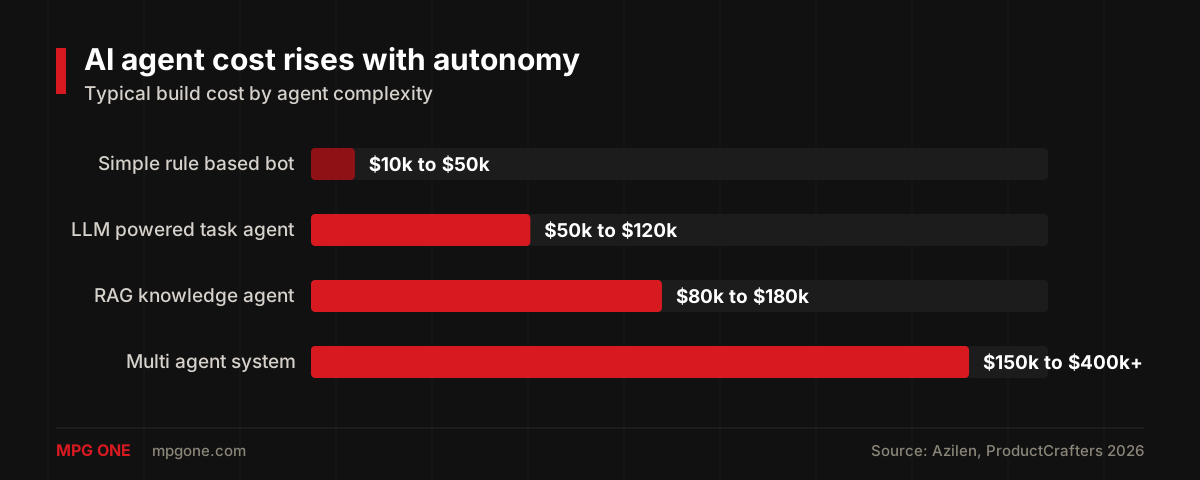
| Agent type | Typical build cost | What it does |
|---|---|---|
| Simple rule based bot | $10k to $50k | Answers FAQs, follows fixed scripts, no real decisions |
| LLM powered task agent | $50k to $120k | Uses a language model to draft, summarize, and handle one job |
| RAG knowledge agent | $80k to $180k | Answers from your own documents using retrieval |
| Multi agent system | $150k to $400k+ | Several agents coordinate, plan, and act across systems |
Most companies do not need the top tier. The mistake I see most often is a team scoping a multi agent moonshot when a single task agent would fix the actual problem for a fifth of the price. Start from the job, not the architecture. If the workflow you care about is memory heavy, our walkthrough on how to build AI agents with memory shows what that adds in practice.
Where the Money Goes: a Support Agent Build
Ranges are useful for sizing a budget, but they hide how a number is actually built. Here is a realistic line item breakdown for one common project: a customer support agent that answers from your own help docs and connects to your helpdesk and CRM. These are point estimates inside the component ranges that ProductCrafters and Azilen publish. It is not a quote, but it shows how a mid tier build adds up.
| Component | Cost | What it covers |
|---|---|---|
| Discovery and design | $12,000 | Scoping the workflow, data audit, success metrics |
| Agent core | $40,000 | The reasoning loop, prompts, and guardrails |
| RAG and knowledge setup | $22,000 | Cleaning docs, embeddings, retrieval |
| Integrations | $18,000 | Helpdesk and CRM connections |
| Admin panel and observability | $12,000 | Dashboards and logging, so you can watch it |
| QA and testing | $10,000 | Checking answers before it goes live |
| Deployment and MLOps | $14,000 | Shipping it and keeping it running |
| Total | $128,000 | Lands in the RAG knowledge agent tier |
Notice what dominates. The core build, the knowledge setup, and the integrations together are more than 60% of the total, while the AI reasoning itself is only a slice of the core. That is the pattern in almost every quote I see: the model is the cheap part, and the plumbing around it is where the money goes.
The Running Cost Nobody Quotes
Here is the trap. The build cost is a one time number, and it is not even the big one over a few years. An AI agent has to run, and running it costs money every single month.
Azilen's 2026 figures put the monthly operating cost of a working agent between roughly $3,200 and $13,000, once you add up model API usage, retrieval infrastructure, monitoring and logging, prompt tuning, and access controls. A model powered task agent alone runs about $2,000 to $6,000 a month to keep live.
The pieces that make up that monthly bill:
- Model usage: roughly $1,000 to $5,000, every call to the model costs tokens, and a busy agent makes a lot of calls
- Retrieval infrastructure: $500 to $2,500 to keep your document search fast and current
- Monitoring and logs: $200 to $1,000, because an agent you cannot watch is an agent you cannot trust
- Prompt tuning and updates: $1,000 to $2,500, agents drift, and someone has to keep them accurate
- Access and security: $500 to $2,000 for the controls that keep it from touching what it should not
On top of that, plan for maintenance. ProductCrafters pegs annual upkeep at 15% to 25% of the original build cost. On a $100,000 agent, that is $15,000 to $25,000 a year before you change a single feature. Whoever signs off on the project needs to see the three year total, not just the build quote.
What the model bill actually looks like
You do not have to take the agency figures on faith. The biggest monthly line, model usage, is one you can estimate yourself from published API prices. Take a support agent handling 2,000 conversations a day. A typical conversation feeds the model about 5,000 input tokens (system prompt, retrieved help docs, chat history) and gets back about 500 output tokens.
Run the math at standard mid tier rates, roughly $3 per million input tokens and $15 per million output tokens for a model like Claude Sonnet, per Anthropic's published pricing:
| Item | Monthly volume | Cost |
|---|---|---|
| Input tokens | 300 million | $900 |
| Output tokens | 30 million | $450 |
| Model usage total | $1,350 per month |
That lands near the middle of the $1,000 to $5,000 model usage range the agencies quote, which is a good sign the ranges are honest. It is also just one line of the monthly bill. The retrieval infrastructure, monitoring, and prompt tuning above all stack on top of it.
Build vs. Buy vs. Hire an Agency
You have three ways to get an AI agent, and they cost very different amounts. The right one depends on how unusual your workflow is.
Buy off the shelf. For common jobs, scheduling, support, sales follow up, a ready made tool is the cheapest and fastest route. Pricing typically runs $20 to $500 per user per month, or a per task fee measured in cents. If a product already does the job well, building your own is usually a waste of money.
Hire an agency to build custom. When the workflow is core to your business, touches private data, or no product fits, custom is worth it. That is where the tier prices above apply. You get an agent shaped to your process, and you own it. The tradeoff is cost and timeline.
Build in house. If you have the engineering talent, building internally can lower the cash cost, but it moves the burden to your team's time and their ongoing attention. Someone has to own the agent after launch, and that role rarely disappears.
Most companies land on a mix: buy for the common tasks, build custom for the one or two workflows that actually set them apart. If that middle path fits you, our custom AI solutions overview lays out how that scoping works.
The ROI Reality Check
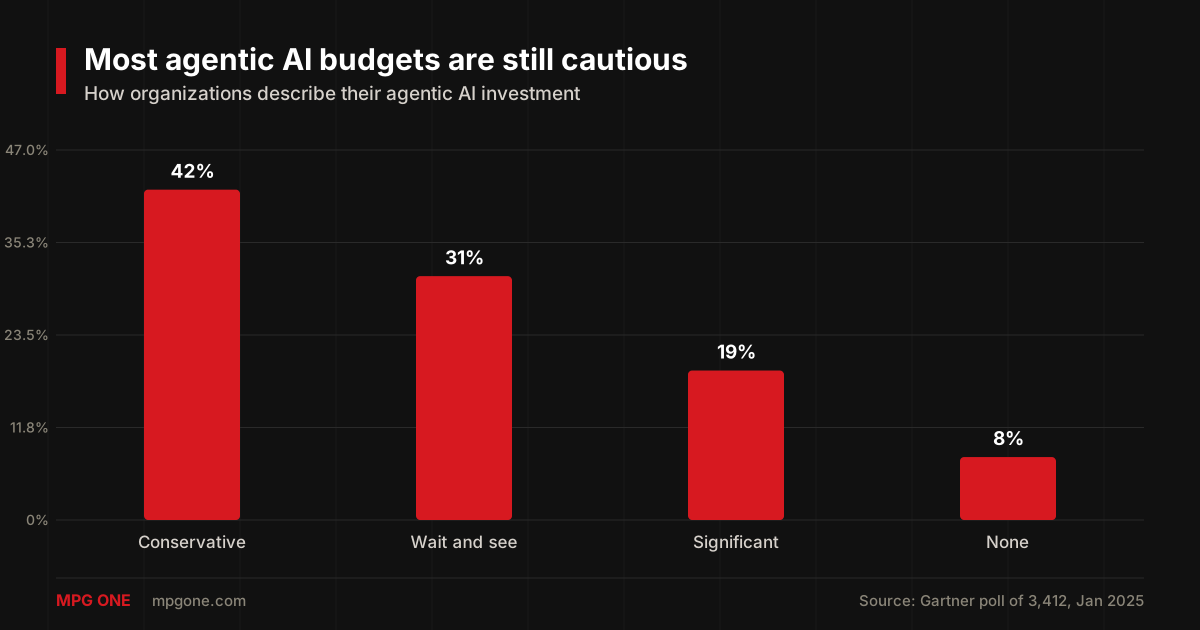
Cost is only half the question. The other half is whether the agent pays for itself, and here the honest data is sobering. Most agentic AI spending in early 2026 is still cautious. A January 2025 Gartner poll of 3,412 people found only 19% had made significant investments in agentic AI, while 42% were investing conservatively and 31% were still waiting to see.
The caution is earned. Gartner predicts that over 40% of agentic AI projects will be canceled by the end of 2027, done in by escalating costs, unclear business value, or weak risk controls. The firm is blunt about the reason: most projects today are early experiments driven by hype, and much of the market is "agent washing," older chatbots and automation relabeled as agents.
The scaling gap backs this up. McKinsey's State of AI research found that while 62% of organizations are at least experimenting with agents, only 23% are actually scaling an agentic system, and in any single business function no more than 10% have scaled one. Plenty of pilots, far fewer that made it to real use.
None of this means agents do not pay off. It means the winners are disciplined about where they point them. Gartner also expects 40% of enterprise applications to include task specific AI agents by the end of 2026, up from under 5% in 2025, so the direction is not in doubt. The projects that succeed pick one task with a measurable payback, prove it, and expand from there. The ones that get canceled tried to boil the ocean.
How to Keep Your AI Agent Budget Under Control
You cannot make an agent free, but you can stop it from becoming a money pit. A few rules keep the numbers honest.
- Start with one task, not a platform. Pick the single workflow that eats the most hours and has a payback you can measure. Ship that, then expand. This alone avoids most canceled projects.
- Build an MVP first. A stripped down version proves the value at a fraction of the cost. If the MVP does not earn its keep, you saved yourself the full build.
- Fix your data before you build. Clean, structured data is the cheapest way to cut both build time and running cost. Messy data is where budgets quietly double.
- Model the three year cost, not the quote. Add build, monthly running cost, and annual maintenance. The real decision lives in that total, not the sticker price.
- Buy what you can, build what you must. Every job an off the shelf tool can do is a job you should not pay to build from scratch.
For a wider view of choosing tools before committing to a custom build, our guide to picking an AI assistant for business covers the same discipline applied to ready made options.
FAQ
How much does it cost to build an AI agent?
A simple rule based agent runs roughly $10,000 to $50,000 to build. An LLM powered task agent lands around $50,000 to $120,000, and a complex multi agent system can run $150,000 to $400,000 or more. The number tracks how much the agent has to do on its own and how much of your data it must touch.
What makes AI agent development expensive?
Four things: how autonomous the agent is, how many systems it connects to, how clean your data is, and your compliance rules. Integrations and governance usually cost more than the model itself, especially in finance and healthcare.
Are there ongoing costs after building an AI agent?
Yes, and people forget them. Expect roughly $3,000 to $13,000 a month for a working agent once you add model usage, retrieval infrastructure, monitoring, and prompt updates. Budget 15% to 25% of the build cost per year for maintenance.
Is it cheaper to buy an AI agent or build one?
Off the shelf tools are cheaper to start, often $20 to $500 per user per month, and they are the right call for common jobs. Build custom only when the workflow is core to your business, touches private data, or no product fits. Many companies do both.
Do most AI agent projects pay off?
Not automatically. Gartner expects over 40% of agentic AI projects to be canceled by the end of 2027, usually from unclear value or runaway cost. The ones that work start narrow, on a task with a measurable payback, not a moonshot.
Final Thoughts
AI agent development cost is not one number, it is a range that tracks ambition. A simple bot is cheap, a system that runs your business is not, and the monthly running cost quietly outweighs the build over time. The teams that win treat the whole thing as an investment with a payback date, not a gadget to buy.
So do the boring math first. Scope one task, price the three year total, and buy anything you can rather than build it. If you want a partner to scope, price, and build an agent that actually earns its keep, our AI agent development services team does exactly that, starting from the workflow, not the hype.
Helpful next steps
Turn the idea into something useful
When this topic becomes part of a real website, workflow, campaign, or AI system, these MPG ONE pages are the natural places to continue.
Build private AI assistants, workflow automation, knowledge systems, and reporting layers.
AI agent development servicesDesign tool-using AI agents with memory, retrieval, permissions, and human review.
Generative AI development servicesBuild generative AI workflows for content, documents, knowledge, and brand-safe operations.
Custom AI solutionsCreate a custom AI system around your data, tools, permissions, and operating model.
Talent management agencyPosition talent, plan campaigns, coordinate media, and build long-term public brand value.