AI
Private AI: What It Is and Why Companies Are Switching
Private AI keeps your company data out of public chatbots. Learn what private AI is, how it works, and the 4 ways to deploy it. Full guide inside.

By Mohamed Ezz CEO & Founder Jul 2, 2026
Private AI is having a moment, and one number explains why: 39.7% of all AI interactions at work involve sensitive data, according to Cyberhaven's 2026 AI Adoption & Risk Report. Your employees are almost certainly pasting customer records, contracts, and internal numbers into chatbots right now.
The short answer up front: private AI means running artificial intelligence in an environment your company controls, so your data never trains someone else's model and never leaves your security boundary. It is not one product. It is a way of deploying AI, and there are four practical paths to get there.
My Main Points:
- Private AI keeps your data inside infrastructure and contracts you control
- Employees already leak sensitive data through personal chatbot accounts, so doing nothing is the riskiest option
- You do not need to self-host everything; zero-retention enterprise agreements count as private AI for most companies
- The four deployment paths are self-hosted open models, private cloud, enterprise agreements, and hybrid setups
- Start with one sensitive workflow, prove the value, then expand
In this guide, I'll explain what private AI actually is, why companies are moving to it, and how to choose between the deployment options. I'll also share what I've learned building internal AI systems for companies, including the questions to answer before you spend a single dollar on GPUs. If you've already read our breakdown of whether ChatGPT saves your data, this is the natural next step.
What Is Private AI?
Private AI is artificial intelligence deployed within a controlled environment where data privacy and security are maintained through the whole AI lifecycle. That definition comes from Cloudera's private AI overview, and it matches what I see in practice: the model can be big or small, hosted anywhere, as long as your organization controls where the data goes.
After nearly 20 years in AI development and digital marketing, I can tell you the label matters less than three concrete guarantees:
- Your prompts and documents are not used to train anyone else's model.
- Your data stays inside a defined boundary — your servers, your private cloud, or a contractually isolated environment.
- You can prove both of those things to an auditor.
If a setup gives you those three guarantees, it qualifies. That is why a self-hosted open model and a signed enterprise agreement with zero data retention can both count, even though one runs in your server room and the other runs in a vendor's data center.
Why Companies Are Moving to Private AI
The push is not paranoia. It is a response to how employees actually behave.
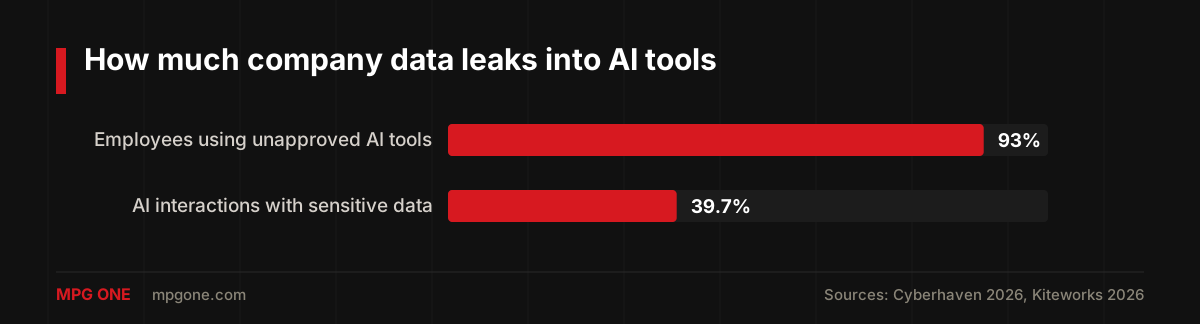
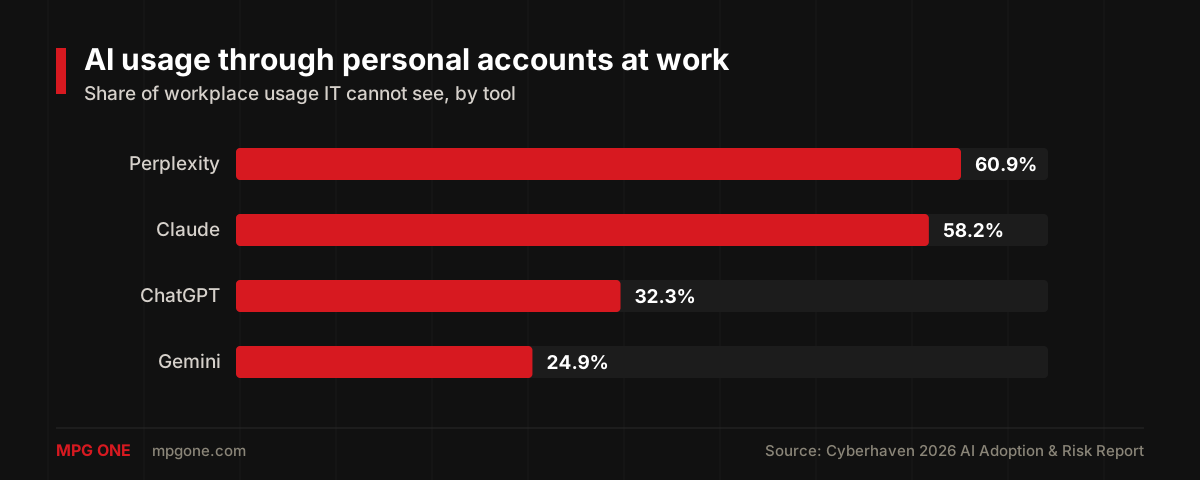
Cyberhaven's report found that employees put sensitive data into AI tools once every three days on average, and a huge share of that happens through personal accounts your IT team cannot see: 32.3% of workplace ChatGPT usage and 58.2% of Claude usage runs through personal logins. A separate Kiteworks analysis found that 93% of employees admit to sharing information with AI tools their company never approved.
So the real choice is not "AI with our data" versus "no AI with our data." Your data is already flowing into AI tools. The choice is whether it flows through systems you control or through personal accounts you cannot even monitor.
Three more forces are driving the shift:
- Regulation. GDPR, HIPAA, and sector rules make it hard to justify sending regulated data to a shared consumer service. Private AI keeps processing inside a jurisdiction and boundary you can document.
- Intellectual property. Product roadmaps, source code, and client strategies are exactly the things employees paste into chatbots for help with. Companies want that value fenced in.
- Better open models. Open-weight models like Llama, Mistral, and DeepSeek closed much of the quality gap, so self-hosting no longer means settling for a toy.
Private AI vs Public AI
Public AI is what most people use every day: consumer chatbots and shared APIs where the provider runs everything and, on consumer tiers, may use your conversations to improve their models. Here is how the two approaches compare on the factors that matter to a business:
| Factor | Private AI | Public AI (consumer tiers) |
|---|---|---|
| Training on your data | Never | Possible unless you opt out |
| Data boundary | You define it | Provider's shared infrastructure |
| Compliance evidence | Strong, auditable | Weak on consumer tiers |
| Model quality | Good and improving | Frontier models, best available |
| Setup cost | Medium to high | Near zero |
| Ongoing effort | Yours to manage | None |
| Visibility into usage | Full logging | None on personal accounts |
The honest summary: public AI wins on convenience and raw model quality, private AI wins on control and proof. That is why the question "is private AI better than cloud AI" has a boring answer — it depends on the sensitivity of the workflow, and most companies end up running both.
The 4 Ways to Deploy Private AI
1. Self-hosted open models
You run an open-weight model like Llama, Mistral, or DeepSeek on your own hardware or rented GPUs. Nothing leaves your network. This is the strictest form of private AI and the right call for defense, healthcare records, and anything a regulator would lose sleep over. The trade-off is real: you own uptime, security patches, and model updates, and you need people who know how to do that.
2. Private cloud deployment
Platforms like AWS Bedrock, Azure OpenAI Service, and Google Vertex AI let you run strong commercial models inside your own cloud tenant, with your data excluded from training by contract. You get near-frontier quality without buying hardware. For most mid-sized companies, this is the sweet spot between control and effort.
3. Enterprise agreements with zero data retention
The enterprise tiers of the big assistants — ChatGPT Enterprise, Claude for Enterprise, Gemini for Workspace — contractually commit to not training on your business data. We've covered whether Anthropic trains on your data in detail, and the pattern holds across vendors: consumer tiers may learn from you, business tiers do not. If your main risk is employees using personal accounts, moving them to a governed enterprise workspace is the fastest win available.
4. Hybrid setups
This is where most companies actually land. Public or enterprise AI handles low-risk work like drafting and research, while a private deployment handles the sensitive workflows: contracts, customer data, internal knowledge. A routing layer or simple policy decides which requests go where. It costs less than going fully private and protects what actually needs protecting.
What Private AI Looks Like in Practice
Some real workflow patterns I see companies deploy:
- Internal knowledge assistants. A private assistant that answers employee questions from policies, manuals, and internal documents, with role-based permissions so people only see what they are allowed to see.
- Document processing. Contracts, invoices, and applications summarized and classified inside the security boundary, instead of being pasted into a consumer chatbot.
- Healthcare and finance analysis. Patient data analysis and fraud detection are the classic cases, because HIPAA and financial regulation make public tools a non-starter.
- Custom-trained assistants. Teams that want a model grounded in their own material can train an assistant on their own data through retrieval or fine-tuning, privately.
Notice what these have in common: none of them are about the model being special. They are about the data being yours. The model is a commodity; the boundary is the product.
How to Get Started with Private AI
Here is the sequence I recommend to companies, in order:
- Find out what employees already use. Survey honestly or check network logs. The 93% statistic above means your baseline is not zero — it is uncontrolled usage.
- Classify your data. Decide which categories can touch public tools, which need an enterprise agreement, and which must never leave your infrastructure.
- Pick one sensitive workflow. Not a platform, a workflow. One document process or one internal Q&A assistant that would save real time.
- Choose the lightest deployment that satisfies your data rules. Enterprise agreement first, private cloud second, self-hosting only when regulation demands it.
- Measure and expand. Track usage, time saved, and quality. Expand to the next workflow only after the first one earns its keep.
The most common mistake I see is starting with hardware. Buying GPUs before you have classified your data and picked a workflow is how private AI projects turn into expensive shelfware.
FAQ
What is private AI?
Private AI is artificial intelligence deployed in an environment your organization controls, so your data is never used to train someone else's model and never leaves your defined security boundary. It covers self-hosted models, private cloud deployments, and zero-retention enterprise contracts.
Is private AI better than cloud AI?
Not always. Private AI wins on control, compliance, and data protection. Public cloud AI wins on cost, convenience, and access to the strongest frontier models. Most companies run a hybrid: public AI for low-risk tasks, private AI for sensitive workflows.
Which AI keeps all data private?
Only a model running on infrastructure you control, such as an open-weight model on your own servers, keeps data fully inside your walls. Enterprise tiers of ChatGPT, Claude, and Gemini exclude your data from training by contract, which is private enough for most business needs.
Is ChatGPT private?
The consumer versions can use your conversations for model improvement unless you opt out. ChatGPT Team and Enterprise do not train on your business data by contract. The practical rule: never run work data through a personal account.
Final Thoughts
Private AI is not a product you buy. It is a decision about where your data is allowed to go, backed by one of four deployment paths. The companies getting it right start small: one sensitive workflow, the lightest deployment that satisfies their data rules, and honest measurement before expanding.
And the do-nothing option does not exist. With 93% of employees already feeding data into unapproved tools, the question is not whether your company uses AI — it is whether you control it.
If you want help designing a private assistant, an internal knowledge system, or a full deployment around your data and permissions, that is exactly what we build at MPG ONE. Take a look at our custom AI solutions and send us the workflow you want to fix first.
Helpful next steps
Turn the idea into something useful
When this topic becomes part of a real website, workflow, campaign, or AI system, these MPG ONE pages are the natural places to continue.
Build private AI assistants, workflow automation, knowledge systems, and reporting layers.
Generative AI development servicesBuild generative AI workflows for content, documents, knowledge, and brand-safe operations.
Custom AI solutionsCreate a custom AI system around your data, tools, permissions, and operating model.
AI agent development servicesDesign tool-using AI agents with memory, retrieval, permissions, and human review.
MPG ONE coursesLearn practical AI systems, SEO growth workflows, and talent brand operations with MPG ONE training.