AI
Gemini 4 Argon vs Opus 5.5: Cheaper, Not Better
Gemini 4 Argon vs Opus 5.5: Argon costs $2/$10 per million tokens until Nov 30, then $4/$20 like Opus 5.5. Artificial Analysis scores 53 vs 58. See the tests.

By Mohamed Ezz CEO & Founder Oct 20, 2026
Gemini 4 Argon vs Opus 5.5 is a price fight with a deadline: Google lists Gemini 4 Argon at $2 per million input tokens and $10 per million output tokens until November 30, 2026, then $4 and $20, the same as Claude Opus 5.5 today. On the independent Artificial Analysis index Opus 5.5 scores 58 and Argon scores 53.
After nearly 20 years in AI development and digital marketing, I have watched every "half the price" launch get judged on the discount before anyone checks the work. In this comparison I will show you Google's own DeepSWE claim next to the public board, the real cost per task before and after December 1, what two independent testers found when they ran both models on the same briefs, and what our own five task battery says about Opus 5.5 while Argon stays locked behind the paid tier.
My Main Points:
- Gemini 4 Argon costs $2 and $10 per million tokens until November 30, 2026, then $4 and $20. Claude Opus 5.5 costs $4 and $20 now, so the price gap disappears on December 1.
- Artificial Analysis scores Opus 5.5 at 58 and Argon at 53. Opus 5.5 wins 9 of the 10 sub tests; Argon wins AutomationBench, 78% to 70%.
- Google reports 77.9% on DeepSWE v1.1 for Argon against 74.2% for Opus 5.5. That is Google's run, not the public board, which has neither model yet.
- The New Stack's three hands on tests: a tie on a 14 bug hunt, 11 of 80 vs 80 of 80 on a billing spec, and 20 of 33 vs 33 of 33 on a 500K token dependency question.
- Opus 5.5 costs $5.98 per Artificial Analysis task to Argon's $1.99, because Opus uses 119k output tokens per task to Argon's 62k.
- Our battery: Opus 5.5 scored 4.40 of 5 at both medium ($0.09) and max ($0.85) effort. Argon could not run on our free tier key, so the first hand Argon numbers wait for a paid tier run.
In this guide I use the same method as our GPT-6.1 Sol vs Opus 5.5 comparison and our Gemini 3.8 Flash test, so the numbers line up across posts.
Gemini 4 Argon vs Opus 5.5 at a Glance
Gemini 4 Argon and Claude Opus 5.5 are both frontier reasoning models with a 1 million token context window, and the differences sit in output limits, input types and price. Google published Argon's specs in its developer guide on October 13, 2026; Anthropic released Opus 5.5 on September 22, 2026.
| Spec | Gemini 4 Argon | Claude Opus 5.5 |
|---|---|---|
| API model id | gemini-4-argon | claude-opus-5-5 |
| Announced / available | Sept 30 / Oct 13, 2026 | Sept 22, 2026 |
| Input and output price (per 1M tokens) | $2 and $10 until Nov 30; $4 and $20 from Dec 1 | $4 and $20 |
| Cached input | 95% off, implicit caching | $0.20 (cache reads) |
| Context window | 1M tokens, shared by input, thinking and output | 1M tokens |
| Output limit | 64K default; up to 1M with long decode | Standard output limit |
| Reasoning control | thinking_level: low, medium (default), high | Effort: low to max, adaptive thinking always on |
| Input types | Text, image, video, audio, PDF | Text and image |
| Where to use it | Gemini API paid tier, Gemini app (Pro and Ultra), Antigravity (Ultra) | Claude API, Claude apps, AWS, Google Cloud, Azure |
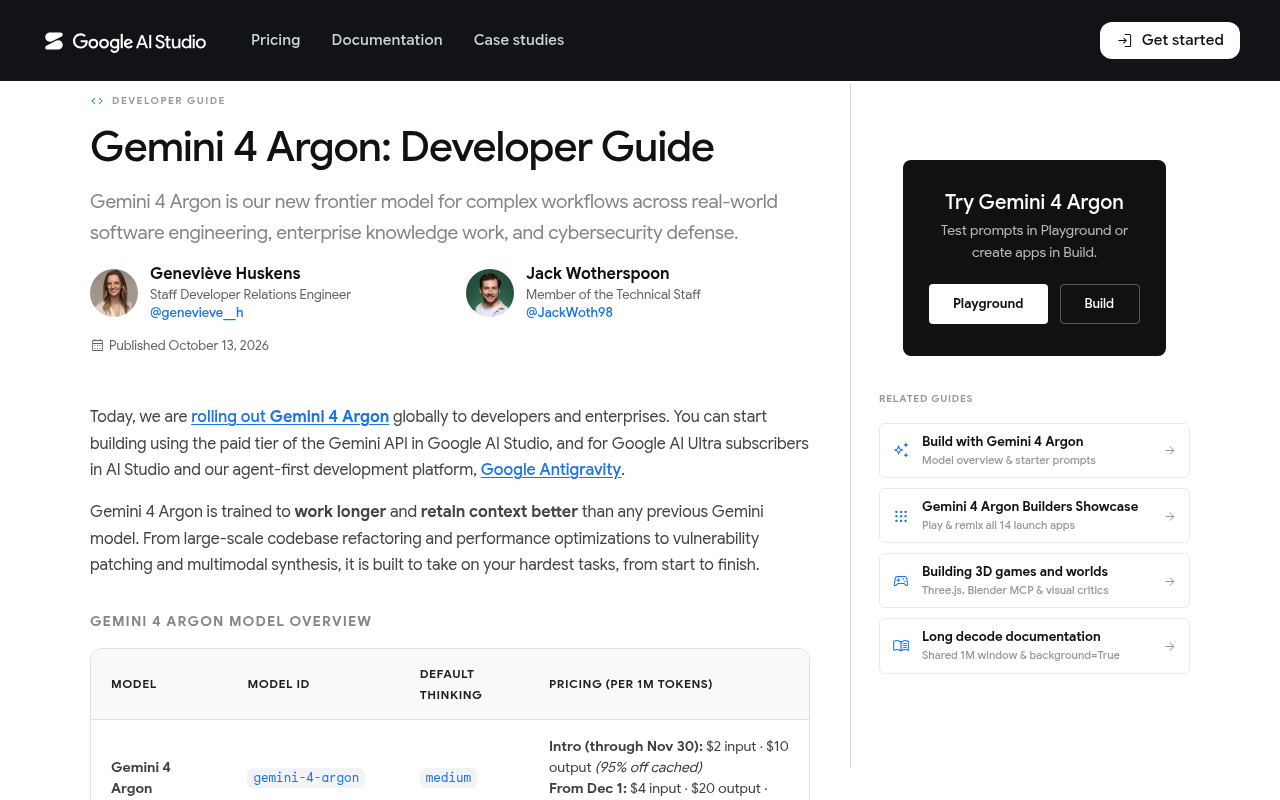
Argon's guide has two details that change how you call it. It says custom temperature, top_p and top_k values are ignored, and hard prompts can run for several minutes, so Google recommends a 15 to 20 minute client timeout or background mode. Opus 5.5 can no longer run with thinking switched off, per Anthropic's release notes.
Gemini 4 Argon vs Opus 5.5 on DeepSWE
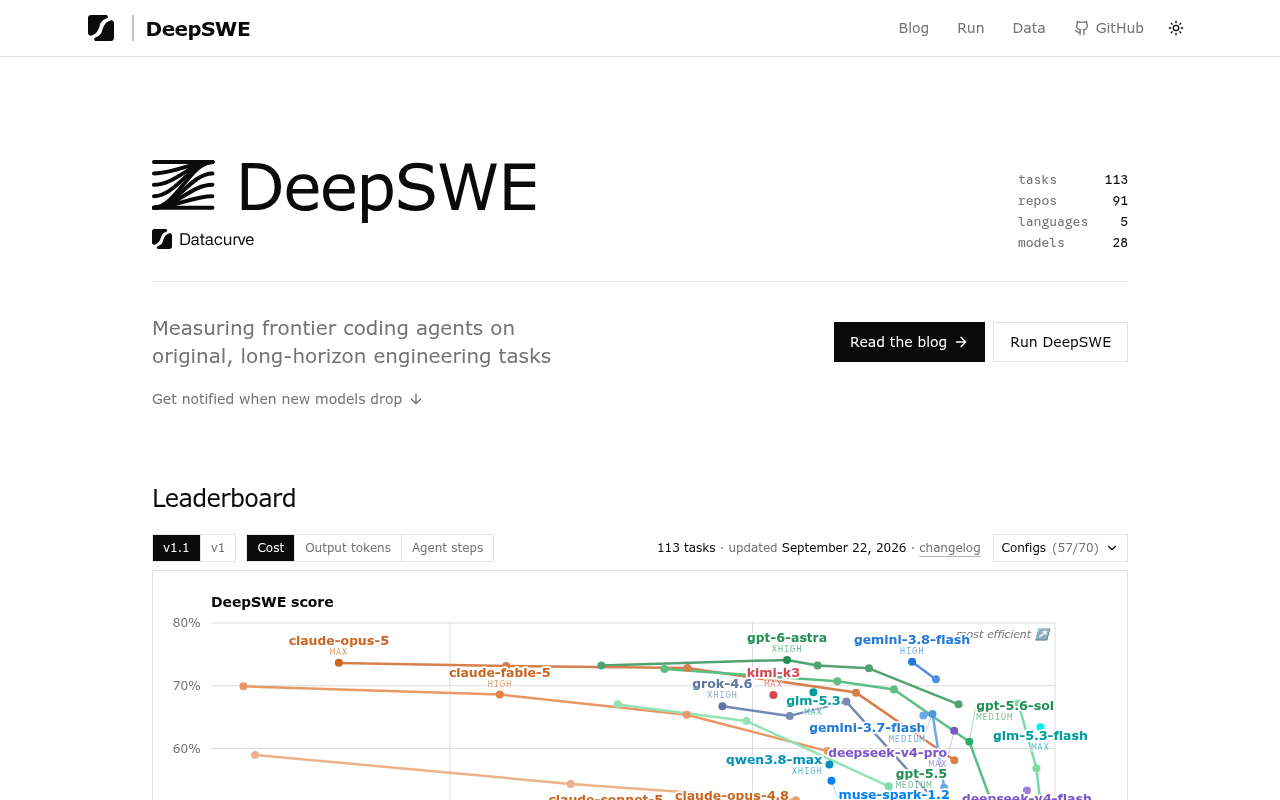
Gemini 4 Argon leads Opus 5.5 on DeepSWE v1.1 by 3.7 points, 77.9% to 74.2%, but only in Google's own runs. The public DeepSWE leaderboard was last updated on September 22, 2026 and lists neither Gemini 4 Argon nor Claude Opus 5.5, so the headline number comes from Google's launch post and model card, with GPT-6 Astra at 74.1% and Claude Fable 5.1 at 67.4% in the same table.
DeepSWE is the benchmark I lead with because Datacurve wrote all 113 tasks from scratch across 91 repositories in 5 languages, so no model saw the answers in training, and every model runs on the same mini-swe-agent harness. On the public board the frontier is a three way tie at 74%: GPT-6 Astra at xhigh effort (74% ±3%, $4.43 per task), Gemini 3.8 Flash at high (74% ±1%, $2.36) and Claude Opus 5 at max (74% ±4%, $11.84). Claude Fable 5 at xhigh sits at 70% ±3% for $13.41 a task.
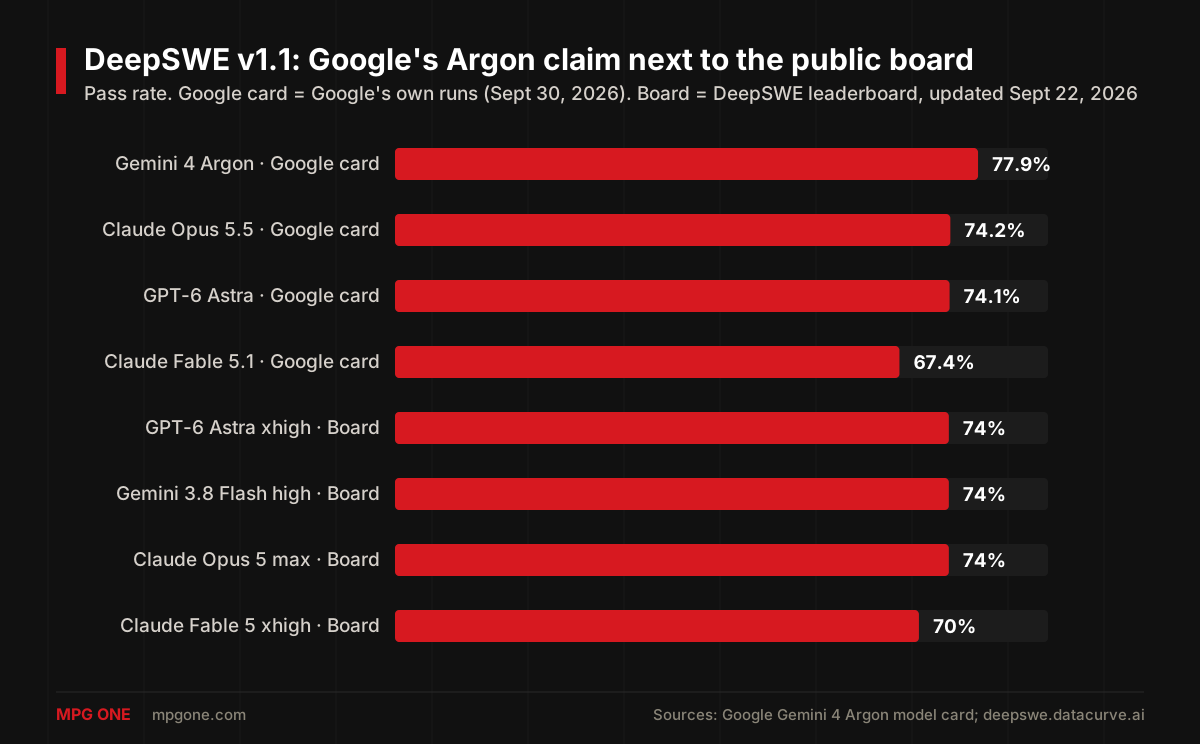
Google's 77.9% would put Argon alone at the top of the board if Datacurve reproduces it. The board's error bars are ±1% to ±4%, so a 3.7 point lead is real if it holds, and a 0.1 point gap between Opus 5.5 and Astra is noise. Datacurve has added every frontier model within weeks of release, and I will update this section when Argon and Opus 5.5 appear.
Gemini 4 Argon vs Opus 5.5 Pricing and Cost per Task
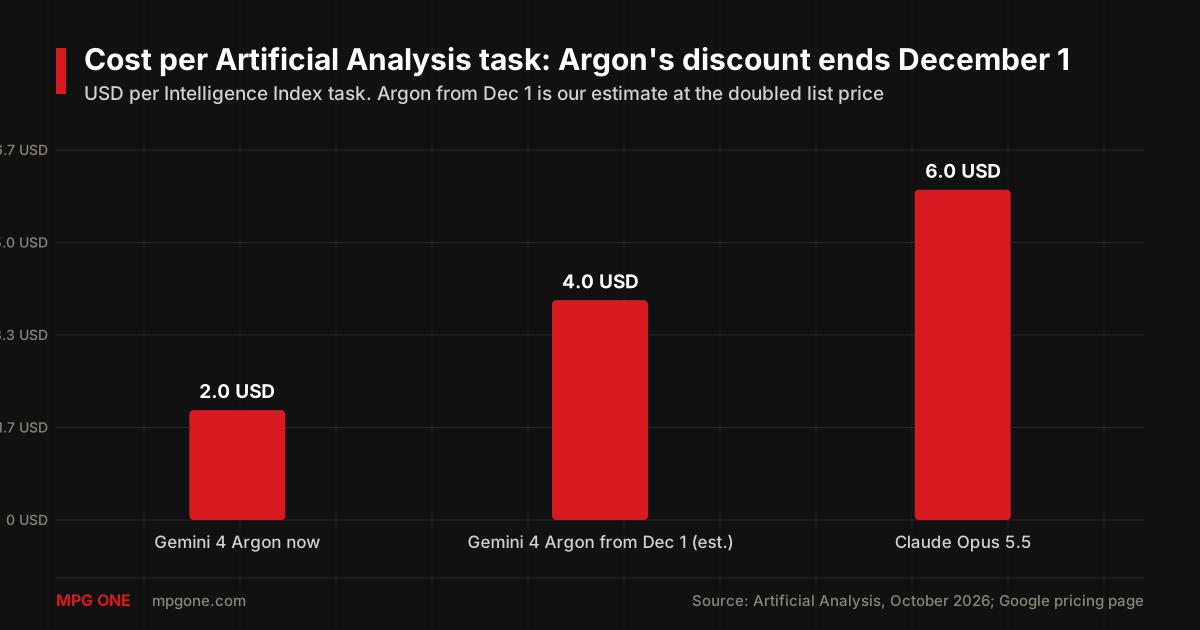
Gemini 4 Argon costs half of Claude Opus 5.5 per token until November 30, 2026, and about one third per task. Artificial Analysis measures $1.99 per Intelligence Index task for Argon at high thinking against $5.98 for Opus 5.5 at max effort, because Argon uses 62k output tokens per task (36k of them reasoning) and Opus 5.5 uses 119k (84k reasoning).
From December 1 Argon moves to $4 and $20, which matches Opus 5.5's list price exactly. At the doubled rate Argon's cost per task would land near $3.98 if its token use stays the same, still about a third below Opus 5.5 because it thinks less per task. Anthropic's cache reads cost $0.20 per million; Google's implicit caching takes 95% off the input price, which is $0.10 now and $0.20 from December.
Subscription access follows other rules. Argon is in the Gemini app for Google AI Pro and Ultra subscribers, and in Google Antigravity for Ultra only. Opus 5.5 is on every Claude plan, and Anthropic raised the five hour usage limits on Pro, Max and Team at launch. If you work through Claude Code or Antigravity rather than the API, the plan you already pay for decides the model more than the token price does.
Secondary Benchmarks for Gemini 4 Argon and Opus 5.5
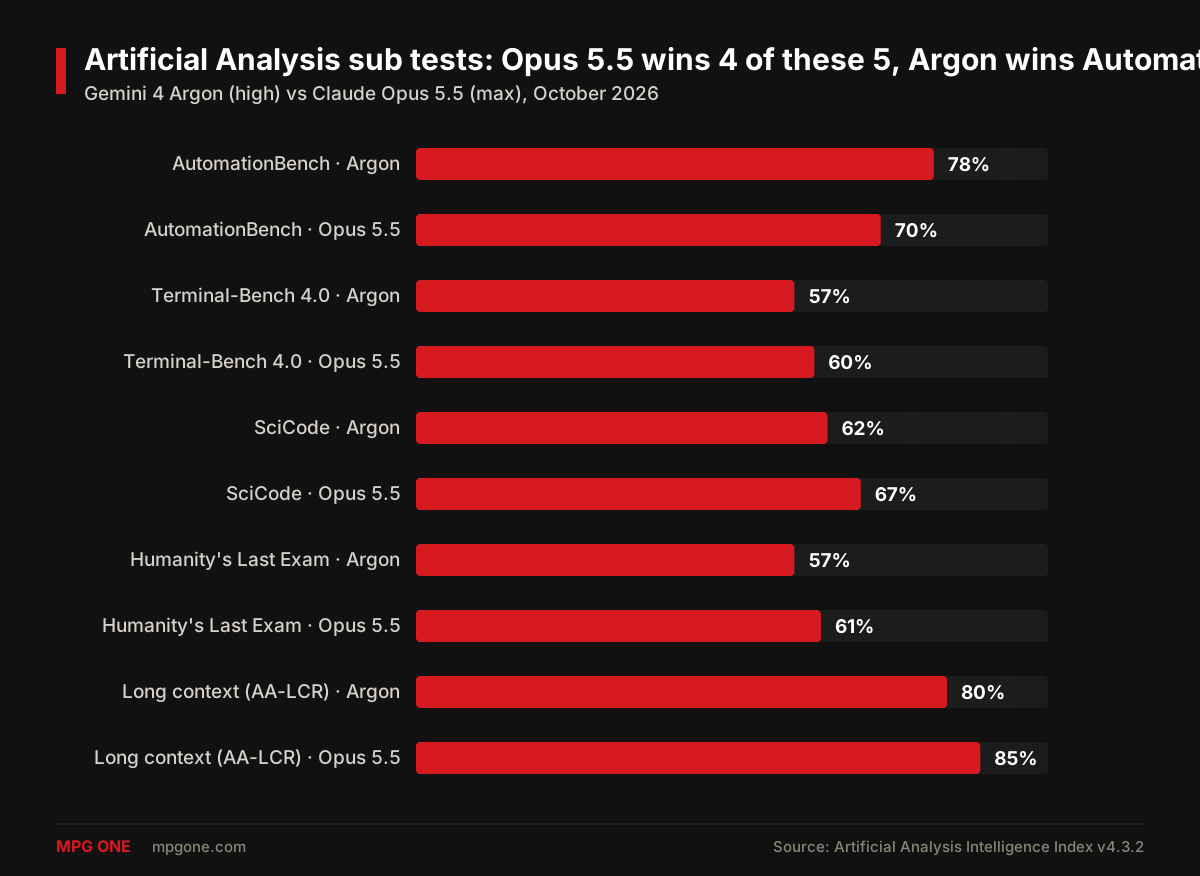
Claude Opus 5.5 beats Gemini 4 Argon on 9 of the 10 tests inside the Artificial Analysis Intelligence Index, and the one Argon wins is AutomationBench, Zapier's test of business workflows across connected apps, at 78% to 70%. The percentage tests tell the story: Terminal-Bench 4.0 is 60% for Opus 5.5 and 57% for Argon, SciCode 67% to 62%, Humanity's Last Exam 61% to 57%, and the long context reasoning test AA-LCR 85% to 80%.
Google's own launch table shows the same shape from the other side. Argon tops DeepSWE and AutomationBench (51.3% on Zapier's own run), sets a new high of 91.7% on the LVBench long video test and ties GPT-6 Astra at 68% on CWE-bench v1 for fixing security vulnerabilities. Opus 5.5 keeps Terminal-Bench 4.0 at 66.4% to Argon's 57.4%, per The New Stack's reading of Google's table, and Anthropic's own page reports the same 66.4%. GPT-6 Astra keeps FrontierSWE v2 at 65.5% to Argon's 55.0%.
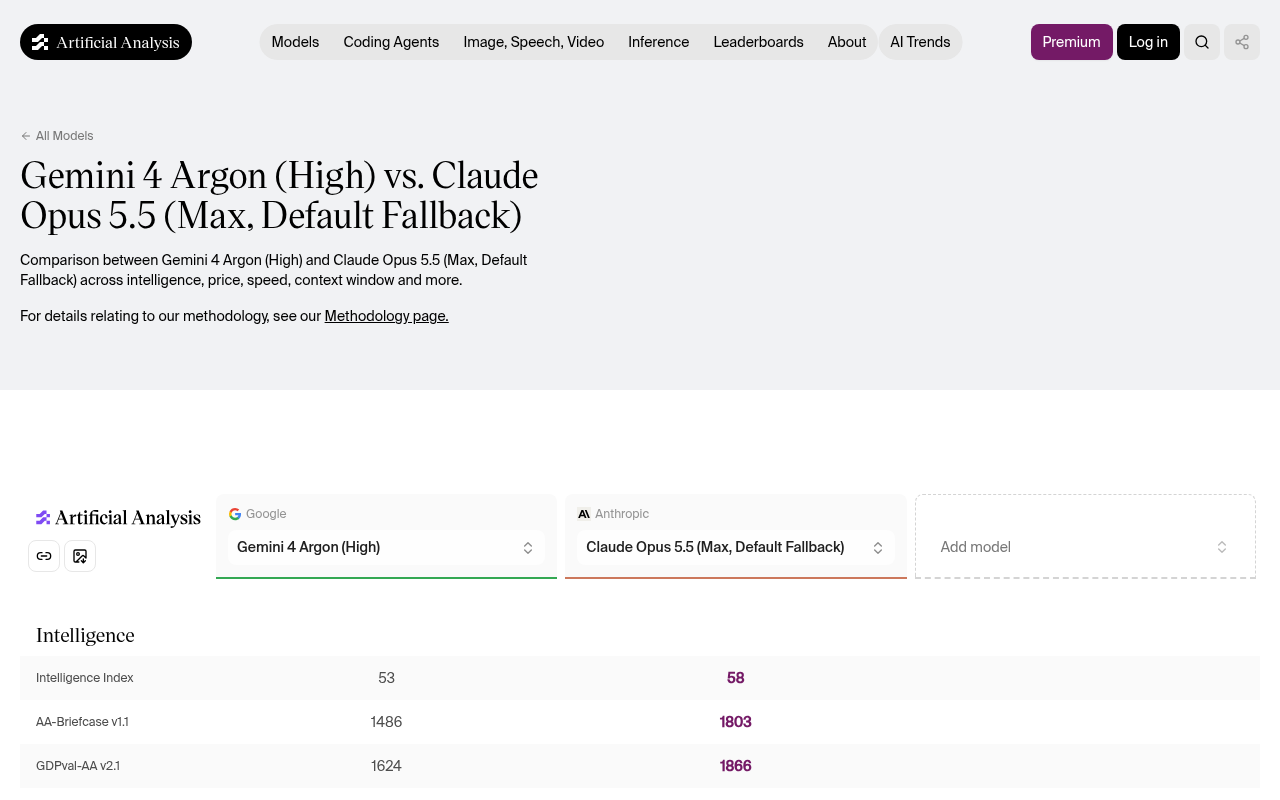
Vendor tables use each vendor's harness and effort settings, so Google's 74.2% for Opus 5.5 on DeepSWE and Anthropic's 66.4% on Terminal-Bench were measured by different people on different setups. Artificial Analysis compares Argon at high thinking with Opus 5.5 at max effort, which is each model's top setting but not a matched compute budget.
What Independent Tests of Gemini 4 Argon and Opus 5.5 Found
Independent testers who ran Gemini 4 Argon and Opus 5.5 on the same briefs found a tie on code review and a clear Opus 5.5 lead on specs, long context and polish. The most careful write up is Jessica Wachtel's three test comparison at The New Stack (October 2026), run through OpenRouter at default reasoning settings and graded by scripts against answer keys built before testing.
The New Stack: bug hunt, billing spec, long context
On the bug hunt, a 3,500 line Python library with 14 planted bugs and 5 decoys, both models found all 14, flagged no decoys and fixed all 14 without breaking any of the 93 existing tests. Argon did it for $0.15 in review and $0.35 in fixes against $0.34 and $0.95 for Opus 5.5.
On the billing spec, graded by 80 hidden tests for daylight saving, month end dates and rounding, Opus 5.5 passed 80 of 80 and then 100 of 100 after a currency follow up. Argon passed 11 of 80 and 20 of 100. Wachtel traced Argon's failure to one line: it passed an extra argument to Python's datetime.combine(), which raises an error that most of the module depends on. With that line fixed by hand, Argon scored 80 of 80.
On long context, a fake wiki of 400 services at three sizes, Opus 5.5 named all 33 services in the "blast radius" question at 500K tokens and 32 at 600K with no wrong entries. Argon got 20 right with 8 wrong at 500K, 19 right with 16 wrong at 600K, and 23 right with 2 wrong at 900K, a size Anthropic's API rejected because Claude's tokenizer counted the document at 1.4 million tokens. Argon answered in 24 to 42 seconds with 243 to 425 output tokens; Opus 5.5 spent over 5,000 tokens reasoning first. Totals for all three tests: $4.98 for Argon, $8.75 for Opus 5.5.
| The New Stack test | Gemini 4 Argon | Claude Opus 5.5 |
|---|---|---|
| Bug hunt review | 14 of 14, 0 false positives | 14 of 14, 0 false positives |
| Bug hunt fix | 14 of 14, 93 of 93 tests kept | 14 of 14, 93 of 93 tests kept |
| Billing spec | 11 of 80 | 80 of 80 |
| Billing follow up | 20 of 100 | 100 of 100 |
| Blast radius, 500K | 20 of 33, 8 wrong | 33 of 33 |
| Blast radius, 600K | 19 of 33, 16 wrong | 32 of 33 |
| Total cost | $4.98 | $8.75 |
The New Stack discloses that its owner, Insight Partners, invests in Anthropic. The scripts and answer keys are described in the article, so the results are checkable, and the disclosure is there for you to weigh.
The AI Automators: six builds in Antigravity
The AI Automators ran both models at high effort on six build briefs inside Google Antigravity and had GPT-6 Astra grade each result against the spec, in a video published October 14, 2026. Opus 5.5 won all four graded builds: 7 to 5 on a flood simulator for an Irish river town, 8 to 6 on a Canva style editor, 8 to 5 on a bike shop site with a 3D hero and booking engine, and 6 to 5 on a driving test simulator.
The host's repeated complaint was interface taste: Argon's apps worked and came out "incredibly cluttered" and technical, while Opus 5.5's looked like products. On the flood simulator Argon also took 74 minutes to Opus 5.5's 54. The one brief where Argon came close was a Blender kitchen with photoreal renders, where both impressed and Opus 5.5 won on detail. These are one shot builds, and another model did the grading, so they read as a taste check with a sample of six.
How I Tested Gemini 4 Argon and Opus 5.5
Our five task battery ran Claude Opus 5.5 on October 12, 2026 and could not run Gemini 4 Argon, because our Gemini API key is on the free tier and Google's quota for gemini-4-argon on that tier is zero. I am reporting the Opus 5.5 numbers here and will add Argon at medium and high thinking once the key moves to the paid tier, so this section covers Opus 5.5 alone for now.
The battery is the same one we used for Kimi K3 vs Opus 5 and Opus 5 vs Fable 5: five original tasks (a bug hunt in an interval merging function, an implementation from a spec with an empty string trap, a churn math problem, a facts and citations check, and a constrained writing brief), one fresh request per task, first response only, no retries, each task scored 0 to 100 and averaged to a score out of 5.
| Claude Opus 5.5 battery run | Medium effort | Max effort |
|---|---|---|
| Score | 4.40 of 5 | 4.40 of 5 |
| Total time, 5 tasks | 44.7 s | 380.6 s |
| Median time to first token | 4.6 s | 52.5 s |
| Output tokens | 4,419 | 42,385 |
| Cost at $4 / $20 | $0.09 | $0.85 |
Opus 5.5 found every planted bug, passed 8 of 8 implementation checks including the empty string trap, got the churn math exact with a closed form, and scored 100 on the writing brief at both settings. Its only misses were on the facts task, where it did not know three prices and said so instead of guessing, which earns honesty credit and loses the points. Max effort cost 9.2 times as much and took 8.5 times as long for the same score, so for this kind of short task the default setting is the right one.
What I expect from Argon on this battery, based on the independent results above: a tie on the bug hunt and implementation tasks, a likely tie on churn math, and the same honest miss on facts. The interesting number will be the cost line, because Argon's lower token use per task is what makes it cheap, and our tasks are short enough that thinking tokens dominate.
Gemini 4 Argon vs Opus 5.5 Speed and Latency
Gemini 4 Argon answers sooner and Claude Opus 5.5 streams faster. Artificial Analysis measures 85 output tokens per second for Argon at high thinking against 94 for Opus 5.5 at max effort, and a time to first answer token of 47 seconds for Argon against 563 seconds for Opus 5.5, because max effort front loads minutes of reasoning on hard prompts.
Those are top setting figures. At its default medium effort, Opus 5.5 gave us a median first token in 4.6 seconds and finished all five battery tasks in 45 seconds. On The New Stack's long context runs Argon came back in 24 to 42 seconds and Opus 5.5 in 68 to 69 seconds, and Argon's speed there came with wrong answers. Argon's own guide warns that hard prompts can take several minutes and recommends background mode, so neither model is a quick chat model when you turn the effort up.
Which Should You Use, Gemini 4 Argon or Opus 5.5?
Use Gemini 4 Argon until November 30 for high volume agent work, video and audio input, and long outputs, and use Claude Opus 5.5 for anything where one wrong line costs you. That split holds until Argon's price doubles.
- Video, audio and PDF input: Argon. Opus 5.5 takes text and images only, and Argon's 91.7% on LVBench is the top long video score Google reports.
- Business workflow agents: Argon, on both AutomationBench runs (78% to 70% at Artificial Analysis, 51.3% first place on Zapier's board).
- Spec to code and billing logic: Opus 5.5. The 80 of 80 against 11 of 80 result came from a single Argon slip, and a single slip is the failure mode you pay a frontier model to avoid.
- Long context reasoning over 500K tokens: Opus 5.5, 33 of 33 against 20 of 33 with 8 invented entries.
- Terminal and command line agents: Opus 5.5, 66.4% to 57.4% on Terminal-Bench 4.0.
- Front end and product polish: Opus 5.5 won all four graded builds in The AI Automators' test.
- Cost sensitive code review: Argon, which tied Opus 5.5 on a 14 bug review for less than half the cost and would still be cheaper at the December price because it uses fewer tokens.
Google's own developer guide suggests a pattern that fits this split: Argon as the orchestrator for architecture and review, with Gemini 3.8 Flash subagents doing the parallel implementation work. If your stack is on Anthropic, the equivalent is Opus 5.5 orchestrating Sonnet 5.5 at $2 and $10, which is what Argon costs today.
FAQ
Is Gemini 4 Argon better than Opus 5.5?
Not on independent scores. Artificial Analysis rates Claude Opus 5.5 at 58 and Gemini 4 Argon at 53, and Opus 5.5 wins 9 of the 10 sub tests. Argon wins on price until November 30, 2026, on AutomationBench (78% vs 70%) and on Google's own DeepSWE run (77.9% vs 74.2%).
How much does Gemini 4 Argon cost?
Gemini 4 Argon costs $2 per million input tokens and $10 per million output tokens through November 30, 2026, with cached input at 95% off. From December 1 the price doubles to $4 and $20, which is exactly what Claude Opus 5.5 charges today.
Is Gemini 4 Argon good for coding?
Gemini 4 Argon is strong on long horizon coding: Google reports 77.9% on DeepSWE v1.1, ahead of Opus 5.5 at 74.2%. It is weaker on terminal work, where Opus 5.5 scores 66.4% to Argon's 57.4% on Terminal-Bench 4.0, and The New Stack's spec to code test went 80 of 80 for Opus 5.5 against 11 of 80 for Argon.
Gemini 4 Argon vs GPT-6 Astra, which wins?
Artificial Analysis scores Gemini 4 Argon and GPT-6 Astra at 53 each. Argon costs $1.99 per index task against $7.70 per million blended tokens for Astra, so Argon is the cheaper of the two. On Google's table Argon leads DeepSWE (77.9% vs 74.1%) and Astra leads FrontierSWE v2 (65.5% vs 55.0%).
Can I use Gemini 4 Argon for free?
No. Gemini 4 Argon needs the paid tier of the Gemini API, a Google AI Pro or Ultra subscription for the Gemini app, or AI Ultra for Google Antigravity. Our own free tier API key returned a quota of zero for gemini-4-argon.
Final Thoughts
Gemini 4 Argon vs Opus 5.5 is cheaper against better for the next six weeks, and then it is a straight quality contest at the same price. Google's DeepSWE lead is a claim the public board has not confirmed, Artificial Analysis gives Opus 5.5 a five point edge, and the two hands on tests I trust most both ended with Opus 5.5 ahead on the work that is hard to check by eye. Argon earns its place on video input, workflow agents and cheap code review, and I will add our own Argon battery numbers as soon as the paid tier run is in.
If you are deciding which of these models should sit inside a product or an internal agent, that choice depends on your tasks and your token volume more than on any leaderboard. Our AI development services team runs exactly this kind of head to head on your own workload before a line of production code is written.
Helpful next steps
Turn the idea into something useful
When this topic becomes part of a real website, workflow, campaign, or AI system, these MPG ONE pages are the natural places to continue.
Build private AI assistants, workflow automation, knowledge systems, and reporting layers.
Generative AI development servicesBuild generative AI workflows for content, documents, knowledge, and brand-safe operations.
AI agent development servicesDesign tool-using AI agents with memory, retrieval, permissions, and human review.
Custom AI solutionsCreate a custom AI system around your data, tools, permissions, and operating model.
MPG ONE coursesLearn practical AI systems, SEO growth workflows, and talent brand operations with MPG ONE training.