AI
Kimi K3 vs Opus 5: 93% of the Score, 39% of the Cost
Kimi K3 vs Opus 5: K3 scores 69% on DeepSWE against 74%, at a third of the cost per task. See the numbers and what open weights really buy.

By Mohamed Ezz CEO & Founder Jul 25, 2026
Moonshot AI released Kimi K3 on July 16, 2026, and it has quietly become the most interesting price comparison in the market. On the DeepSWE benchmark it scores 69% against Claude Opus 5's 74%, and it finishes the average task for $4.65 against $11.84.
That is roughly 93% of the score for 39% of the cost. The short answer: if your workload is high volume and a few points of accuracy will not break anything, K3 is the better economics. If quality is the constraint, Opus 5 still wins, and Moonshot itself agrees.
The headline everyone is running with is that K3 is open weight. That part is true and it matters, but it does not mean what most people assume, and I will get to why.
My Main Points:
- Kimi K3 scores 69% on DeepSWE against 74% for Claude Opus 5
- Both carry wide error bars that overlap, so the capability gap is smaller than the ranking implies
- K3 finishes the average task for $4.65 against $11.84, roughly a third of the cost
- List pricing is $3 and $15 per million tokens against $5 and $25, with cached input at just $0.30
- Open weights are scheduled for July 27, 2026, but 2.8 trillion parameters means self hosting needs 64 or more accelerators
- Moonshot publishes its own limitations, including that K3 still trails on overall user experience
After nearly 20 years in AI development and digital marketing, the pattern I keep seeing is that the cheaper model is usually closer than the price gap suggests. In this comparison I will show you the independent benchmark, the real cost per task, what the open weights actually buy you, and where Opus 5 keeps a genuine edge. For the other side of the Opus 5 picture, see our comparisons of Opus 5 against Fable 5 and Opus 5 against Opus 4.8.
What Moonshot Shipped
Kimi K3 is a 2.8 trillion parameter multimodal reasoning model, which makes it the largest open weight model released to date. It is a sparse mixture of experts design, so only a small slice of that network runs on any given token: 16 of 896 routed experts. That is how a model this large stays affordable to serve.
| Kimi K3 | Claude Opus 5 | |
|---|---|---|
| Maker | Moonshot AI | Anthropic |
| Released | July 16, 2026 | July 24, 2026 |
| Parameters | 2.8 trillion (sparse MoE) | Not published |
| Context window | 1M tokens | 1M tokens |
| Input per 1M | $3 ($0.30 cached) | $5 |
| Output per 1M | $15 | $25 |
| Weights | Open, scheduled July 27 | Closed |
Same context window, noticeably lower price, and a weight release that Anthropic will never match. On paper that is a serious challenge. The question is whether the capability holds.
The DeepSWE Verdict
For model comparisons I lead with DeepSWE, because it uses newly written tasks and hand written verifiers, which makes it much harder to contaminate than benchmarks that have circulated for years.
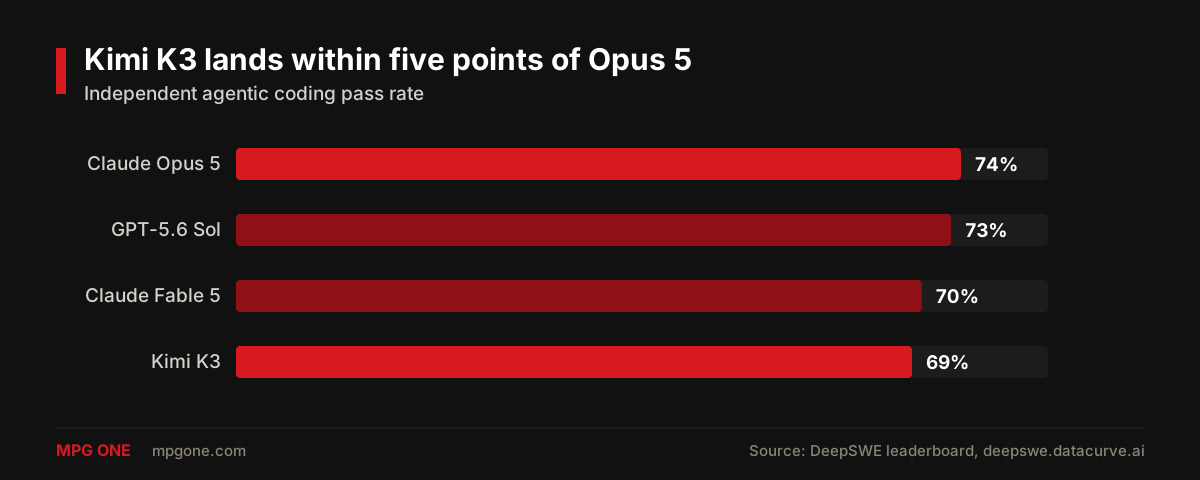
Claude Opus 5 leads at 74%. Kimi K3 sits at 69%, fifth overall, behind Opus 5, GPT-5.6 Sol, Fable 5, and GPT-5.6 Terra. On a straight reading, Opus 5 wins.
Read the error bars, though, and the picture softens. Opus 5's score carries 4 points of uncertainty and K3's carries 5, so the ranges are 70% to 78% against 64% to 74%. They overlap between 70 and 74. A five point gap between two scores with that much spread is a lead, not a verdict. K3 is competing at the frontier, from a model you will soon be able to download.
Worth noting where K3 does win outright: it currently tops arena.ai's Code WebDev leaderboard in blind developer testing, ahead of Fable 5. Benchmarks measure different things, and front end work is clearly one of its strengths.
The Cost Gap Is Not Close
Where the benchmark is a photo finish, the pricing is not.
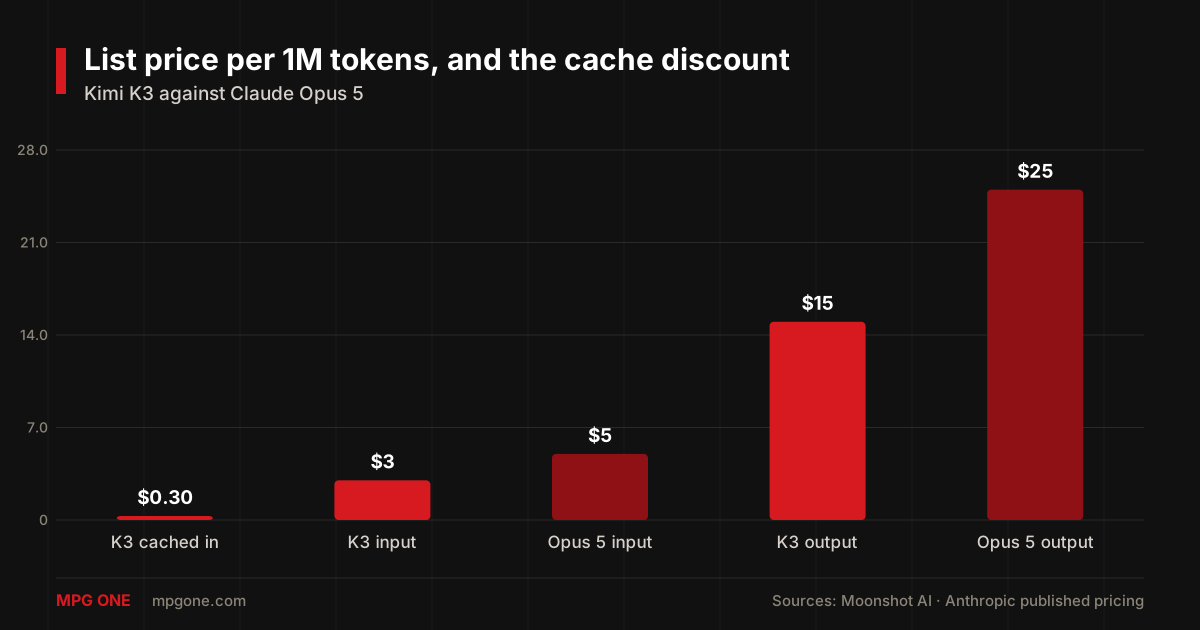
K3 runs $3 per million input tokens and $15 per million output, against $5 and $25 for Opus 5. That is roughly 40% cheaper on both sides. The number that stands out, though, is cached input at $0.30 per million. If your workload sends the same large context repeatedly, which describes most retrieval and agent workloads, that line does more for your bill than the headline rate.
List prices can mislead, because a cheaper model that burns more tokens finishing the job can cost more in practice. DeepSWE measures the real thing.
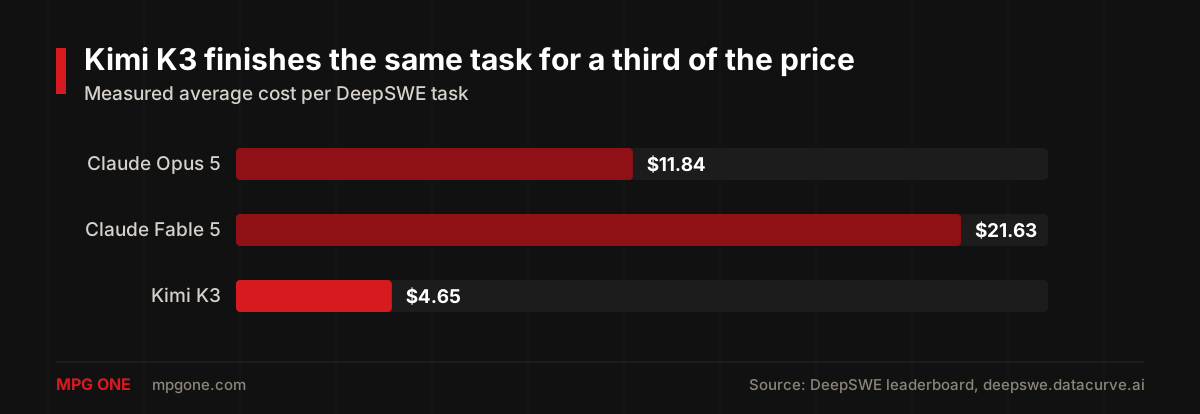
K3 completes the average DeepSWE task for $4.65. Opus 5 spends $11.84 and Fable 5 spends $21.63. So the measured saving is even larger than the rate card implies: about 61% cheaper than Opus 5 per finished task, on identical work.
Put those two facts together and you get the trade in one line: you give up about 5 points of pass rate and you keep about 61% of your model budget. Whether that is a good deal depends entirely on what a failed task costs you, which is the same math we walk through in our guide to AI agent development cost.
What "Open Weights" Actually Buys You
This is where most of the coverage this week is going to mislead people, so let me be precise.
Moonshot has set July 27, 2026 for publishing K3's full weights. As I write this, they are not out yet. Everything measured above was measured against the hosted API, not a self hosted copy.
More importantly, open weights and self hosting are not the same thing. K3 is 2.8 trillion parameters, and Moonshot recommends a deployment of 64 or more accelerators. That is a data center project with a serious capital budget, not a machine you put under a desk. For the overwhelming majority of teams, "we could download it" and "we could run it" are very different sentences.
So what do the open weights genuinely give you?
- No vendor lock in at the model layer. If Moonshot changes pricing or retires the model, the weights still exist and other providers can host them.
- A real option for regulated or air gapped work, if you have the infrastructure. This is the case where downloading actually matters.
- Competitive pressure on price. Multiple hosts serving the same weights compete on margin, which is good for buyers regardless of who you eventually use.
- Inspectability for researchers and for teams whose compliance process requires it.
What they do not give you is a cheap escape from API bills. If your plan for controlling model spend is self hosting K3, price the hardware first.
Where Opus 5 Still Wins
Moonshot is refreshingly direct about K3's weak points, and I would rather quote them than pretend otherwise. The company states that K3 still trails Fable 5 and GPT-5.6 Sol in overall user experience, that it requires complete reasoning history in multi turn conversations, and that it may resolve ambiguities on its own rather than checking with the user first.
That last one matters for agent work. A model that quietly picks an interpretation and proceeds is harder to supervise than one that asks, and the cost of that shows up in review time rather than on your invoice.
Opus 5 also holds a few advantages that do not appear on a leaderboard. It is available through Claude.ai, Claude Code, and Claude Cowork as well as the API, so the same model backs your terminal and your team's chat. Anthropic reports it as their most aligned model to date on internal behavioral audits, which is vendor reported but points the right way for agents with real permissions. And there is a deep ecosystem of tooling built around it.
Which Should You Use?
Three cases came out of the numbers.
Use Kimi K3 when volume is the constraint. Bulk classification, document processing, high traffic support, code review at scale, anything where you run the same job thousands of times and a small accuracy difference is absorbed by review or retries. At a third of the cost per task, the savings compound quickly.
Use Claude Opus 5 when quality is the constraint. Work where a failure is expensive, agents operating with real permissions, or anything customer facing where the polish gap Moonshot admits to would show. Five points of pass rate is cheap insurance when a bad output costs more than the model call.
Consider running both. The most cost effective setups I see route by difficulty: the cheaper model handles the bulk, and the expensive one handles the cases that fail or that carry real risk. That pattern captures most of the savings without accepting the accuracy hit everywhere.
Whichever way you lean, test it on your own workload before committing. We found the same lesson testing Gemini 3.6 Flash against its cheaper sibling, where the premium model bought nothing on short tasks, and our Claude vs Grok comparison lays out the five task battery we use to check.
FAQ
Is Kimi K3 better than Claude Opus 5?
No, but it is closer than the price suggests. Opus 5 scores 74% on DeepSWE against 69% for Kimi K3, and the error bars overlap, so the capability gap is small. K3 finishes the average task for $4.65 against $11.84, so it wins clearly on cost.
How much does Kimi K3 cost?
$3 per million input tokens and $15 per million output tokens, dropping to $0.30 per million for cached input. Claude Opus 5 is $5 and $25, so K3 is around 40% cheaper on standard rates and far cheaper on repeated context.
Is Kimi K3 open source?
It is open weight rather than open source, and Moonshot set July 27, 2026 for publishing the full weights. Note that open weights do not mean easy self hosting: at 2.8 trillion parameters, Moonshot recommends 64 or more accelerators to run it.
Can I self host Kimi K3?
In principle yes, once the weights are published, but the hardware requirement puts it out of reach for most teams. A 64 accelerator deployment is a data center project, not a server in your office. Most users will still reach K3 through a hosted API.
Should I use Kimi K3 instead of Claude Opus 5?
Use K3 for high volume work where cost dominates and a few points of accuracy will not break anything. Use Opus 5 where quality matters most, or where you need the polish Moonshot itself admits K3 still lacks.
Final Thoughts
Kimi K3 does not beat Claude Opus 5, and Moonshot does not claim it does. What it does is land close enough that the price difference becomes the deciding factor for a large class of work. Five points of pass rate for 61% of your model budget is a trade plenty of teams should take.
Just be clear eyed about the open weights. They are a genuine strategic asset and a poor cost saving plan, because almost nobody is running a 2.8 trillion parameter model on their own hardware. Judge K3 on the hosted price and the measured accuracy, which are both excellent, rather than on a download you will probably never use. If you want help routing work between a cheap model and an expensive one so you only pay for quality where it counts, our AI development services team builds exactly that.
Helpful next steps
Turn the idea into something useful
When this topic becomes part of a real website, workflow, campaign, or AI system, these MPG ONE pages are the natural places to continue.
Build private AI assistants, workflow automation, knowledge systems, and reporting layers.
AI agent development servicesDesign tool-using AI agents with memory, retrieval, permissions, and human review.
Generative AI development servicesBuild generative AI workflows for content, documents, knowledge, and brand-safe operations.
Custom AI solutionsCreate a custom AI system around your data, tools, permissions, and operating model.
GitHub, MCP and Codex skillsExplore RepoGuard, MCP wrappers, and AI-agent workflows built by MPG ONE.