AI
GPT-6.1 Sol vs Opus 5.5: Benchmarks, Cost, Verdict
GPT-6.1 Sol vs Opus 5.5: Sol is $2/$10 per million tokens, Opus 5.5 is $4/$20. Both scored 4 of 4 on our test battery. See cost per task and the verdict.

By Mohamed Ezz CEO & Founder Oct 12, 2026
GPT-6.1 Sol vs Opus 5.5 comes down to price against depth. OpenAI lists GPT-6.1 Sol at $2 per million input tokens and $10 per million output tokens, and Anthropic lists Claude Opus 5.5 at $4 and $20. On our own five task battery the two models tied at 4 of 4 on the graded tasks, at both medium and max effort.
After nearly 20 years in AI development and digital marketing, I have learned that the cheaper model is usually closer than the price gap suggests, and this pair proves it again. In this comparison I will show you the independent DeepSWE picture, the real cost per task at every effort level, what we measured when we ran both models ourselves, and where Opus 5.5 still earns double the price.
My Main Points:
- GPT-6.1 Sol costs $2 and $10 per million tokens; Claude Opus 5.5 costs $4 and $20, so Sol is half the list price
- Both models scored 4 of 4 on the graded tasks in our battery, at medium and at max effort
- Opus 5.5 at medium effort was the fastest and cheapest run we made: 45 seconds and $0.09 for all five tasks
- Opus 5.5 at max effort scored the same as medium for 9 times the cost and 8.5 times the time
- Artificial Analysis scores Opus 5.5 at 58 and Sol at 52 at max effort, at $5.98 and $0.72 per task
- Neither model is on the independent DeepSWE leaderboard yet, so the coding numbers in both launch posts are vendor claims
This is the newest pair in our Opus series, after Kimi K3 vs Opus 5 and Opus 5 vs Fable 5, and the first where I could run both models on the same day they were available to me.
GPT-6.1 Sol vs Opus 5.5 at a Glance
GPT-6.1 Sol and Claude Opus 5.5 launched one week apart in September 2026 and target the same job: the model you run all day for coding and knowledge work. Anthropic shipped Opus 5.5 on September 22 as the first model of its Claude 5.5 family, and OpenAI shipped GPT-6.1 Sol on September 29 at DevDay as an upgrade to GPT-6 Sol.
| GPT-6.1 Sol | Claude Opus 5.5 | |
|---|---|---|
| Maker | OpenAI | Anthropic |
| Released | September 29, 2026 | September 22, 2026 |
| API model id | gpt-6.1-sol | claude-opus-5-5 |
| Context window | 1,050,000 tokens | 1M tokens |
| Max output | 128,000 tokens | 128K tokens |
| Knowledge cutoff | April 30, 2026 | June 2026 |
| Input per 1M | $2 ($0.10 cached) | $4 ($0.20 cache read) |
| Output per 1M | $10 | $20 |
| Effort levels | low, medium, high, xhigh, max | low, medium, high, xhigh, max |
| Default effort | medium | medium |
| Thinking | Configurable | Adaptive, always on |
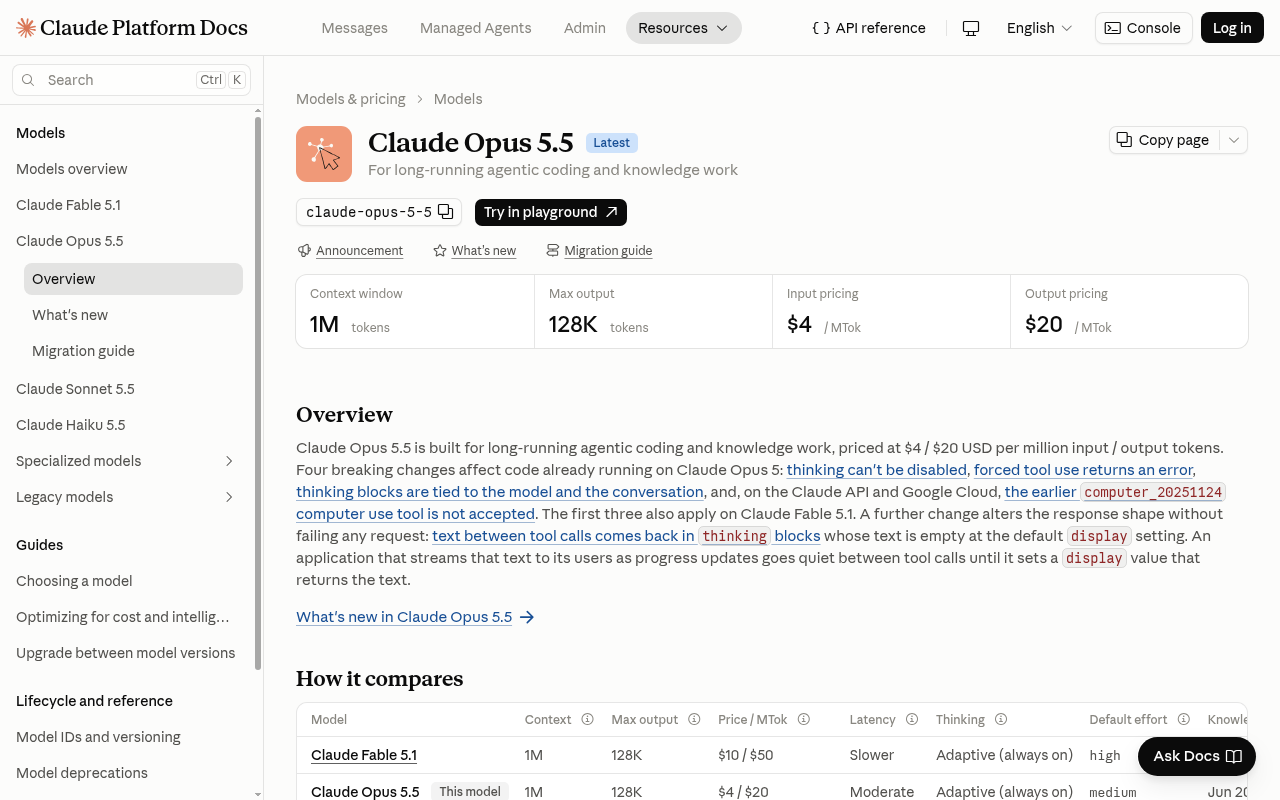
The specs come from the GPT-6.1 Sol model page and the Opus 5.5 overview. Two lines in the fine print change the bill more than the headline prices. Sol charges double for input and 1.5 times for output on any request above 272,000 input tokens, while Opus 5.5 has no long context surcharge. And Opus 5.5 can no longer run with thinking switched off, so effort is the only cost dial you get.
GPT-6.1 Sol vs Opus 5.5 on DeepSWE
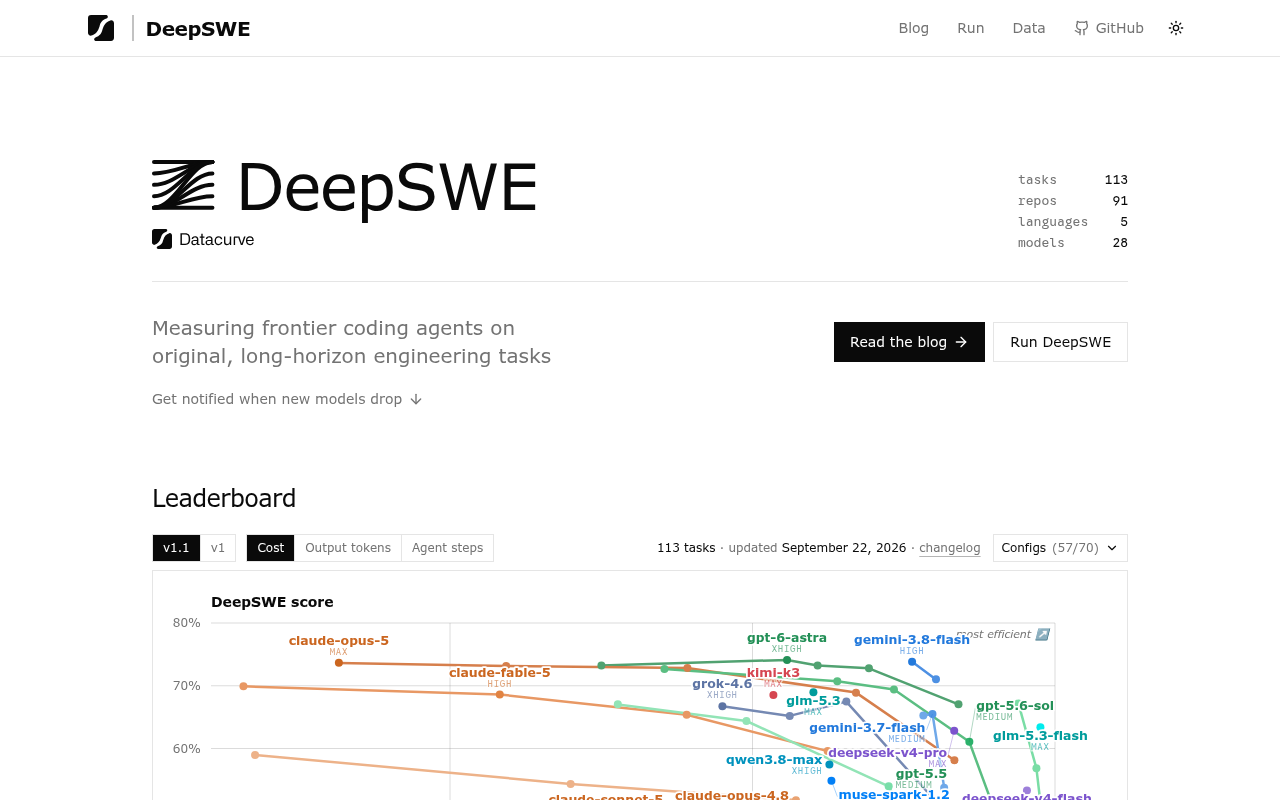
GPT-6.1 Sol and Opus 5.5 are both missing from the independent DeepSWE leaderboard as of October 12, 2026, because its last update was September 22, the day Opus 5.5 shipped. For model comparisons I lead with DeepSWE because its 113 tasks are newly written with hand built verifiers, which makes it far harder to contaminate than benchmarks that have circulated for years. Until the board updates, the best independent evidence is what it says about the two predecessors.
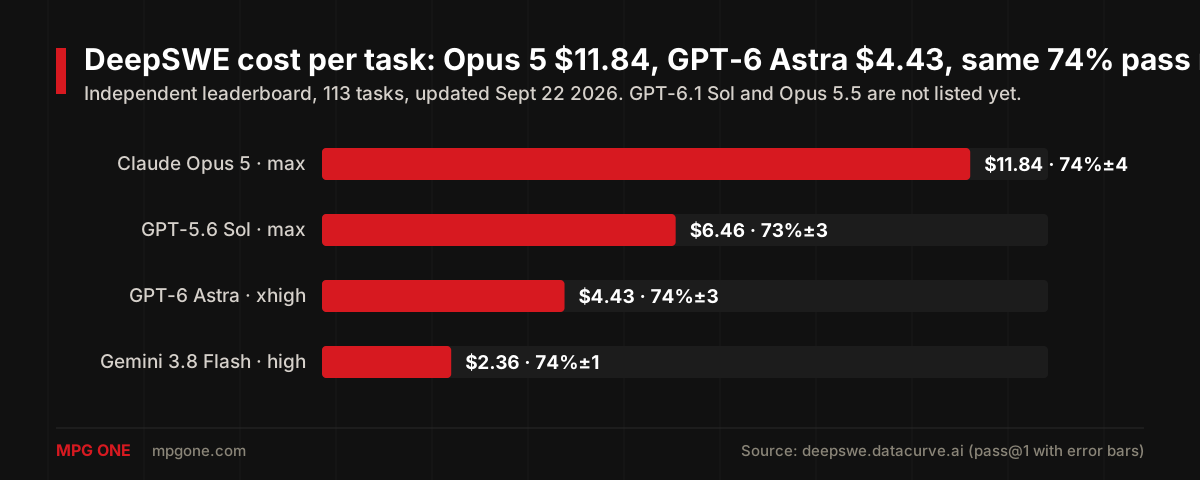
On that board, Claude Opus 5 at max effort scores 74% (±4) at $11.84 per task, and GPT-6 Astra at xhigh scores 74% (±3) at $4.43. GPT-5.6 Sol at max scores 73% (±3) at $6.46, and Gemini 3.8 Flash at high scores 74% (±1) at $2.36, which is why we called it a tie with Opus 5 at a fifth of the cost. The error bars on all four overlap, so the pass rates are a tie and the cost column is the only real separation.
The vendor claims fit that pattern. OpenAI's launch post says GPT-6.1 Sol matches GPT-6 Astra on DeepSWE v1.1 at roughly one fifth of the cost, and beats GPT-6 Sol's best score by 6.4 percentage points, but the chart carries no number for Sol itself. Anthropic's Opus 5.5 announcement does not report DeepSWE at all. Until the leaderboard adds them, Sol probably lands near Astra's 74% and Opus 5.5 near or above Opus 5's 74%, and I will update this section when the numbers exist.
GPT-6.1 Sol vs Opus 5.5 Pricing and Cost per Task
GPT-6.1 Sol costs exactly half of Opus 5.5 on every list price line: $2 against $4 for input, $10 against $20 for output, and $0.10 against $0.20 for cached input. Opus 5.5 charges $5 per million to write a 5 minute cache and $8 for a 1 hour cache; Sol's cache write is $2.50. Anthropic's fast mode for Opus 5.5 doubles the price to $8 and $40.
Per token is only half the story, because models at higher effort write more tokens. Artificial Analysis measures cost per task across its index at every effort level. Opus 5.5 costs $5.98 per task at max, $3.46 at xhigh, $1.82 at high, $1.34 at medium and $0.55 at low. GPT-6.1 Sol costs $0.72 at max, $0.39 at xhigh, $0.32 at high, $0.21 at medium and $0.13 at low. At the default medium setting, Sol is about a sixth of the price of Opus 5.5 per completed task.
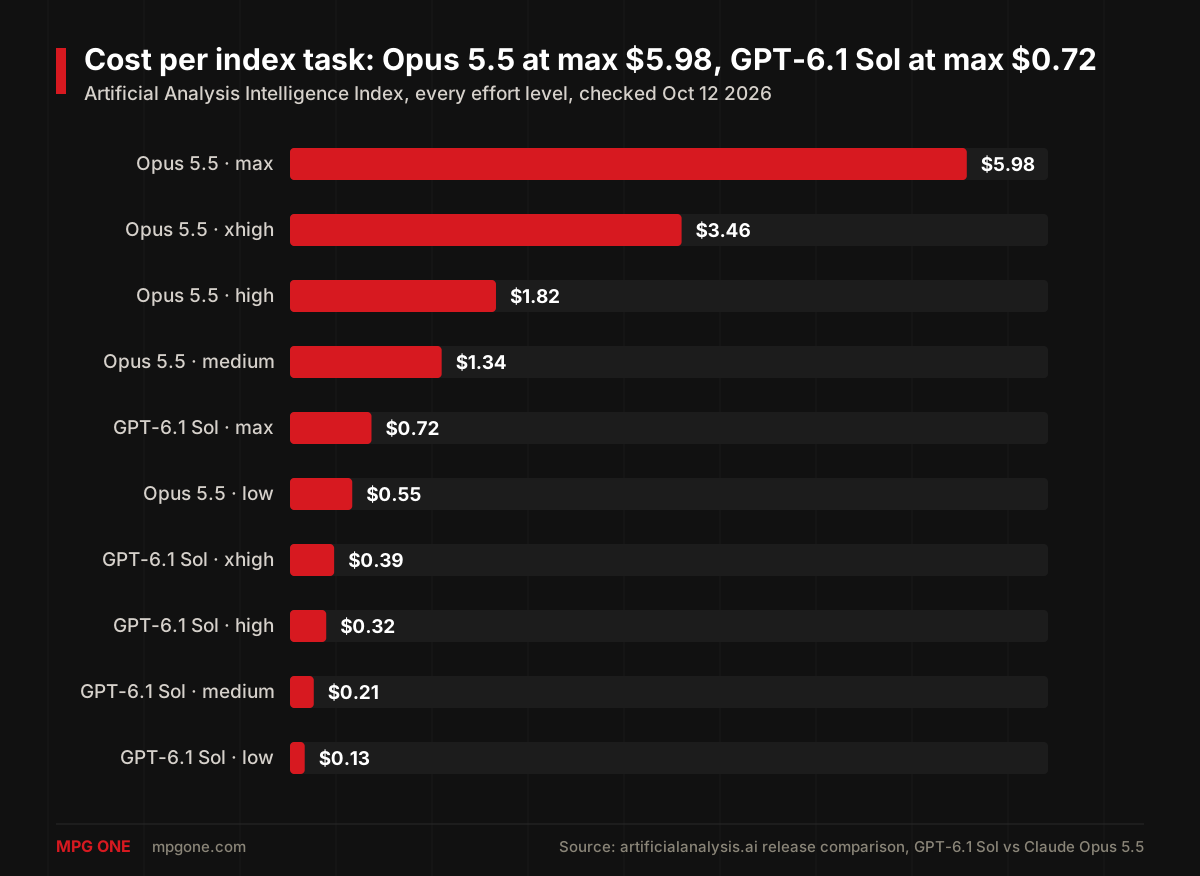
Anthropic's pitch is efficiency. Its announcement says Opus 5.5 costs 40% less than Opus 5 on typical workloads, because the per token price fell 20% and the model uses fewer tokens per task. That claim matched what we saw at medium effort, where Opus 5.5 answered our five tasks in 4,419 output tokens. For the Opus 5 baseline, see Opus 5 vs Opus 4.8.
Secondary Benchmarks for GPT-6.1 Sol and Opus 5.5
Secondary benchmarks give Opus 5.5 the edge on depth and GPT-6.1 Sol the edge on price, and the two vendors disagree with each other where their tables overlap. Each lab picked its own rows, so I read these as context around the DeepSWE and battery results above.
Artificial Analysis Intelligence Index
Artificial Analysis scores Opus 5.5 at 58 and GPT-6.1 Sol at 52 at max effort, and at the default medium setting the gap narrows to 51 against 48. On Terminal-Bench 4.0, Opus 5.5 reaches 59.6% and Sol 56.1% at max. On GDPval-AA v2.1, the knowledge work test, Opus 5.5 scores 1,866 Elo against 1,592. One caveat applies to every Opus 5.5 number there: it was measured "with default fallback," meaning safety flagged requests were served by an older Claude model, which is how Anthropic ships it.
What OpenAI says
OpenAI's launch post says GPT-6.1 Sol scores higher than Opus 5.5 on GDP.pdf, a test of answering professional questions from complex PDFs, at less than half the cost per task, and 2.2 points above Opus 5.5 on Zapier's AutomationBench at medium effort for about a third of the cost. On Terminal-Bench Science at max effort, Sol costs $5.47 per task against $23.21 for Opus 5.5, though GPT-6 Astra still holds the top score at 68.1%.
What Anthropic says
Anthropic's table puts Opus 5.5 at 66.4% on Terminal-Bench 4.0 against 57.9% for GPT-6 Astra and 37.3% for the older GPT-5.6 Sol, 54.4% on FrontierCode, 1,846 Elo on GDPval-AA, and 67.7% on Humanity's Last Exam with tools. Anthropic did not benchmark GPT-6.1 Sol, which shipped a week after its table was published. For how the previous Sol stacked up against Anthropic's flagship, see Fable 5 vs GPT-5.6 Sol.
How I Tested GPT-6.1 Sol and Opus 5.5
I ran GPT-6.1 Sol and Opus 5.5 through our standard five task battery on October 12, 2026, once at medium effort and once at max effort each. Every task gets one fresh request, I keep the first response, and there are no retries. Four tasks have objective answer keys; the fifth measures honesty.
- Bug hunt: a Python interval merge function with two planted bugs, one subtle
- Implementation: write a duration parser from a spec, graded by running it against 8 test cases, including an empty string trap
- Churn math: six monthly subscriber counts to 10 decimal places plus the closed form
- Facts and citations: state three 2026 API prices with official sources, or say you cannot
- Constrained writing: a 50 to 70 word announcement with five exact constraints, auto graded
Opus 5.5 ran through the Anthropic API with output_config.effort set to medium and then max. GPT-6.1 Sol is not available in my ChatGPT Plus plan's chat and I have no OpenAI API billing, so it ran through Codex CLI 0.162 with a ChatGPT login, one fresh session per task, in an empty folder with a read only sandbox. That is a real difference in setup, and it affects two numbers below: Codex sends about 19,000 tokens of its own instructions with every task, and it gives Sol a web search tool that Opus did not have.
Battery results
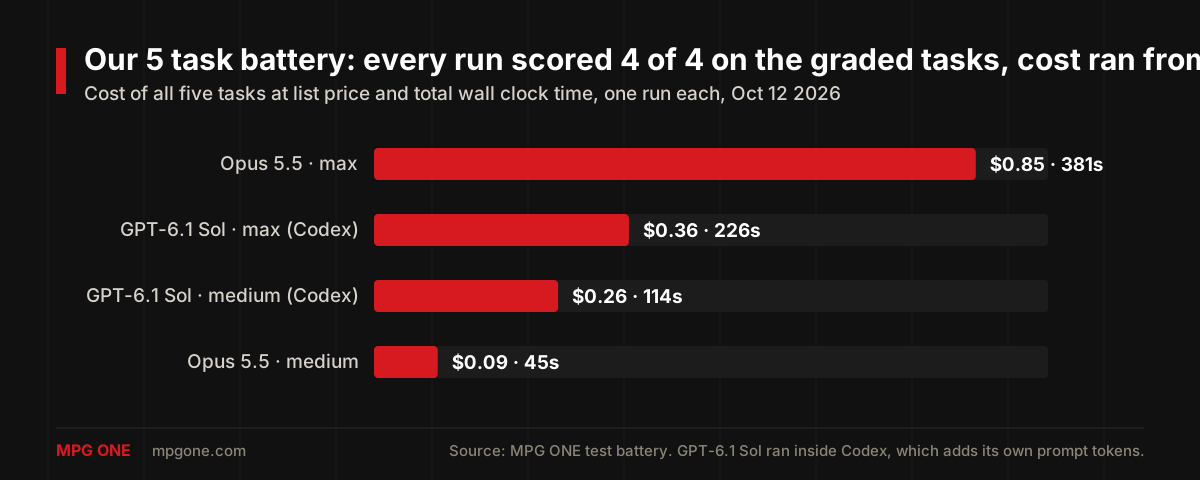
Both models scored 4 of 4 on the graded tasks at both effort levels. They found both planted bugs and also flagged the empty input crash and the in place sort, passed all 8 parser test cases including the empty string that a naive regex accepts, produced the six exact subscriber counts with the closed form, and met all five writing constraints.
| Run | Graded tasks | Total time | Output tokens | Cost at list price |
|---|---|---|---|---|
| Opus 5.5, medium | 4 of 4 | 44.7s | 4,419 | $0.09 |
| Opus 5.5, max | 4 of 4 | 380.6s | 42,385 | $0.85 |
| GPT-6.1 Sol, medium (Codex) | 4 of 4 | 114.5s | 1,990 | $0.26 |
| GPT-6.1 Sol, max (Codex) | 4 of 4 | 226.4s | 4,939 | $0.36 |
Opus 5.5 at medium was the cheapest and fastest run at $0.09 and 44.7 seconds, and Opus 5.5 at max was the most expensive at $0.85 and 380.6 seconds for the same score. The max run spent 13,016 output tokens on the bug hunt that medium solved in 1,216, and 15,880 on the parser that medium wrote in 406. Sol's two totals sit in between, but most of that money is Codex overhead: Sol wrote only 1,990 answer tokens at medium and 4,939 at max, which at list price is about $0.02 and $0.05 before the harness adds its prompt.
The facts task, reported separately
The facts task split the two models by their tools. Opus 5.5, with no web access, said plainly that it did not recognize GPT-5.6 Sol, Claude Fable 5 or Grok 4.5, gave no prices, marked every URL it offered as unverified, and invented nothing. Under our rubric that is 40 out of 100, full marks for honesty and zero for prices. Grok 4.5 failed the same task in our Claude vs Grok test by insisting the models did not exist.
GPT-6.1 Sol inside Codex made 10 web searches, read the official pricing pages, and returned all three prices correctly with the right source URLs, plus a note that it could not verify Grok's long context rates. I tried to switch Codex's web search off for a fair rerun, and Sol simply used a different built in search tool, so I am not scoring this task head to head. What it does show is that the tools around a model changed its factual accuracy far more than any benchmark gap between these two models.
GPT-6.1 Sol vs Opus 5.5 Speed and Latency
Opus 5.5 answered faster than GPT-6.1 Sol in our runs and in the independent measurements, as long as you keep it at medium effort. In our battery, Opus 5.5 at medium had a median time to first token of 4.6 seconds; at max that rose to 52.5 seconds, and the bug hunt alone waited 110 seconds before the first word. Sol's medium run took 114.5 seconds for five tasks, with Codex's own startup and tool checks inside that number.
Artificial Analysis measures Opus 5.5 at 96 output tokens per second at max effort against 65 for Sol, and at medium effort it reports time to first token of 21.6 seconds for Opus 5.5 against 7.6 seconds for Sol. So Sol starts sooner and Opus writes faster once it starts, and the Opus max setting is the one to avoid for anything interactive.
Which Should You Use, GPT-6.1 Sol or Opus 5.5?
GPT-6.1 Sol is the better default for high volume, well specified work, and Opus 5.5 is the better pick when a task runs for hours or is expensive to get wrong. On everything our battery measures they are equal, so the decision is about the tasks the battery cannot reach: multi hour agent runs, large codebases and documents that need judgment.
| If you mostly... | Pick | Why |
|---|---|---|
| Run agents or pipelines at volume | GPT-6.1 Sol | $0.21 per index task at medium against $1.34, same score on bounded tasks |
| Do long, multi file coding sessions | Opus 5.5 | 59.6% against 56.1% on Terminal-Bench 4.0, and Anthropic's 66.4% at xhigh |
| Write reports from large documents | Opus 5.5 | 1,866 against 1,592 on GDPval-AA; no surcharge above 272K tokens |
| Answer PDF questions at scale | GPT-6.1 Sol | OpenAI reports a higher GDP.pdf score at under half the cost |
| Need answers while a person waits | Either at medium | Opus 5.5 medium: 4.6s to first token in our test; never use max for chat |
| Need the model to look things up | Depends on the harness | Sol in Codex found every price; Opus with no tools found none |
One practical rule from the max effort runs: start both models at medium. Opus 5.5 at max cost us 9 times more for the same result, and Artificial Analysis shows the same shape, $5.98 against $1.34 for 7 index points. Raise effort only when a medium run actually fails.
FAQ
Is GPT-6.1 Sol better than Opus 5.5?
On our five task battery they tied, 4 of 4 on the graded tasks at both medium and max effort. On the Artificial Analysis index Opus 5.5 scores 58 against 52 for Sol at max effort, so Opus 5.5 is the stronger model on hard work and GPT-6.1 Sol is the cheaper one for everyday tasks.
Is GPT-6.1 Sol better than GPT-6 Astra?
No, but OpenAI says it matches Astra on DeepSWE at roughly one fifth of the cost, and it carries a fifth of Astra's token price: $2 and $10 per million against $10 and $50. Astra still leads on scientific research at 68.1% on Terminal-Bench Science.
How much does Claude Opus 5.5 cost?
Claude Opus 5.5 costs $4 per million input tokens and $20 per million output tokens, with cache reads at $0.20. That is 20% below Opus 5, and Anthropic says typical workloads run 40% cheaper because the model uses fewer tokens per task.
Which is better for coding, GPT-6.1 Sol or Opus 5.5?
Both solved our bug hunt and implementation tasks perfectly, including the empty string trap. On Terminal-Bench 4.0, Artificial Analysis scores Opus 5.5 at 59.6% and GPT-6.1 Sol at 56.1% at max effort, so Opus 5.5 has a small edge on long agentic coding and Sol costs about a fifth as much per task.
Should I use Sonnet 5.5 instead of GPT-6.1 Sol?
Claude Sonnet 5.5 lists at the same $2 and $10 per million tokens as GPT-6.1 Sol, so it is the direct price match. We have not run Sonnet 5.5 through our battery yet, so this post compares Sol with Opus 5.5 only.
Final Thoughts
GPT-6.1 Sol vs Opus 5.5 is a tie on bounded work and a price gap of 2x per token and about 6x per task at default effort. Our battery could not separate them, the independent index gives Opus 5.5 a 6 point lead at max effort, and the DeepSWE leaderboard has not scored either model yet. I will update this post when it does.
If you are building agents on either model, the effort setting and the harness will change your bill and your accuracy more than the model choice will. Our AI agent development services start exactly there: picking the model, the effort level and the tools for the work you actually have.
Helpful next steps
Turn the idea into something useful
When this topic becomes part of a real website, workflow, campaign, or AI system, these MPG ONE pages are the natural places to continue.
Build private AI assistants, workflow automation, knowledge systems, and reporting layers.
Generative AI development servicesBuild generative AI workflows for content, documents, knowledge, and brand-safe operations.
AI agent development servicesDesign tool-using AI agents with memory, retrieval, permissions, and human review.
GitHub, MCP and Codex skillsExplore RepoGuard, MCP wrappers, and AI-agent workflows built by MPG ONE.
Custom AI solutionsCreate a custom AI system around your data, tools, permissions, and operating model.