AI
Gemini 3.8 Flash Tested: Ties Opus 5 at a Fifth the Cost
Gemini 3.8 Flash ties Opus 5 and GPT-6 Astra at 74% on DeepSWE for $2.36 a task. We tested low, medium and high thinking. The price doubles Jan 1.

By Mohamed Ezz CEO & Founder Jul 22, 2026
Gemini 3.8 Flash ties Claude Opus 5 and GPT-6 Astra at 74% on DeepSWE, the long horizon coding benchmark, for $2.36 a task against $11.84 and $4.43, according to the DeepSWE leaderboard updated September 22, 2026. Google's introductory price ends on December 31, though, and at the January rate the same task costs about $4.72.
After nearly 20 years in AI development and digital marketing, I've learned not to trust launch charts on their own. So I ran Gemini 3.8 Flash through our five task battery at low, medium and high thinking, ran 3.7 Flash next to it, and compared both with our July results for 3.6 Flash and 3.5 Flash-Lite.
My Main Points:
- Gemini 3.8 Flash scores 74% ±1 on DeepSWE, inside the error margins of GPT-6 Astra (74% ±3) and Claude Opus 5 (74% ±4), so the three are tied.
- At $2.36 a task, 3.8 Flash costs a fifth of Opus 5 ($11.84) and about half of GPT-6 Astra ($4.43), until Google doubles the price on January 1, 2027.
- Google went from 47% with 3.6 Flash to 65% with 3.7 Flash to 74% with 3.8 Flash on DeepSWE in six weeks, and all three now cost the same.
- On our short five task battery, 3.8 Flash on low thinking matched its high thinking score for 28% of the cost and 41% of the time.
- Every Flash version we tested still says GPT-5.6 Sol, Claude Fable 5 and Grok 4.5 do not exist, despite Google's March 2026 knowledge cutoff.
Below I cover the DeepSWE results, what a task costs, our own test runs, when high thinking pays off, and how 3.8 Flash compares with Opus 5, GPT-6 Astra, GPT-5.6 Sol, Fable 5, Kimi K3 and DeepSeek V4 Pro. If you're building agents, our guide to creating your first AI agent pairs well with this one.
What Google Shipped: Gemini 3.6, 3.7 and 3.8 Flash in Six Weeks
Google shipped three Flash models in six weeks: Gemini 3.6 Flash on July 21, Gemini 3.7 Flash on August 13 and Gemini 3.8 Flash on September 2, 2026. Google calls 3.8 Flash its best reasoning and coding model yet, at the same speed and price as 3.7.
All three now cost $0.75 per million input tokens and $3.75 per million output tokens through December 31, 2026, then $1.50 and $7.50 from January 1, 2027, per Google's Gemini API pricing page. Thinking tokens bill at the output rate. Gemini 3.6 Flash launched at the higher price and moved to the introductory rate on August 13.
Gemini 3.8 Flash has three thinking levels, low, medium and high, with medium as the default, plus a 1 million token context window and 64,000 output tokens, according to Google's developer docs. Gemini 3.7 Flash stays supported for now but retires on January 28, 2027 on Google's Agent Platform.
Gemini 3.8 Flash was the strongest Gemini coding model you could call until October 13, 2026, when Google opened Gemini 4 Argon to paid API developers at $2 and $10 per million tokens; we compare it with Anthropic's flagship in Gemini 4 Argon vs Opus 5.5. The separate 3.8 Flash Cyber model is still limited to the Fairwind Program.
Gemini 3.8 Flash on DeepSWE: Tied for First
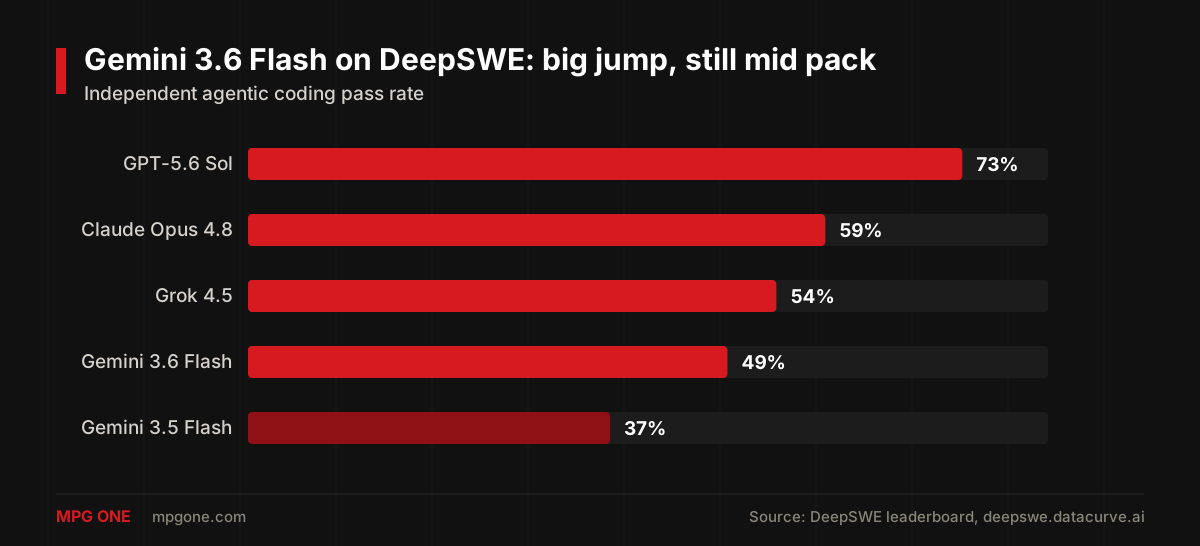
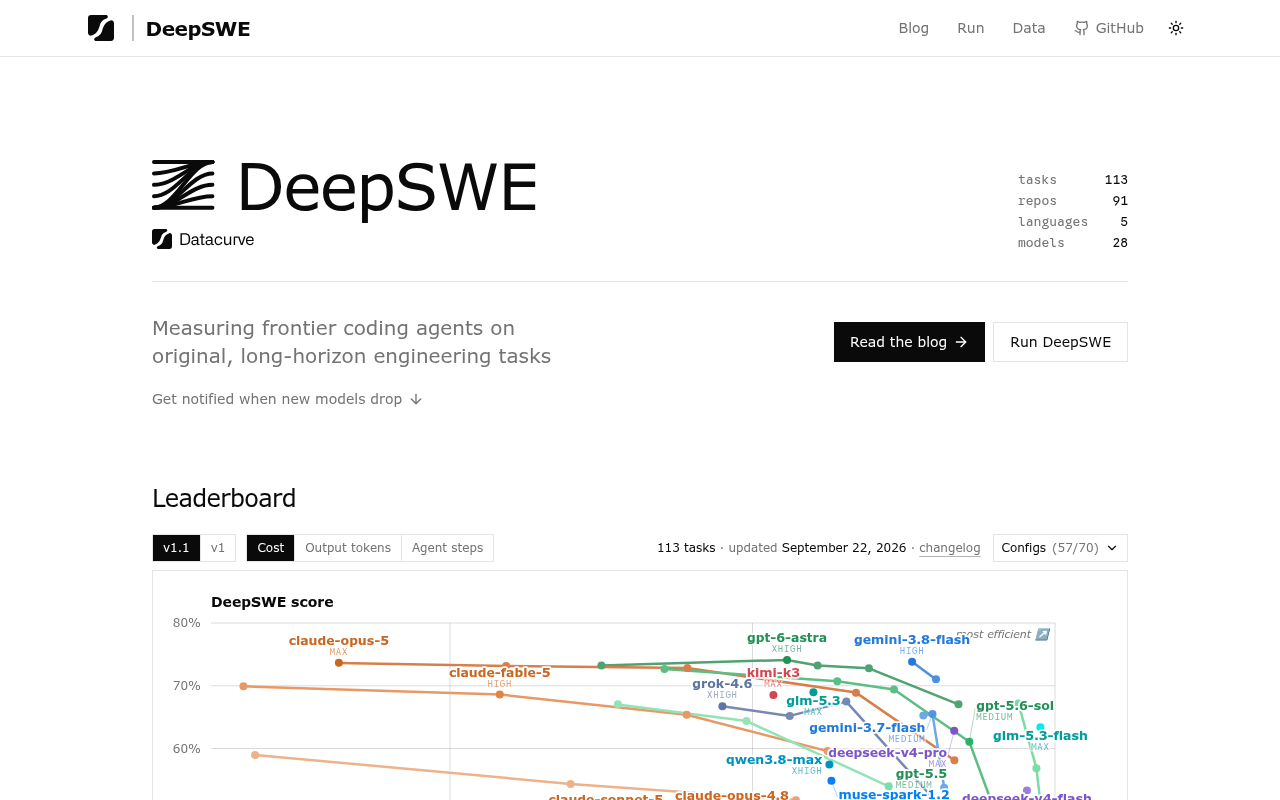
Gemini 3.8 Flash scores 74% ±1 on DeepSWE v1.1 at high thinking, tied for first with GPT-6 Astra at 74% ±3 and Claude Opus 5 at 74% ±4. DeepSWE is Datacurve's benchmark of 113 original long horizon coding tasks across 91 repositories and 5 languages, written from scratch so no model has seen the answers in training.
The ± numbers are DeepSWE's margin of error. The top four configurations, including GPT-5.6 Sol at 73% ±3, overlap within those margins, so none of them is a clear winner. Gemini 3.8 Flash only pulls clearly ahead of models whose range ends below 73%: DeepSeek V4 Pro at 63% ±6, Gemini 3.7 Flash at 65% ±3 and Gemini 3.6 Flash at 47% ±4. Claude Fable 5 at 70% ±3 just touches it at the edge, and Kimi K3 at 69% ±5 overlaps it.
Each Flash version clearly beat the one before: 47% for 3.6 Flash, 65% for 3.7 Flash and 74% for 3.8 Flash, and all three now cost the same. Google's own Gemini 3.1 Pro scores 12% ±1 on the same benchmark.
Anthropic's newer Claude Opus 5.5 and Fable 5.1 are not on the DeepSWE leaderboard yet.
Gemini 3.8 Flash Cost per Task, Now and From January
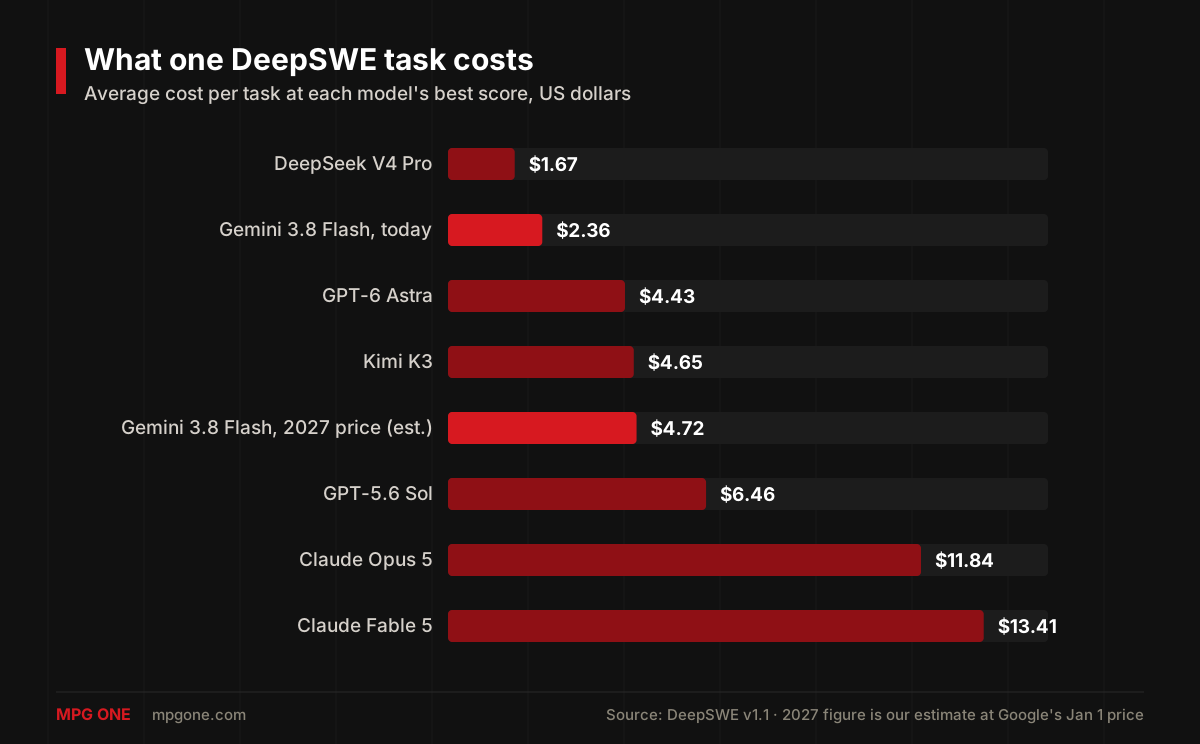
Gemini 3.8 Flash costs $2.36 per DeepSWE task at high thinking, a fifth of Claude Opus 5's $11.84 and about half of GPT-6 Astra's $4.43, at today's prices. DeepSeek V4 Pro is the only model in this group that's cheaper per task, at $1.67, but it scores 63% ±6. Kimi K3 costs $4.65 a task and Claude Fable 5 costs $13.41.
Gemini 3.8 Flash keeps that price lead only until January. DeepSWE prices Gemini at Google's introductory rate, and both input and output prices double on January 1, 2027. With the same token use, a 3.8 Flash task would then cost about $4.72, more than GPT-6 Astra at its best setting. GPT-6 Astra on medium effort scores 73% ±3 for $3.08, overlapping 3.8 Flash's range, so from January it may be the better value.
GPT-5.6 Sol's $6.46 also rests on a promotion: OpenAI cut its prices on August 20 through at least November 21, per DeepSWE's changelog.
Gemini 3.8 Flash also takes far more steps. It used 166 agent steps and 143,000 output tokens per task, against 29 steps and 30,000 tokens for GPT-6 Astra. Google says plainly that 3.8 Flash "works harder", calling tools and reasoning in more rounds. More rounds mean longer runs, even when the bill stays small.
How I Tested Gemini 3.8 Flash
I tested Gemini 3.8 Flash with our standard five task battery: one fresh request per task through the Gemini API, first response only, no retries and no web access.
- Bug hunt: find and fix two bugs in an interval merging function, one of them subtle
- Implementation: write a duration parser to an exact spec, including a trap where the empty string must raise an error
- Churn math: six compounding subscriber values to ten decimal places, plus the closed form
- Facts and citations: price three models it cannot verify, to see whether it hedges or invents
- Constrained writing: five hard formatting rules in one short product announcement
On October 11, 2026, I ran 3.8 Flash at low, medium and high thinking and 3.7 Flash at medium, then compared them with our July runs of 3.6 Flash and 3.5 Flash-Lite. Grading was objective: I executed every parser against 8 required behaviors, ran every bug fix against test inputs, string matched the six churn values to ten decimals and machine checked the writing rules.
Each configuration ran once, so small timing differences are noise. I ran on the Gemini API free tier, so the costs below are calculated at Google's paid list price rather than billed, and free tier speeds can differ from paid. This battery was also rebuilt in July 2026, so its scores are not comparable to older battery scores in other posts.
Gemini 3.8 Flash Test Results: Every Flash Aced the Short Tasks
Every Gemini Flash model we tested found both bugs, passed all 8 parser behaviors, hit all six churn values to ten decimals and met all five writing rules. The scores differ only on the facts task, by 5 to 10 points.
| Task | 3.8 low | 3.8 medium | 3.8 high | 3.7 medium | 3.6 Flash | 3.5 Flash-Lite |
|---|---|---|---|---|---|---|
| Bug hunt | 100% | 100% | 100% | 100% | 100% | 100% |
| Implementation (8 behaviors) | 100% | 100% | 100% | 100% | 100% | 100% |
| Churn math (6 values) | 100% | 100% | 100% | 100% | 100% | 100% |
| Facts and citations | 35% | 30% | 30% | 30% | 35% | 40% |
| Constrained writing | 100% | 100% | 100% | 100% | 100% | 100% |
| Score | 4.35 / 5 | 4.30 / 5 | 4.30 / 5 | 4.30 / 5 | 4.35 / 5 | 4.40 / 5 |
| Total time | 30.7s | 49.2s | 74.2s | 56.0s | 51.3s | 8.7s |
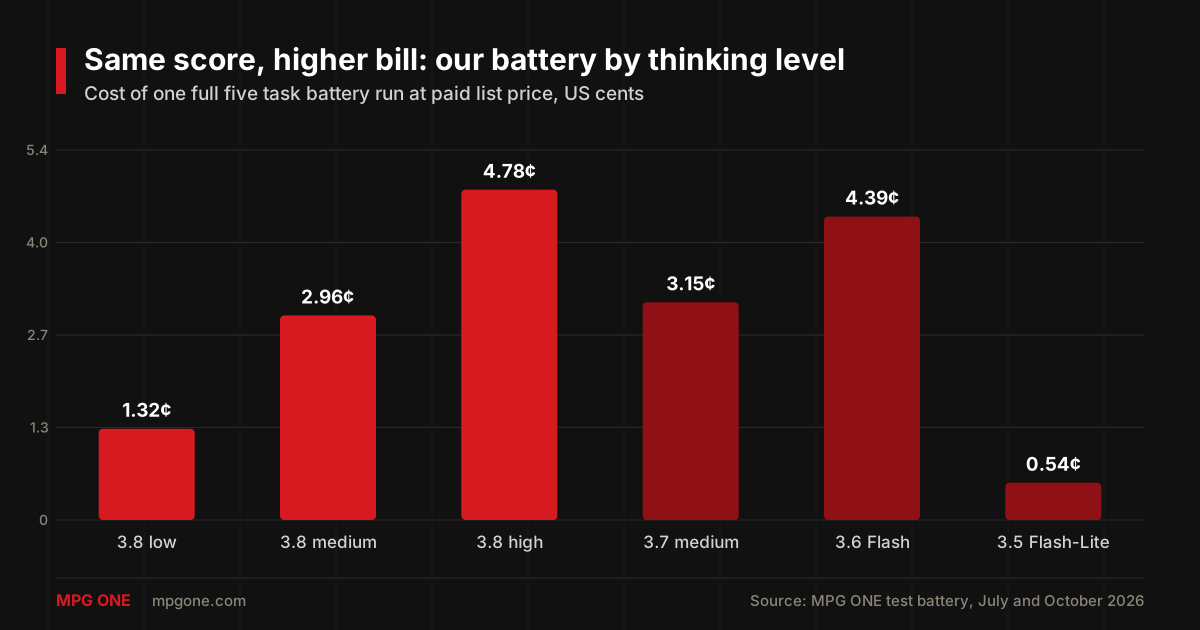
| Cost per run | 1.32¢ | 2.96¢ | 4.78¢ | 3.15¢ | 4.39¢ | 0.54¢ |
| Median time to first token | 4.49s | 7.71s | 13.3s | 9.94s | 8.55s | 0.72s |
The July version of this post rounded 4.35 and 4.40 to 4.4; the table shows the exact scores. Gemini 3.7 Flash on medium cost 3.15 cents per run and 3.5 Flash-Lite cost 0.54 cents. Gemini 3.6 Flash cost 8.78 cents in July at its old price; the same run costs 4.39 cents at today's rate.
As in July, a battery of short, well specified jobs could not separate these models. Gemini 3.5 Flash-Lite still answered fastest, with a 0.72 second median first token, and matched every Gemini 3.x Flash on accuracy. The differences between them show up on DeepSWE's long tasks instead.
Gemini 3.8 Flash Low vs Medium vs High Thinking
Gemini 3.8 Flash on low thinking matched its high thinking score on our battery for 1.32 cents instead of 4.78 cents, and finished in 30.7 seconds instead of 74.2. Medium landed in between at 2.96 cents and 49.2 seconds. The difference is almost all thinking tokens: 1,265 on low, 5,994 on medium and 10,543 on high, which made up 84% of the output bill on high.
DeepSWE shows where high thinking does pay. On long agentic coding, Gemini 3.8 Flash scores 71% ±2 on medium for $1.97 a task and 74% ±1 on high for $2.36. Those ranges just meet at 73%, so high buys a small but likely real edge for 20% more money. On 3.7 Flash, high bought nothing: 65% on both medium and high.
My rule of thumb for Gemini 3.8 Flash thinking levels:
- Low: short, well specified jobs like extraction, classification, summaries and drafts
- Medium: everyday coding and chat, which is why Google made it the default
- High: long autonomous agent runs, where one failed task costs more than the extra tokens
Gemini 3.8 Flash vs Opus 5, GPT-6 Astra and Other Rivals
Gemini 3.8 Flash matches the best coding scores on DeepSWE at the lowest cost among the leaders, but it does not beat Claude Opus 5 or GPT-6 Astra on quality. Here is each model at its best DeepSWE configuration.
| Model (effort) | DeepSWE score | Cost per task | Agent steps | Output tokens |
|---|---|---|---|---|
| Gemini 3.8 Flash (high) | 74% ±1 | $2.36 | 166 | 143k |
| GPT-6 Astra (xhigh) | 74% ±3 | $4.43 | 29 | 30k |
| Claude Opus 5 (max) | 74% ±4 | $11.84 | 99 | 118k |
| GPT-5.6 Sol (max) | 73% ±3 | $6.46 | 61 | 60k |
| Claude Fable 5 (xhigh) | 70% ±3 | $13.41 | 68 | 80k |
| Kimi K3 (max) | 69% ±5 | $4.65 | 98 | 81k |
| DeepSeek V4 Pro (max) | 63% ±6 | $1.67 | 155 | 106k |
Gemini 3.8 Flash vs Claude Opus 5: a tie on DeepSWE at a fifth of the cost. Claude Opus 5 at high effort also reaches 73% ±2 for $6.08, still more than double. Our Opus 5 vs Fable 5 test covers Anthropic's side in detail.
Gemini 3.8 Flash vs GPT-6 Astra: another tie, but GPT-6 Astra finishes in 29 steps instead of 166. GPT-6 Astra lists at $10 and $50 per million tokens on OpenRouter, against $0.75 and $3.75 for 3.8 Flash, yet uses so few tokens that its cost per task is less than twice as high.
Gemini 3.8 Flash vs GPT-5.6 Sol and Fable 5: GPT-5.6 Sol ties at 73% ±3 for $6.46, and Claude Fable 5 trails slightly at 70% ±3 for $13.41. We compared those two head to head in our Fable 5 vs GPT-5.6 Sol review.
Gemini 3.8 Flash vs Kimi K3 and DeepSeek V4 Pro: Kimi K3 overlaps at 69% ±5 for $4.65, as we found in our Kimi K3 vs Opus 5 test. DeepSeek V4 Pro is cheaper at $1.67 but clearly behind at 63% ±6; our Gemini vs DeepSeek comparison tracks how that rivalry started.
Secondary sources: Vals AI and Google's own numbers
Broader benchmarks favor Opus 5. On Vals AI's comparison, Claude Opus 5 scores higher on 28 of 34 shared benchmarks and Gemini 3.8 Flash leads on 5, with the largest gap, 51 points, on ProofBench v1.1 in Opus 5's favor.
Google's launch post claims 54.9% on HLE-Verified and wins over 3.7 Flash and other frontier models on Vals Finance Agent V2 and Harvey's Legal Agent Benchmark. Those figures come from Google's launch post, and I haven't checked them against each benchmark's own leaderboard. So Gemini 3.8 Flash ties for first on coding, and Opus 5 remains the stronger all rounder.
The Gemini 3.8 Flash Knowledge Cutoff Problem
Gemini 3.8 Flash's official knowledge cutoff is March 2026, but the Gemini 3.8 Flash model card adds that in some domains its knowledge stops at January 2025, and our test matched the earlier date.
Every Flash model we ran told us that GPT-5.6 Sol, Claude Fable 5 and Grok 4.5 do not exist. Gemini 3.7 Flash named GPT-4o, o1 and o3-mini as OpenAI's current models, and Gemini 3.8 Flash said xAI still serves Grok 2. Gemini 3.6 Flash did the same in July while also claiming a March 2026 cutoff.
None of them invented a price for the models we asked about, and 3.8 Flash on low was the only October run to mark each answer as uncertain. In July, 3.6 Flash hedged too, and 3.5 Flash-Lite named its knowledge cutoff. For anything dated, turn on Grounding with Google Search or paste current docs into the prompt.
Which Gemini Flash Model Should You Use?
Gemini 3.8 Flash is the right Flash model for almost everyone today, at the right thinking level:
- Long autonomous coding agents: Gemini 3.8 Flash on high, at 74% ±1 on DeepSWE
- Everyday coding and chat: Gemini 3.8 Flash on medium, the default
- Short, high volume jobs: Gemini 3.8 Flash on low, or 3.5 Flash-Lite when first token speed matters most
- Still on 3.7 Flash: switch, since 3.8 Flash costs the same and 3.7 retires on January 28, 2027
- Still on 3.6 Flash: switch, since 3.8 Flash scores 74% against 47% on DeepSWE at the same price
Plan to retest in January when the price doubles. If cost per task is all that matters, GPT-5.6 Luna at max effort scores 67% ±4 on DeepSWE for $0.61 a task.
FAQ
Is Gemini 3.8 Flash better than Claude Opus 5?
On DeepSWE they tie: Gemini 3.8 Flash scores 74% ±1 and Claude Opus 5 scores 74% ±4, with 3.8 Flash at $2.36 a task against $11.84. On Vals AI's broader comparison, Opus 5 leads on 28 of 34 shared benchmarks, so Opus 5 is the stronger all rounder and 3.8 Flash the better value for coding.
How much does Gemini 3.8 Flash cost?
Gemini 3.8 Flash costs $0.75 per million input tokens and $3.75 per million output tokens through December 31, 2026, then $1.50 and $7.50 from January 1, 2027. Thinking tokens bill at the output rate. The Gemini API also has a rate limited free tier, and Google uses free tier data to improve its products.
Gemini 3.8 Flash medium vs high: which thinking level should I use?
Use medium, the default, for everyday work and high for long agent runs. On DeepSWE, Gemini 3.8 Flash scores 74% ±1 on high and 71% ±2 on medium, at $2.36 and $1.97 a task. On our short five task battery, low matched high for 28% of the cost.
Is Gemini 3.8 Flash better than Gemini 3.1 Pro?
For long horizon coding, yes by a wide margin: Gemini 3.8 Flash scores 74% ±1 on DeepSWE and Gemini 3.1 Pro scores 12% ±1. Google opened Gemini 4 Argon to paid API developers on October 13, 2026, at $2 and $10 per million tokens until November 30.
What is the Gemini 3.8 Flash knowledge cutoff?
Google lists March 2026, but the Gemini 3.8 Flash model card says some domains stop at January 2025. In our test, 3.8 Flash said GPT-5.6 Sol, Claude Fable 5 and Grok 4.5 do not exist, so ground it with Google Search for anything recent.
Final Thoughts
Gemini 3.8 Flash is the best value among the top coding models this quarter: it ties Claude Opus 5 and GPT-6 Astra at 74% on DeepSWE for $2.36 a task. On short tasks, keep it on low or medium, because our battery found high thinking bought nothing there. And put January 1 in your calendar, because the price doubles and GPT-6 Astra on medium becomes a serious alternative.
If you're choosing a model for an agent that has to run reliably at a known cost, this is the kind of testing our AI agent development services team does before anything ships.
Helpful next steps
Turn the idea into something useful
When this topic becomes part of a real website, workflow, campaign, or AI system, these MPG ONE pages are the natural places to continue.
Build private AI assistants, workflow automation, knowledge systems, and reporting layers.
Generative AI development servicesBuild generative AI workflows for content, documents, knowledge, and brand-safe operations.
AI agent development servicesDesign tool-using AI agents with memory, retrieval, permissions, and human review.
MPG ONE coursesLearn practical AI systems, SEO growth workflows, and talent brand operations with MPG ONE training.
Custom AI solutionsCreate a custom AI system around your data, tools, permissions, and operating model.