AI
Claude Opus 5 vs Fable 5: The Cheaper Model Won
Claude Opus 5 vs Fable 5: Opus 5 scores higher on DeepSWE at half the price. See the benchmarks, the real costs, and which one to buy.

By Mohamed Ezz CEO & Founder Jul 25, 2026
Anthropic released Claude Opus 5 on July 24, 2026, and the independent numbers landed the same way Anthropic's own did: the cheaper model now scores higher than the expensive one. On DeepSWE, Opus 5 posts a 74% pass rate against Fable 5's 70%, at half the API price.
The short answer: for most work, Opus 5 is now the better buy. It matches or beats Fable 5 on every public benchmark I can verify while costing $5 and $25 per million tokens instead of $10 and $50. Fable 5 is still an excellent model. It is just no longer the obvious default.
One caveat up front, because it matters. The 4 point gap on DeepSWE sits inside both models' margin of error, so this is not a rout on capability. What is not inside any margin of error is the price.
My Main Points:
- Opus 5 ranks first on DeepSWE at 74%, with Fable 5 at 70% and GPT-5.6 Sol at 73%
- Those three are statistically tied once you account for the error bars, so read it as parity, not dominance
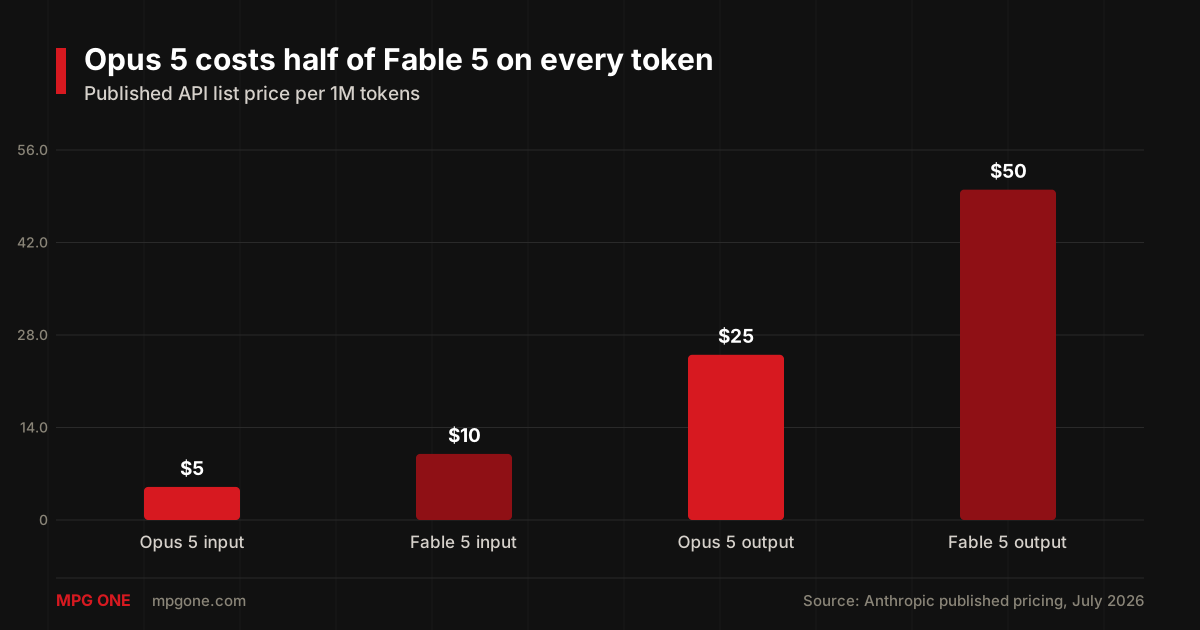
- Opus 5 costs half of Fable 5 per token, $5 and $25 against $10 and $50
- It also costs less per finished task, $11.84 against $21.63 on the same benchmark
- Anthropic's own figures agree: near equal scores at a third to a half of the cost
- Fable 5 keeps a real edge in a few places, including always on thinking and the hardest long horizon work
After nearly 20 years in AI development and digital marketing, I have watched a lot of launches claim a new leader. What makes this one worth your attention is not the top line score, it is that the price moved in the opposite direction from the capability. In this comparison I will show you what the independent benchmark says, what the two models actually cost to run, where Fable 5 still wins, and which one belongs in your stack. For how Fable 5 stacked up against its previous rival, see our test of Fable 5 vs GPT-5.6 Sol.
What Anthropic Shipped
Claude Opus 5 arrived on July 24, 2026, available immediately across Claude.ai, the Claude API, Claude Code, and Claude Cowork. It is the default model on Claude Max and the strongest model available on Claude Pro. The API model ID is claude-opus-5.
The headline detail is what did not change. Opus 5 ships at exactly the same price as Opus 4.8 before it.
| Model | Input per 1M | Output per 1M | Context window |
|---|---|---|---|
| Claude Opus 5 | $5 | $25 | 1M tokens |
| Claude Fable 5 | $10 | $50 | 1M tokens |
Same context window, half the price. That framing is the whole comparison, and it only holds up if the capability holds up too. So let us check that first.
The DeepSWE Verdict
For model comparisons I lead with DeepSWE, because it uses newly written tasks and hand written verifiers, which makes it much harder to contaminate than benchmarks that have been circulating for years. It also publishes cost per run alongside the score, so you can judge value on the same data.
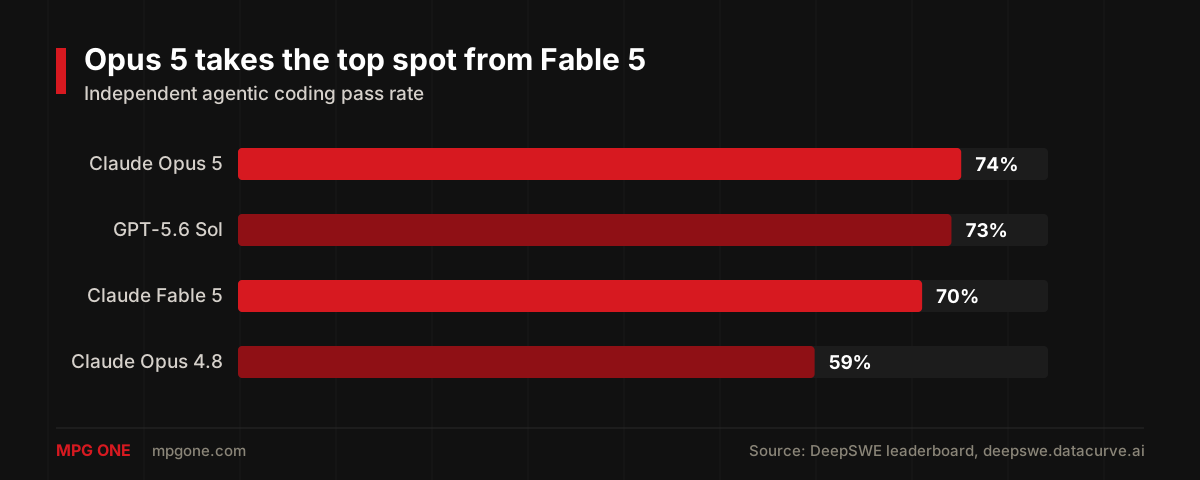
Claude Opus 5 sits at the top of the leaderboard with a 74% pass rate. Fable 5 is at 70%, and OpenAI's GPT-5.6 Sol is at 73%. Opus 4.8, the model Opus 5 replaces, is far back at 59%.
Now the honest reading. Opus 5's score carries a margin of error of 4 points, and Fable 5's carries the same. GPT-5.6 Sol's is 3 points. Once you overlay those, the top three models overlap completely. Anyone telling you Opus 5 decisively beat Fable 5 at coding is reading the ranking and ignoring the error bars.
What you can say with confidence is that Opus 5 performs at the same level as models that cost considerably more, and that it is a large, unambiguous jump over Opus 4.8. A 15 point gap between 59% and 74% is well outside the error bars in a way the Fable 5 comparison is not.
The Price Gap Is the Real Story
If the capability is roughly tied, then cost decides it. Here the two models are not close at all.
Sticker price is only half the picture though. A cheaper model that needs more tokens to finish the same job can easily cost more in practice. DeepSWE measures that directly, by reporting the average spend per completed task.
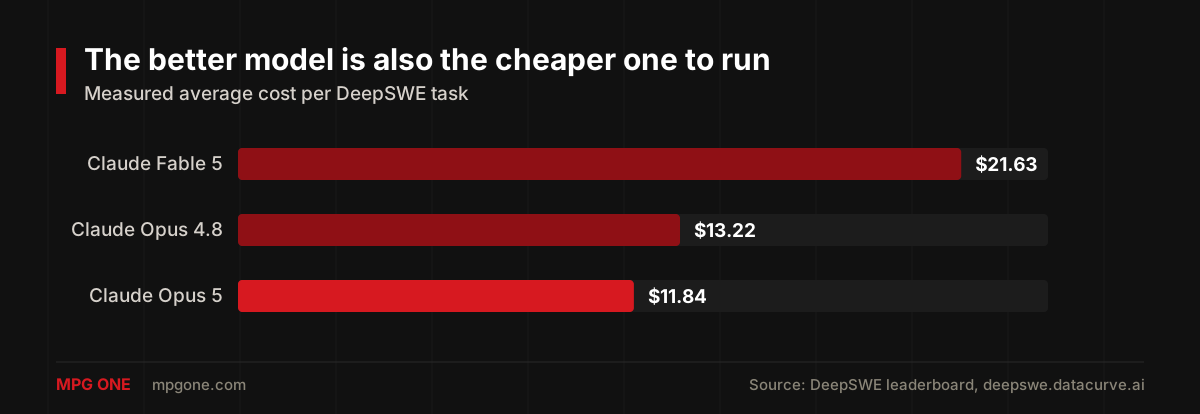
Opus 5 finishes the average DeepSWE task for $11.84. Fable 5 spends $21.63 on the same work. That is a 45% saving on real, measured usage, not a projection from the rate card.
It also beats the model it replaces on cost. Opus 4.8 spent $13.22 per task to score 59%, so Opus 5 is both cheaper per task and 15 points more accurate. That combination is rare enough to be worth saying plainly: on this benchmark, there is no argument for staying on Opus 4.8.
If you are budgeting an agent workload, remember the model bill is only one line of the total. Our guide to AI agent development cost breaks down the retrieval, monitoring, and maintenance costs that usually dwarf it.
What Anthropic Claims
Everything above comes from an independent leaderboard. Anthropic also published its own figures, and I am labeling them clearly as vendor reported, because a company grading its own model is not the same as a third party doing it.
Their launch announcement makes four claims that bear directly on this comparison:
| Benchmark | Anthropic's claim |
|---|---|
| CursorBench 3.2 | Within 0.5% of Fable 5's peak score, at half the cost per task |
| OSWorld 2.0 | Surpasses Fable 5's best result at just over a third of the cost |
| Frontier-Bench v0.1 | Surpasses all other models, and more than doubles Opus 4.8 |
| ARC-AGI 3 | Three times as high as the next best model |
Notice how closely the first two track the independent picture: near equal capability, dramatically lower cost. When a vendor's own framing and a third party leaderboard tell the same story, that story is usually true.
Anthropic also reports gains outside coding, with organic chemistry accuracy 10.2 percentage points above Opus 4.8 and protein prediction 7.7 points higher, plus its best score yet on internal behavioral audits for alignment. Those are harder for anyone outside the company to verify, so weigh them accordingly.
Where Fable 5 Still Wins
None of this makes Fable 5 obsolete, and I would be overselling the result if I implied otherwise. Three things still favor it.
The hardest long horizon work. Fable 5 remains Anthropic's most capable widely released model, built for the most demanding reasoning and the longest autonomous runs. Benchmarks measure a sample of tasks, not your task. If your workload sits at the extreme end of difficulty, test both before assuming the cheaper model holds up.
Always on thinking. Fable 5 thinks on every request and cannot be told not to. That is a constraint on paper and a feature in practice, because it removes an entire category of configuration mistake. Opus 5 lets you disable thinking at lower effort settings, which is useful for latency but is one more thing to get wrong.
A known quantity. Fable 5 has been in production long enough for teams to have tuned prompts around it. Opus 5 is two days old. If you have a heavily tuned Fable 5 pipeline, the migration is real work, and the right time to do it is after you have measured the gain on your own evaluations.
There is one place the comparison flips entirely. Fable 5 requires 30 day data retention and is not available to organizations running under zero data retention. If that describes your compliance setup, Fable 5 was never an option and Opus 5 is the upgrade you have been waiting for.
Which One Should You Buy?
Three clear cases came out of the numbers.
Choose Opus 5 for almost everything. Equal published capability at half the price, and lower measured cost per finished task. For coding, agents, and general knowledge work, this is now the default. If you build on Claude Code, our Claude Code guide covers getting the most out of it.
Choose Fable 5 when your own tests say so. Not when the marketing says so. Run your real workload through both, measure accuracy and total cost, and let that decide. The gap is small enough that workload specifics will swing it either way.
Upgrade from Opus 4.8 immediately. Same price, 15 more points on DeepSWE, and a lower cost per task. There is no version of this decision where staying put wins, though two API changes can break working code on the way over. Our Claude Opus 5 vs Opus 4.8 comparison covers the audit to run first.
The broader lesson is one our testing keeps repeating: the most expensive model is not automatically the best one, and the only way to know is to run your own workload through the options. That applies outside Anthropic too, and our comparison of Kimi K3 against Opus 5 found an open weight challenger landing within five points at a third of the cost per task. We saw the same pattern testing Gemini 3.6 Flash against its cheaper sibling, where the budget model matched the premium one outright. If you want a rigorous methodology for that kind of test, our Claude vs Grok comparison lays out the five task battery we use.
FAQ
Is Claude Opus 5 better than Fable 5?
On the DeepSWE benchmark Opus 5 scores 74% against Fable 5's 70%, but both carry a 4 point margin of error, so treat them as roughly equal on coding. The clear difference is price: Opus 5 costs half as much per token and about half as much per task.
How much does Claude Opus 5 cost?
$5 per million input tokens and $25 per million output tokens, the same as Opus 4.8. Fable 5 costs $10 and $50 for the same volumes, so Opus 5 is half the price on both sides.
Should I switch from Fable 5 to Opus 5?
For most work, yes. Opus 5 matches or beats Fable 5 on the public benchmarks at half the cost. Stay on Fable 5 only if your own tests show it winning on your specific workload, or if you need its always on thinking behavior.
What is the difference between Claude Opus 5 and Fable 5?
Price is the biggest one: $5 and $25 per million tokens versus $10 and $50. Fable 5 keeps thinking on at all times and cannot be used under zero data retention. Opus 5 lets you turn thinking off at lower effort settings and has no retention requirement.
Is Fable 5 still worth using?
It remains one of the most capable models available and is worth testing on the hardest long horizon reasoning. But it is no longer the automatic pick, because a cheaper model in the same family now matches it on published benchmarks.
Final Thoughts
Claude Opus 5 versus Fable 5 is not the blowout the leaderboard position suggests. The two models are statistically tied on the benchmark I trust most, and anyone claiming otherwise is ignoring the error bars. What is not tied is the bill: half the price per token, and 45% less per finished task.
That makes the decision easy for most teams and interesting for the rest. Buy Opus 5 by default, keep Fable 5 on the shortlist for your hardest problems, and settle it with your own numbers rather than anyone's launch post. If you want a partner to run that evaluation and wire the right model into your product, our AI development services team does exactly that, starting from your workload instead of the leaderboard.
Helpful next steps
Turn the idea into something useful
When this topic becomes part of a real website, workflow, campaign, or AI system, these MPG ONE pages are the natural places to continue.
Build private AI assistants, workflow automation, knowledge systems, and reporting layers.
Generative AI development servicesBuild generative AI workflows for content, documents, knowledge, and brand-safe operations.
AI agent development servicesDesign tool-using AI agents with memory, retrieval, permissions, and human review.
Custom AI solutionsCreate a custom AI system around your data, tools, permissions, and operating model.
GitHub, MCP and Codex skillsExplore RepoGuard, MCP wrappers, and AI-agent workflows built by MPG ONE.