AI
Claude Opus 5 vs Opus 4.8: Same Price, Big Jump
Claude Opus 5 vs Opus 4.8: 15 points higher on DeepSWE, cheaper per task, same price. See the numbers and the breaking changes before you upgrade.

By Mohamed Ezz CEO & Founder Jul 25, 2026
Here is the rare launch where the upgrade math takes about ten seconds. Claude Opus 5 scores 74% on the DeepSWE benchmark against 59% for Opus 4.8, finishes the average task for less money, and ships at exactly the same price per token. Anthropic released it on July 24, 2026.
The short answer: upgrade. This is not a close call, and unlike most model comparisons the improvement is comfortably outside the margin of error. What deserves your attention is not whether to switch, but the two API changes that can quietly break working code on the way over.
My Main Points:
- Opus 5 scores 74% on DeepSWE against 59% for Opus 4.8, a 15 point jump
- That gap sits well outside both error bars, so it is a real improvement, not benchmark noise
- Pricing is identical at $5 and $25 per million tokens
- It is also cheaper per finished task, $11.84 against $13.22
- Thinking is now on by default, which can raise your bill and truncate responses if max_tokens is tight
- Disabling thinking above high effort now returns an error, so audit any code that does it
After nearly 20 years in AI development and digital marketing, I have learned to be suspicious of upgrades that arrive with a price increase attached. This one does not have one. In this comparison I will show you what the independent benchmark measures, what the two models actually cost to run, what Anthropic reports beyond coding, and exactly what to check in your code before you flip the model string. If you are also weighing the tier above, see our comparison of Claude Opus 5 vs Fable 5.
What Changed
Claude Opus 5 arrived on July 24, 2026, available immediately on Claude.ai, the Claude API, Claude Code, and Claude Cowork. It is the default model on Claude Max and the strongest model available on Claude Pro. The API model ID is claude-opus-5.
The parts that did not change matter as much as the parts that did.
| Claude Opus 4.8 | Claude Opus 5 | |
|---|---|---|
| Input per 1M tokens | $5 | $5 |
| Output per 1M tokens | $25 | $25 |
| Context window | 1M tokens | 1M tokens |
| Max output | 128K tokens | 128K tokens |
| DeepSWE pass rate | 59% | 74% |
| Cost per DeepSWE task | $13.22 | $11.84 |
Same price, same context window, same output ceiling, meaningfully better results. That is the whole upgrade case in one table.
The DeepSWE Numbers
For model comparisons I lead with DeepSWE, because it uses newly written tasks and hand written verifiers, which makes it far harder to contaminate than benchmarks that have been circulating for years.
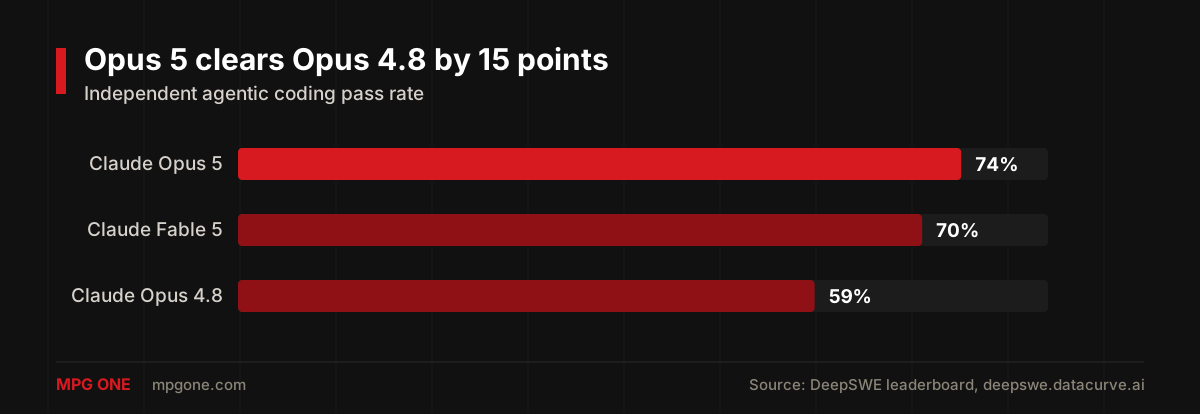
Opus 5 leads the entire leaderboard at 74%. Opus 4.8 sits at 59%, which put it eighth of eighteen models before this release.
The margins of error matter here, and they work in the upgrade's favor. Opus 5's score carries 4 points of uncertainty and Opus 4.8's carries 2, so the two ranges are 70% to 78% against 57% to 61%. They do not touch. Compare that with Opus 5 against Fable 5, where the ranges overlap completely and the honest verdict is a tie. Against Opus 4.8, the improvement is unambiguous.
It Also Costs Less to Run
A better model at the same list price would already be a good deal. This one is cheaper in practice as well, because it needs fewer tokens to finish the job.
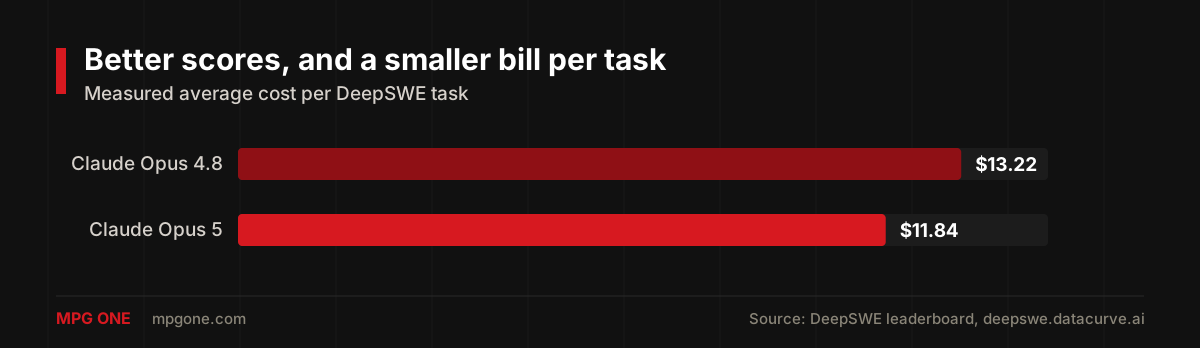
Opus 5 completes the average DeepSWE task for $11.84 against $13.22 for Opus 4.8. That is roughly 10% less per task while solving 15 points more of them, measured on real runs rather than projected from the rate card.
One caveat worth planning for: the same efficiency does not automatically apply to your workload. Model spend is also only one line in a production budget, which our guide to AI agent development cost breaks down alongside the retrieval, monitoring, and maintenance costs that usually outweigh it.
Beyond Coding: What Anthropic Reports
DeepSWE measures agentic coding. For everything else we have Anthropic's own figures, which I am labeling clearly as vendor reported because a company grading its own model is not the same as an independent test.
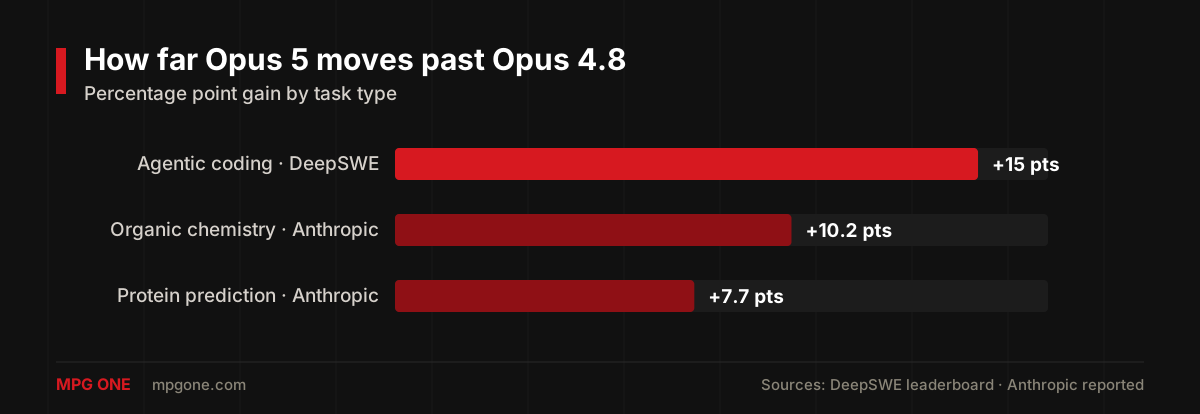
In its launch announcement Anthropic reports organic chemistry accuracy 10.2 percentage points above Opus 4.8 and protein prediction 7.7 points higher. On Frontier-Bench v0.1 the company says Opus 5 more than doubles Opus 4.8's score, though it does not publish the underlying number for 4.8, so treat that one as directional.
Anthropic also calls Opus 5 its most aligned model to date, scoring best of any recent Claude model on internal behavioral audits, ahead of Opus 4.8. That is a claim only Anthropic can currently verify, but it points the right way for anyone deploying agents with real permissions.
What Will Break in Your Code
This is the part most launch coverage skips, and it is the reason to read the release notes before flipping the model string. Two changes can affect working code.
Thinking is now on by default. On Opus 4.8, a request that omitted the thinking parameter ran without thinking. On Opus 5, the same request thinks. That is a silent cost change, and a silent truncation risk: max_tokens caps thinking and response text together, so a workload that sized max_tokens tightly around its answer can now run out of room mid response. Review max_tokens on every route that never set thinking, or pass the disabled setting explicitly.
Disabling thinking is capped at high effort. Turning thinking off is only allowed at effort high or below. Pairing the disabled setting with xhigh or max returns an error, and the check runs on every request, so a later call that raises effort will fail even though earlier ones succeeded. Opus 4.8 accepted that combination, so audit any route that disables thinking.
Two smaller changes are worth knowing. The minimum cacheable prompt drops to 512 tokens from 1,024, so prompts you previously wrote off as too short to cache may now work with no code change. And Opus 5 draws on a separate rate limit pool from the Opus 4.x models, so moving traffic over neither frees headroom on the old pool nor inherits it. Check your limits before shifting volume.
If you drive Claude through the terminal rather than the API, our Claude Code guide covers the workflow side of the same upgrade.
Should You Upgrade?
Yes, and I would not usually put it that bluntly. Better on every published benchmark, identical per token pricing, lower cost per completed task, and no capability you lose in the trade. The only work is the audit above.
A sensible order of operations:
- Audit before you switch. Find every route that disables thinking or sizes max_tokens tightly. Those are the two things that break.
- Switch one route first. Change the model string on a single workload, measure accuracy and cost against your own evaluations, and confirm the benchmark gain shows up in your numbers.
- Retune effort afterward. Opus 5 performs unusually well at lower effort settings, so a route that needed high on Opus 4.8 may do fine cheaper. Sweep it rather than carrying the old setting over.
- Then roll out. Watch the separate rate limit pool as volume moves.
The habit worth keeping is measuring on your own workload rather than trusting a leaderboard. If cost is the pressure rather than capability, our comparison of Kimi K3 against Opus 5 covers a cheaper cross vendor option that lands close on the same benchmark. We found the opposite result when we tested Gemini 3.6 Flash against its cheaper sibling, where the premium model bought nothing on short tasks. Our Claude vs Grok comparison lays out the five task battery we use for that.
FAQ
Is Claude Opus 5 better than Opus 4.8?
Yes, and the gap is real rather than marginal. Opus 5 scores 74% on the DeepSWE benchmark against 59% for Opus 4.8, a 15 point lead that sits well outside both models' error bars. It also costs less per completed task.
Does Claude Opus 5 cost more than Opus 4.8?
No. Both are $5 per million input tokens and $25 per million output tokens. Opus 5 also finishes the average DeepSWE task for $11.84 against $13.22 for Opus 4.8, so it is cheaper in practice too.
Will my Opus 4.8 code work on Opus 5?
Mostly, but two changes can bite. Thinking is on by default on Opus 5, so requests that never set it now spend thinking tokens and may truncate. And disabling thinking is only allowed at effort high or below, so combining it with xhigh or max returns an error.
Should I upgrade from Opus 4.8 to Opus 5?
Yes. It is better on every published benchmark, costs the same per token, and costs less per task. Review your max_tokens settings and any code that disables thinking before you switch.
What is the Claude Opus 5 context window?
One million tokens, as both the default and the maximum, with up to 128,000 output tokens per request. That matches Opus 4.8.
Final Thoughts
Claude Opus 5 versus Opus 4.8 is the easiest model decision of the year. Fifteen points of measured improvement, a smaller bill per task, and no price increase to argue about internally. The upgrade pays for itself on the first workload you move.
Just do the audit first. Check what happens when thinking turns itself on, fix anything that disables it above high effort, and retune your effort settings once you are across. If you want a partner to run that migration and prove the gain on your own workloads rather than a leaderboard, our AI development services team does exactly that.
Helpful next steps
Turn the idea into something useful
When this topic becomes part of a real website, workflow, campaign, or AI system, these MPG ONE pages are the natural places to continue.
Build private AI assistants, workflow automation, knowledge systems, and reporting layers.
Generative AI development servicesBuild generative AI workflows for content, documents, knowledge, and brand-safe operations.
AI agent development servicesDesign tool-using AI agents with memory, retrieval, permissions, and human review.
Custom AI solutionsCreate a custom AI system around your data, tools, permissions, and operating model.
GitHub, MCP and Codex skillsExplore RepoGuard, MCP wrappers, and AI-agent workflows built by MPG ONE.