AI
Is Solvely AI Detector Accurate? We Tested 28 Texts
Solvely AI detector tested on 28 texts: 16 of 16 AI caught, 0 of 12 humans flagged, but its ZeroGPT, Turnitin and GPTZero panel is an estimate. See the data.

By Mohamed Ezz CEO & Founder Oct 31, 2026
The Solvely AI detector caught all 16 AI texts in our 28 text test and flagged none of the 12 human texts as AI, but its "Cross check results" panel, which shows ZeroGPT, Turnitin and GPTZero scores, is Solvely's own estimate of those tools, not their real output. On the four texts we checked directly, Solvely's ZeroGPT estimate missed the real zerogpt.com score by 17 to 93 points.
I've spent nearly 20 years in AI development and digital marketing, and this is the fifth AI detector I've put through the same 28 texts this year, after GPTZero, ZeroGPT, JustDone and Originality.ai. Solvely's main score held up well. The multi engine panel it advertises is the part you need to read with care, and this post shows why.
My Main Points:
- Solvely labeled 16 of 16 AI texts "High AI". The lowest score was 62.2% on a disguised Fable 5.1 essay; 11 of the 16 scored a flat 100%.
- No human text was labeled High AI. Eight of 12 scored 0%. Four landed on "Moderate AI", with the highest at 27.2% for a peer reviewed academic introduction.
- Solvely's overall score was identical to its "ZeroGPT" panel number on all 28 texts, and its "Turnitin" and "GPTZero" numbers never strayed more than 5 points from it.
- Solvely confirmed to us that the panel numbers are estimates produced by its own model. Real ZeroGPT, checked the same day, gave 7.4% where Solvely's panel said 100%.
- Verdict: a solid single detector with a misleading dashboard. Use the main score, ignore the engine names.
In this review I'll show the results by text type, how Solvely compares with GPTZero and ZeroGPT on the same samples, and what the cross check panel actually measures. The method is the same one behind our AI detector accuracy hub.
Solvely AI Detector Test Results on 28 Texts
Solvely scored every plain AI text from Claude Opus 5.5 at 100% and averaged 96.4% on the five plain Fable 5.1 texts, with the lowest at 84%. The disguised texts, written in a casual student voice with typos, averaged 98.6% for Opus and 78.2% for Fable. All 16 carried the "High AI" label.
Human writing went the other way. The three developer doc sections averaged 1.0%, the two personal blog posts and the three essays by non native English learners all scored 0%, and the four academic introductions averaged 16.8%. Those four, plus one technical text at 3.1%, were the only texts Solvely labeled "Moderate AI".
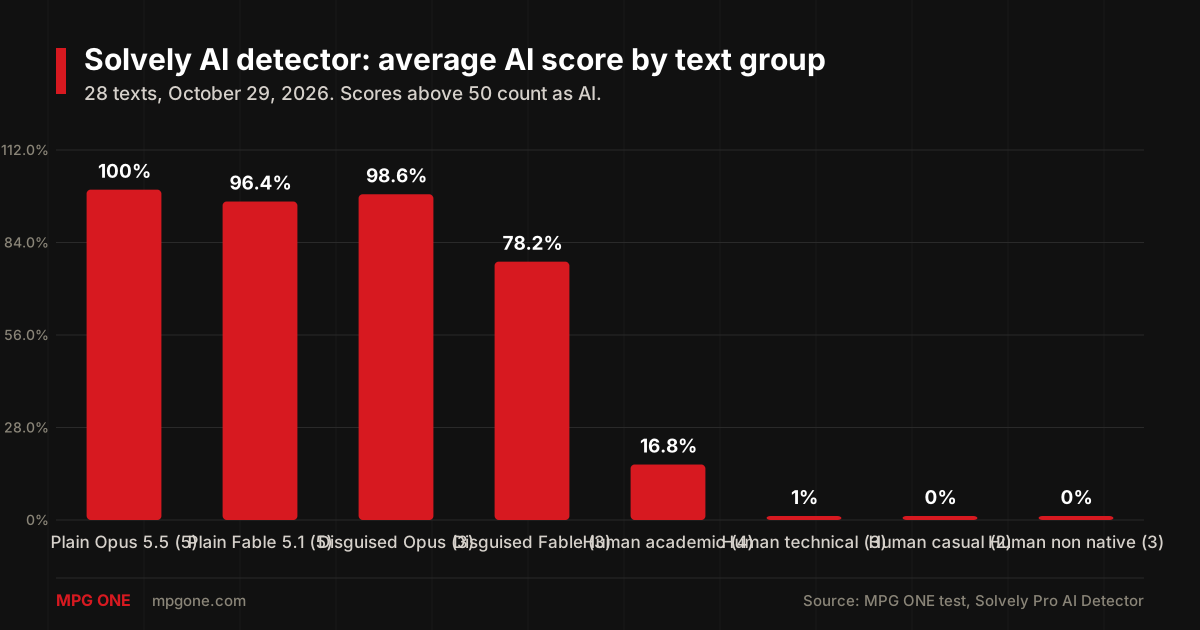
| Text group | Texts | Average score | Labels |
|---|---|---|---|
| Plain AI, Opus 5.5 | 5 | 100% | 5 High AI |
| Plain AI, Fable 5.1 | 5 | 96.4% | 5 High AI |
| Disguised AI, Opus 5.5 | 3 | 98.6% | 3 High AI |
| Disguised AI, Fable 5.1 | 3 | 78.2% | 3 High AI |
| Human, academic (2017 to 2019) | 4 | 16.8% | 1 Low AI, 3 Moderate AI |
| Human, developer docs (2019 to 2020) | 3 | 1.0% | 2 Low AI, 1 Moderate AI |
| Human, blogs (2014 and 2017) | 2 | 0% | 2 Low AI |
| Human, non native learners (2006) | 3 | 0% | 3 Low AI |
The labels are coarser than the scores. A Django doc section on caching scored 3.1% and still got the "Moderate AI" label, while texts at 0% got "Low AI". A student who sees "Moderate AI" on a 3% result would reasonably panic over nothing, so read the number and treat the label as a rough band.
How We Tested the Solvely AI Detector
Solvely got exactly the same 28 texts and rules as the other detectors in our series: 10 plain AI texts (5 from Claude Opus 5.5, 5 from Claude Fable 5.1), 6 AI texts disguised with a casual tone and typos, and 12 human texts written before 2022 so no AI could have touched them. The human set is four peer reviewed introductions from PubMed Central, three developer doc sections for Python, PostgreSQL and Django, two personal blog posts, and three 2006 essays by English learners from the PELIC corpus. Texts run 280 to 390 words.
We ran each text once through the Pro AI Detector on October 29, 2026, uploading the file rather than pasting, and recorded the overall score, the label and the three panel numbers. Two reruns returned identical scores to the decimal. Solvely gave us one month of Pro access for the test at our request. No money changed hands in either direction, and Solvely saw no scores before this post.
Solvely vs GPTZero and ZeroGPT on the Same Texts
Solvely and GPTZero both caught 16 of 16 AI texts, while ZeroGPT's AI score caught only 10 of 16 in our October 22 test. Solvely cleared the disguised Fable texts that tripped ZeroGPT, including the typo filled essay ZeroGPT scored at 15.5%, which Solvely put at 62.2%.
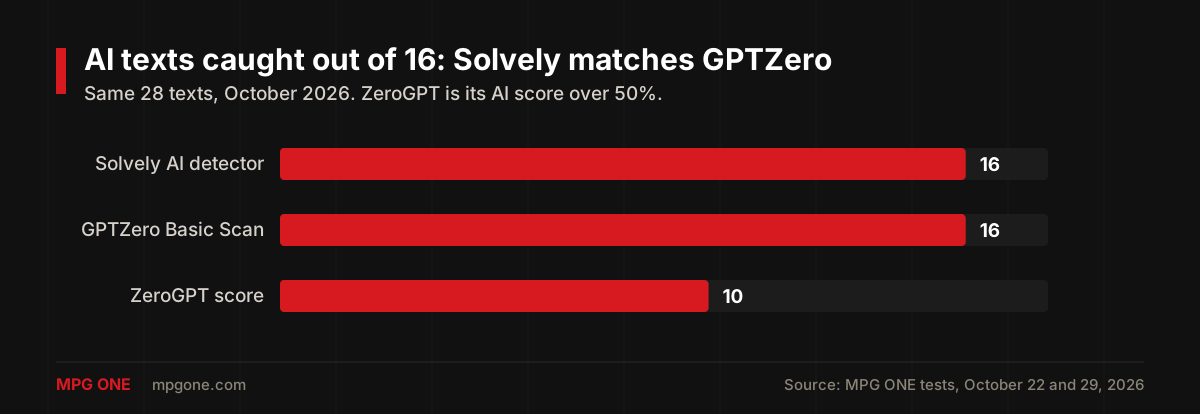
On human writing, all three tools flagged 0 of 12 texts as AI, but they got there differently. GPTZero returned a clean human verdict on every one. ZeroGPT's highest human scores were 24.9% and 17%, both on academic introductions. Solvely's were 27.2%, 22.4% and 17.5%, also on academic introductions, and those three carried the "Moderate AI" label. Formal, citation heavy prose is where every detector we've tested gets nervous, and Solvely is no exception.
The practical difference for a student: GPTZero would hand back a 2018 journal introduction with no warning, while Solvely would hand it back with a "Moderate AI" label and a "Humanize this text" button underneath.
What Solvely's Cross Check Results Panel Actually Shows
Solvely's "Cross check results" panel shows Solvely's own guesses at what ZeroGPT, Turnitin and GPTZero would say about your text. The pattern in the data gave that away before Solvely confirmed it.
Across all 28 texts, Solvely's overall score was identical to its "ZeroGPT" number. Its "Turnitin" and "GPTZero" numbers sat within 5 points of that score on every text, and in the 8 cases where the overall score had a decimal, all three engines shared the same decimal. Three independent detectors do not behave like that. The real GPTZero and ZeroGPT disagreed with each other by more than 80 points on one of these texts in our October test.
So we checked. The same day, we ran four of the texts through the free checker at zerogpt.com. A plain Opus 5.5 text that Solvely's panel scored "ZeroGPT 100%" came back from the real ZeroGPT at 26.1%. A disguised Opus text, "ZeroGPT 100%" in the panel, scored 7.4% at zerogpt.com. The disguised Fable essay was 62.2% in the panel and 15.5% at ZeroGPT, and a human academic introduction was 17.5% in the panel and 0% at ZeroGPT. The panel's "GPTZero" number was no closer: it gave the disguised Fable essay 57.2%, where GPTZero itself scored it 100% AI.
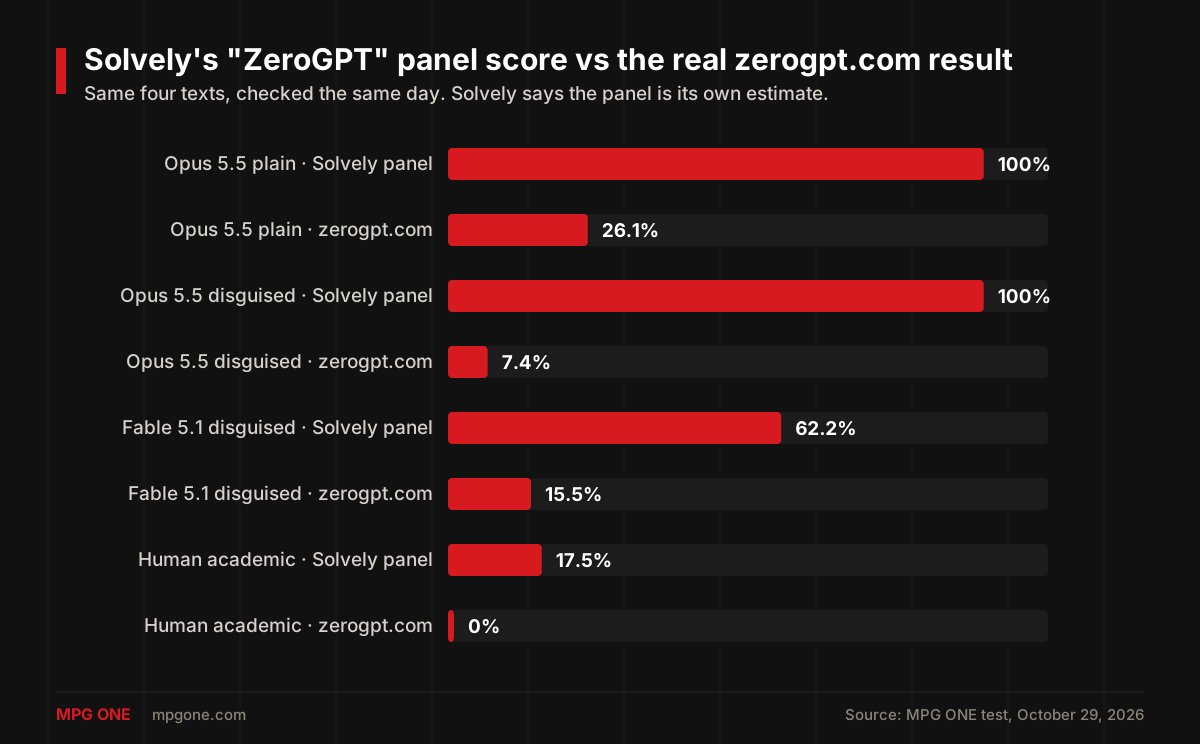
We asked Solvely how the panel numbers are produced. Solvely told us they are estimates generated by its own model, trained on data from cross checking texts with ZeroGPT, Turnitin and GPTZero, and that these estimates can differ from what the tools return directly. Solvely also said the distinction should have been clearer in the panel. Credit where it's due: the answer was prompt and honest.
The page itself is less careful. Solvely's detector page says the tool "analyzes your text against ZeroGPT, Turnitin, and GPTZero at the same time" and that "when multiple detection engines agree, you can trust the result". A student who reads a "Turnitin 15%" in that panel will assume Turnitin said 15%. Turnitin said nothing. Turnitin sells its AI detection to schools and institutions and doesn't offer it as a public service other apps can query, which is the simplest reason that number can't be a Turnitin result.
Should You Use the Solvely AI Detector?
Solvely works as a single AI detector, and on our 28 texts its main score performed as well as GPTZero on AI text and slightly worse on human text. The free tier, with no sign up, gives you that main score, which is the only number in the product we'd act on.
Don't use Solvely to predict what Turnitin or GPTZero will say about your essay. The panel is a model guessing at another model, and on our four spot checks it was off by 17 to 93 points. If you need to know what GPTZero thinks, run GPTZero; its free tier covers 10,000 words a month.
Pro is priced for students: Solvely's pricing page listed it at $3.99 for the first week and $8.99 a week after that on October 31, 2026, with monthly and yearly plans in the same place, and it bundles the math solver, flashcards and mock exams. For the detector alone, the free tier is enough.
Two changes would fix most of our complaints: label the panel as "estimated" in the interface, and stop putting "Moderate AI" on 3% results. Solvely's own page already says, in a section further down, that AI detection "is a signal, not final proof". The dashboard should say it too.
FAQ
Is Solvely AI detector accurate?
In our October 2026 test the Solvely AI detector scored all 16 AI texts above 62% and labeled them High AI, and it gave 8 of 12 human texts a 0% score. Four human texts landed on a Moderate AI label, with a top score of 27.2%, so its main score is reliable on clear AI text and cautious on formal human writing.
Is Solvely AI detector legit?
Solvely's main AI score is a real detector result and it performed well on our 28 texts. The Cross check results panel is different: Solvely confirmed to us that its ZeroGPT, Turnitin and GPTZero numbers are estimates made by Solvely's own model, not results returned by those services.
Does Solvely really check against Turnitin?
No. Solvely told us the Turnitin, ZeroGPT and GPTZero scores in its panel are its own model's estimates of what those tools might report. On the four texts we checked directly, Solvely's ZeroGPT estimate differed from zerogpt.com by 17 to 93 points.
Is Solvely AI detector free?
Solvely's AI detector is free without sign up, with daily limits and the ZeroGPT style estimate only. Pro, which we used, unlocks unlimited words and the Turnitin and GPTZero estimates; Solvely's pricing page listed Pro at $3.99 for the first week and $8.99 a week after that on October 31, 2026.
How does Solvely compare to GPTZero?
On the same 28 texts, Solvely and GPTZero both caught 16 of 16 AI texts and flagged 0 of 12 human texts as AI. GPTZero gave every human text a clean result, while Solvely labeled four human texts Moderate AI, so GPTZero was slightly cleaner on human writing.
Final Thoughts
Is the Solvely AI detector accurate? Its main score was: 16 of 16 AI texts caught, no human text flagged as AI, and results that didn't move on rerun. The multi engine panel that Solvely leads with is a different product. Those ZeroGPT, Turnitin and GPTZero numbers are Solvely's estimates, by Solvely's own account, and they missed the real ZeroGPT by up to 93 points on the texts we checked.
Use it as one detector with one score and it earns its place next to GPTZero. Read the panel as three detectors and you're acting on numbers nobody measured. The full picture across every tool we've tested lives in our AI detector accuracy hub, and if your organization needs a detection or review process built on measured results rather than vendor claims, our custom AI solutions team does that work.
Helpful next steps
Turn the idea into something useful
When this topic becomes part of a real website, workflow, campaign, or AI system, these MPG ONE pages are the natural places to continue.
Build generative AI workflows for content, documents, knowledge, and brand-safe operations.
AI development servicesBuild private AI assistants, workflow automation, knowledge systems, and reporting layers.
AI agent development servicesDesign tool-using AI agents with memory, retrieval, permissions, and human review.
Custom AI solutionsCreate a custom AI system around your data, tools, permissions, and operating model.
GitHub, MCP and Codex skillsExplore RepoGuard, MCP wrappers, and AI-agent workflows built by MPG ONE.