AI
AI Automation Services: Types, Costs, and ROI
AI automation services explained: the types, real pricing, and the ROI data most vendors skip, so you know what to buy before you spend. See the numbers.

By Mohamed Ezz CEO & Founder Jul 20, 2026
Here is the number the sales pages leave out: about 95% of generative AI pilots deliver no measurable return, according to an MIT report on the state of AI in business. So before you sign up for AI automation services, it is worth knowing what separates the projects that pay off from the ones that quietly burn a budget.
The short answer: the difference is almost never the technology. It is the approach. The best providers do not sell you a clever model. They find one painful, repetitive task, automate it well, and prove the savings before they touch anything else. That is the whole game.
AI automation services are simply the packaged version of that discipline. A provider builds and runs AI systems that take repetitive work off your team, reading documents, answering customers, moving data between tools, and following up on leads, so people can spend their time on the work that actually needs a human.
My Main Points:
- AI automation services handle messy, unstructured work that old rule based automation could never touch
- The five most common types are customer service, document processing, back office, sales and marketing, and workflow orchestration
- Pricing usually falls into three buckets: project fees, monthly retainers, or a share of the savings
- The gains are real, nearly half of companies report efficiency up 25% or more, but only when the project is scoped tightly
- Buying from a specialist beats building in house by a wide margin, so pick your provider carefully and start narrow
After nearly 20 years in AI development and digital marketing, I have scoped, built, and rescued enough of these projects to know the demos are the easy part. In this guide I will explain what AI automation services actually cover, the main types you can buy, what they cost in 2026, the ROI data most vendors skip, and how to pick a provider that ships results instead of slideware. If you are weighing ready made tools first, our guide to choosing an AI assistant for business is a good companion read.
What Are AI Automation Services?
AI automation services are the design, build, and running of AI systems that do repetitive work for you. A provider studies a workflow, figures out where AI can safely take over, then builds the system and keeps it running. You get the outcome without hiring an AI team.
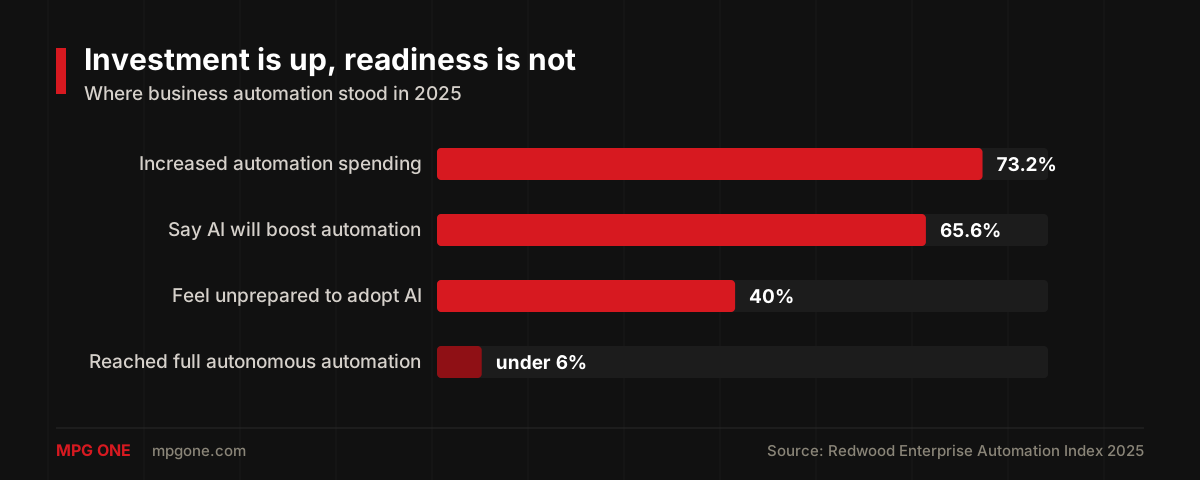
The demand is real and growing fast. In the Enterprise Automation Index 2025, a survey of 285 automation practitioners, 73.2% of businesses said they increased automation spending in the past year, and 65.6% believe AI will significantly boost what automation can do. Yet 40% still feel unprepared to adopt it, and fewer than 6% have reached full autonomous automation in any core process. Plenty of intent, not much maturity, which is exactly the gap good services fill.
The key word is AI. Older automation, often called RPA or robotic process automation, follows fixed rules and breaks the moment a process changes. AI automation reads unstructured inputs like emails, PDFs, and chat messages, makes a judgment call, and adapts. That is why it can handle work the old bots never could.
| Traditional automation (RPA) | AI automation |
|---|---|
| Follows fixed, rule based steps | Handles messy, unstructured inputs |
| Breaks when the process changes | Adapts and keeps working |
| Moves data between two apps | Reads an email, decides, and replies |
| Needs a developer for every edge case | Learns patterns from examples |
The Main Types of AI Automation Services
"AI automation" covers a lot of ground, so it helps to break it into the jobs providers actually deliver. Most engagements fall into one of these five buckets.
| Type | What it does | Common use |
|---|---|---|
| Customer service automation | Answers, routes, and resolves requests | Support chat, email triage, call summaries |
| Document and data processing | Reads and extracts unstructured documents | Invoices, contracts, forms, onboarding |
| Back office and finance | Automates repetitive internal tasks | Reconciliation, compliance checks, reporting |
| Sales and marketing automation | Drafts, personalizes, and follows up | Lead scoring, outreach, content |
| Workflow orchestration | Connects tools and agents across a process | Multi step handoffs between systems |
Customer service is where most companies start, and for good reason. An AI system can answer the common questions, route tickets, and summarize calls around the clock, then hand the tricky cases to a person. It is a well defined job with a payback you can measure in response times and ticket volume.
Document processing is the quiet winner. Any team drowning in invoices, contracts, or intake forms can hand that reading and filing to AI. And workflow orchestration is where it gets powerful: several automations, sometimes several AI agents, passing work between systems. If that is your goal, our walkthrough on how to build AI agents with memory shows what the more autonomous end of this looks like in practice.
What AI Automation Services Cost
Pricing is the question everyone asks first, so let me be direct. AI automation services usually charge in one of three ways, and the right one depends on whether you want a finished thing, an ongoing partner, or a bet tied to results. The ranges below reflect typical 2026 market pricing from provider pricing guides.
| Pricing model | Typical range | Best for |
|---|---|---|
| Project fee (one time build) | $2,500 to $15,000, enterprise builds pass $50,000 | A defined automation with a clear finish line |
| Monthly retainer | $2,000 to $12,000 a month | Ongoing monitoring, new automations, and support |
| Usage or outcome based | Often 10% to 25% of documented savings | Aligning what you pay with what you get |
A word of warning that applies to every model: the build fee is not the real cost. An AI automation has to run, and running it means model usage, monitoring, and someone keeping it accurate as your process drifts. If your project leans on autonomous agents, those running costs can dwarf the build, which we break down in detail in our guide to AI agent development cost. Always ask a provider for the total cost over a year, not just the setup quote.
Do AI Automation Services Actually Pay Off?
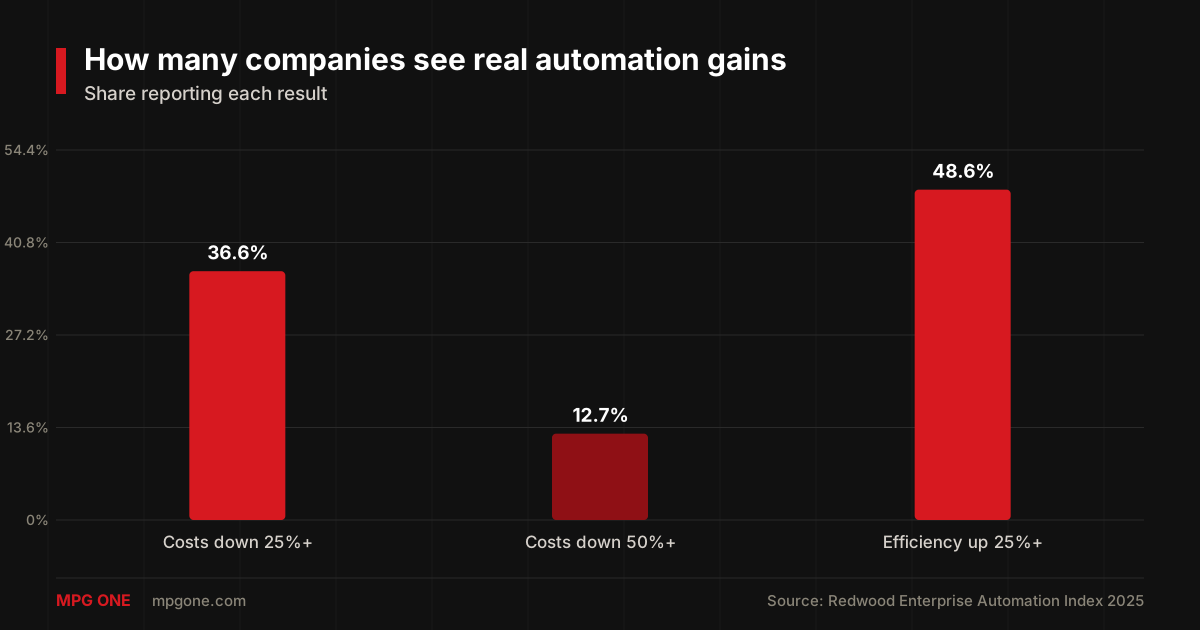
Here is the honest picture, good news and bad. The good news: for the companies that get it right, the savings are not small. In the Enterprise Automation Index 2025, 36.6% of companies reported cutting costs by at least 25%, 12.7% cut costs by more than half, and 48.6% improved efficiency by 25% or more.
Now the bad news, and it is the number I opened with. MIT's research on AI in business found that about 95% of generative AI pilots delivered no measurable impact on profit or loss. Only around 5% reached real revenue acceleration. The failure, the researchers were clear, was rarely about model quality. It was about approach: vague goals, no owner, and tools that never connected to the real workflow.
That same research points straight at the fix, and it is the strongest argument for using a specialist. AI efforts that partnered with or bought from expert vendors succeeded about 67% of the time. Teams that tried to build everything in house succeeded only about one third as often, roughly one in five.
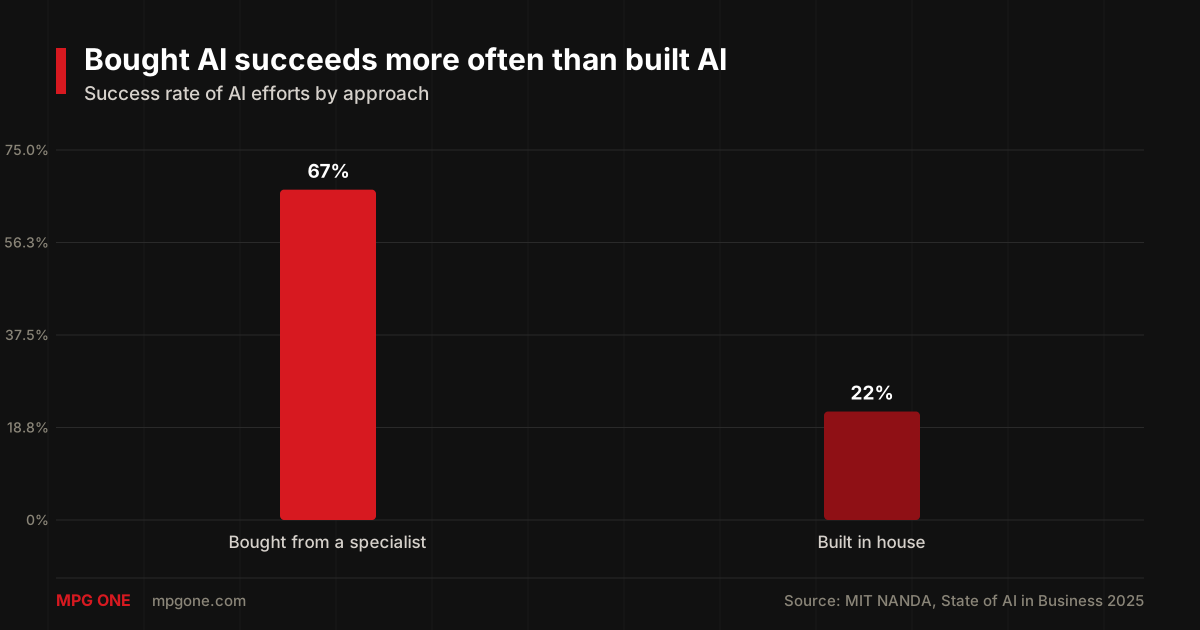
The lesson is not that AI automation does not work. It clearly does. The lesson is that how you approach it decides everything, and doing it alone is the hard road. A provider who has shipped this work before knows where the traps are, which is most of the value you are actually buying.
How to Choose an AI Automation Provider
Since the provider matters more than the model, choosing one well is the most important decision you will make. Here is the checklist I would use.
- They start with your workflow, not their tool. A good provider asks what task is eating your hours before they mention any technology. If the first conversation is a product demo, be careful.
- They can prove ROI. Ask for a payback timeline and a metric you will track. If nobody can tell you how you will know it worked, that is how projects end up in the 95%.
- They handle your data safely. Automation touches your documents, your customers, and your systems. Ask where your data goes and who can see it. If privacy is a hard requirement, our explainer on what private AI is covers the options that keep data in house.
- You own what they build. Make sure the automations, prompts, and integrations belong to you, not locked inside the provider's account.
- They integrate with your real systems. The value is in connecting to your CRM, helpdesk, and files. Open standards like the Model Context Protocol make those connections cleaner and less brittle.
- They start narrow. The best providers push you to automate one task first, not your whole company. That discipline is exactly what the failure data rewards.
Most companies end up with a mix: buy ready made tools for common jobs, and bring in a partner for the one or two workflows that actually set the business apart. If that middle path fits you, our overview of custom AI solutions lays out how that scoping works.
FAQ
What are AI automation services?
Services where a provider builds and runs AI systems that handle repetitive work: reading documents, answering customers, moving data, and following up on leads. Unlike traditional automation that follows fixed rules, AI automation handles messy, unstructured inputs and adapts as the work changes.
How much do AI automation services cost?
Most project builds run about $2,500 to $15,000, with enterprise builds passing $50,000. Monthly retainers usually land between $2,000 and $12,000. Some providers charge a share of the savings instead, often 10% to 25%.
What is the difference between AI automation and RPA?
RPA, or robotic process automation, follows fixed, rule based steps and breaks when the process changes. AI automation reads unstructured inputs like emails and documents, makes judgment calls, and adapts, so it handles work that rule based bots cannot.
Can AI automate customer service?
Yes, and it is the most common starting point. AI can answer common questions, route tickets, summarize calls, and draft replies, while handing the hard cases to a person. Done well it cuts response times without lowering quality.
Are AI automation services worth it for a small business?
They can be, if you start narrow. Pick one task that eats hours and has a payback you can measure, prove it works, then expand. The businesses that lose money try to automate everything at once.
Final Thoughts
AI automation services are worth it, but only when they are done with discipline. The data is clear on both sides: real cost cuts and efficiency gains for the companies that scope one task and prove it, and no measurable return for the 95% that chase a moonshot with no owner and no metric. The technology is ready. The approach is what separates the two groups.
So start small, demand a payback you can measure, and lean on a partner who has shipped this work before instead of learning on your budget. If you want a team to scope, build, and run an automation that earns its keep from day one, our AI development services team does exactly that, starting from the task, not the hype.
Helpful next steps
Turn the idea into something useful
When this topic becomes part of a real website, workflow, campaign, or AI system, these MPG ONE pages are the natural places to continue.
Build private AI assistants, workflow automation, knowledge systems, and reporting layers.
Generative AI development servicesBuild generative AI workflows for content, documents, knowledge, and brand-safe operations.
AI agent development servicesDesign tool-using AI agents with memory, retrieval, permissions, and human review.
Custom AI solutionsCreate a custom AI system around your data, tools, permissions, and operating model.
GitHub, MCP and Codex skillsExplore RepoGuard, MCP wrappers, and AI-agent workflows built by MPG ONE.