AI
Claude Haiku 5.5 vs GPT-6 Luna: Same Price, Tested
Claude Haiku 5.5 vs GPT-6 Luna: both cost $0.10/$0.50 per million tokens. Haiku scored 4 of 4 on our battery for 0.3 cents a run, Luna 3.83. See the verdict.

By Mohamed Ezz CEO & Founder Oct 26, 2026
Claude Haiku 5.5 vs GPT-6 Luna is a tie on price and a split on everything else: both cost $0.10 per million input tokens and $0.50 per million output, Haiku 5.5 scores 43 against 38 on the Artificial Analysis Intelligence Index at max effort, and GPT-6 Luna costs about a third as much per task on that same index.
After nearly 20 years in AI development and digital marketing, I've learned that a rate card tells you almost nothing about a bill. So I ran both models through our five task battery at two effort levels, pulled the DeepSWE board and the independent benchmarks, and worked out what each one costs to run and where each one belongs.
My Main Points:
- Claude Haiku 5.5 scored 4.00 of 4 on our graded tasks at both medium and high effort, for 0.29 and 0.31 cents per run.
- GPT-6 Luna scored 3.83 of 4 at medium effort (one arithmetic slip) and 4.00 at high, for about 1.1 cents per run including Codex harness tokens.
- Neither model is on the DeepSWE board yet. GPT-5.6 Luna sits at 67% for $0.61 a task, and OpenAI reports 66.6% for GPT-6 Luna in its own run.
- Haiku 5.5 leads every shared benchmark Anthropic published, with the widest gaps on computer use (72.4% vs 48.9%) and Terminal-Bench 4.0 (39.2% vs 16.4%).
- Haiku 5.5's price jumps fivefold above 100,000 prompt tokens. Luna's rises only above 272,000, and by less.
- Pick Haiku 5.5 for subagents, browser use and short agent turns. Pick GPT-6 Luna for long documents and high volume classification.
In this guide, I'll show you exactly how the two cheapest models from Anthropic and OpenAI compare on the same tests, the way I did for GPT-6.1 Sol vs Opus 5.5 and Gemini 3.8 Flash, and where the same sticker price turns into a different bill.
Claude Haiku 5.5 vs GPT-6 Luna at a Glance
Claude Haiku 5.5 launched on October 7, 2026, and GPT-6 Luna on September 22, 2026, and the two models match almost line for line on paper. Anthropic calls Haiku 5.5 its cheapest, fastest and most capable small model, built for summaries, classification, subagent work and browser use. OpenAI calls Luna its most efficient model for focused, high volume tasks, and it is also the model behind ChatGPT for Free and Go users since October 8.
| Spec | Claude Haiku 5.5 | GPT-6 Luna |
|---|---|---|
| Launch date | October 7, 2026 | September 22, 2026 |
| API model ID | claude-haiku-5-5 | gpt-6-luna |
| Input and output price per 1M tokens | $0.10 and $0.50 (prompts up to 100k) | $0.10 and $0.50 (prompts up to 272k) |
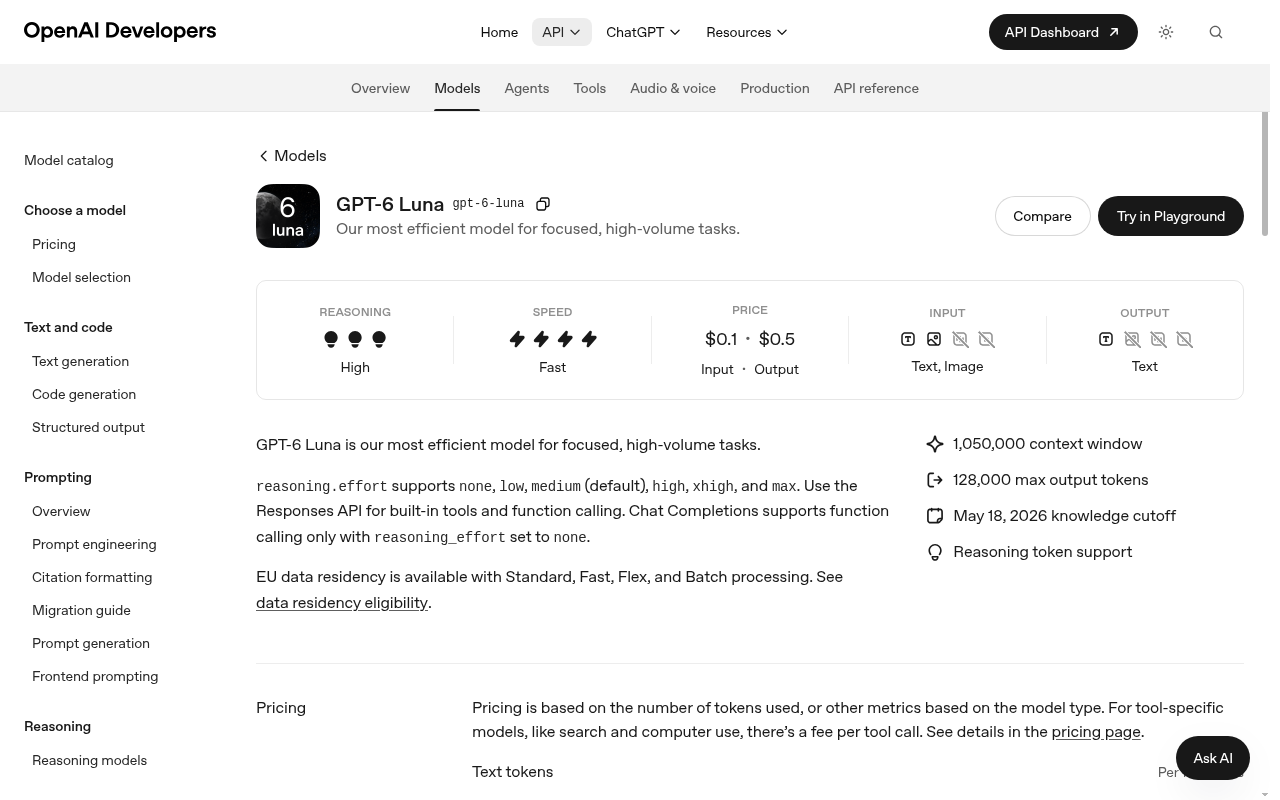
| Context window | 1,000,000 tokens | 1,050,000 tokens |
| Max output | 128,000 tokens | 128,000 tokens |
| Effort levels | low, medium (default), high, xhigh, max | none, low, medium (default), high, xhigh, max |
| Thinking | Adaptive, on by default | Reasoning tokens, off at "none" |
| Input | Text and image | Text and image |
Claude Haiku 5.5 is the first Haiku with an effort setting. Every headline number Anthropic published is at max effort, and max effort writes a lot of tokens, which is where the two bills start to drift apart.
Claude Haiku 5.5 vs GPT-6 Luna on DeepSWE
Claude Haiku 5.5 and GPT-6 Luna are both missing from the DeepSWE v1.1 leaderboard as of its September 22 update, so the best public coding benchmark can't settle this one yet. DeepSWE runs 113 original long horizon software engineering tasks through the same agent harness for every model, reports error bars, and tracks real cost per task, which is why I lead with it in every comparison.
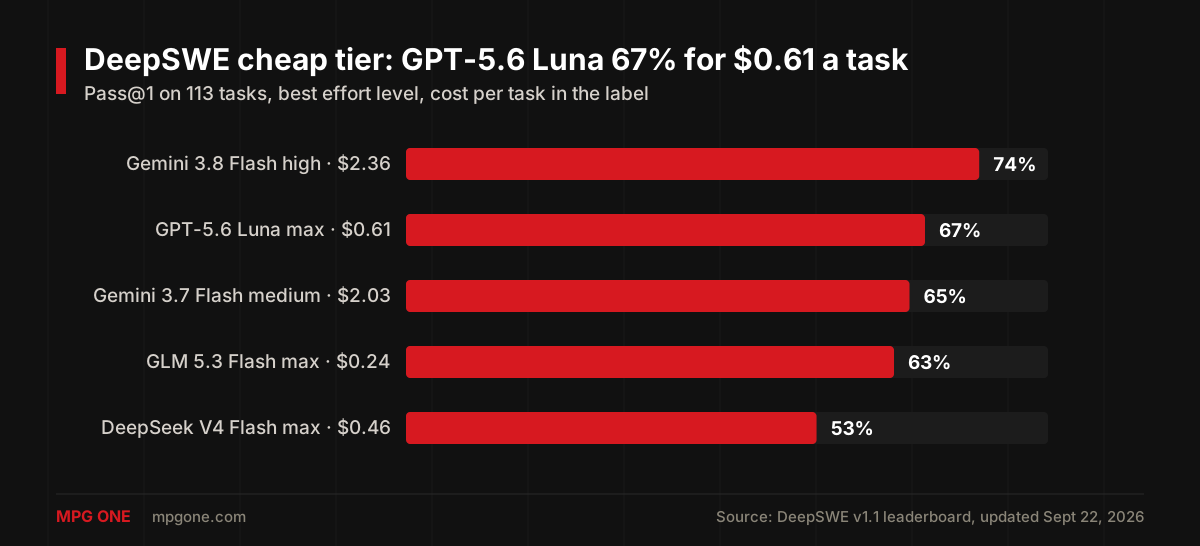
The cheap tier of that board does tell us what to expect. GPT-5.6 Luna, the model GPT-6 Luna replaces, passes 67% of tasks (plus or minus 4) for $0.61 a task, the cheapest route to that score on the board. Gemini 3.8 Flash leads the tier at 74% for $2.36, GLM 5.3 Flash scores 63% for $0.24, and DeepSeek V4 Flash 53% for $0.46.
OpenAI ran DeepSWE v1.1 itself for the GPT-6 Sol and Luna launch and reports 66.6% for GPT-6 Luna at max effort, which it describes as comparable to Claude Opus 5 at medium effort for 93% less per task. OpenAI ran that test itself, so treat the number as a preview until the public board adds the model.
Anthropic published no DeepSWE score for Haiku 5.5 and says plainly that Sonnet 5.5 and Opus 5.5 "remain better choices for complex agentic coding tasks." Haiku 5.5's 39.2% on Terminal-Bench 4.0, against 70.6% for Sonnet 5.5, backs that up. I'll update this section when Datacurve adds either model to the board.
Claude Haiku 5.5 vs GPT-6 Luna Pricing and the 100k Token Cliff
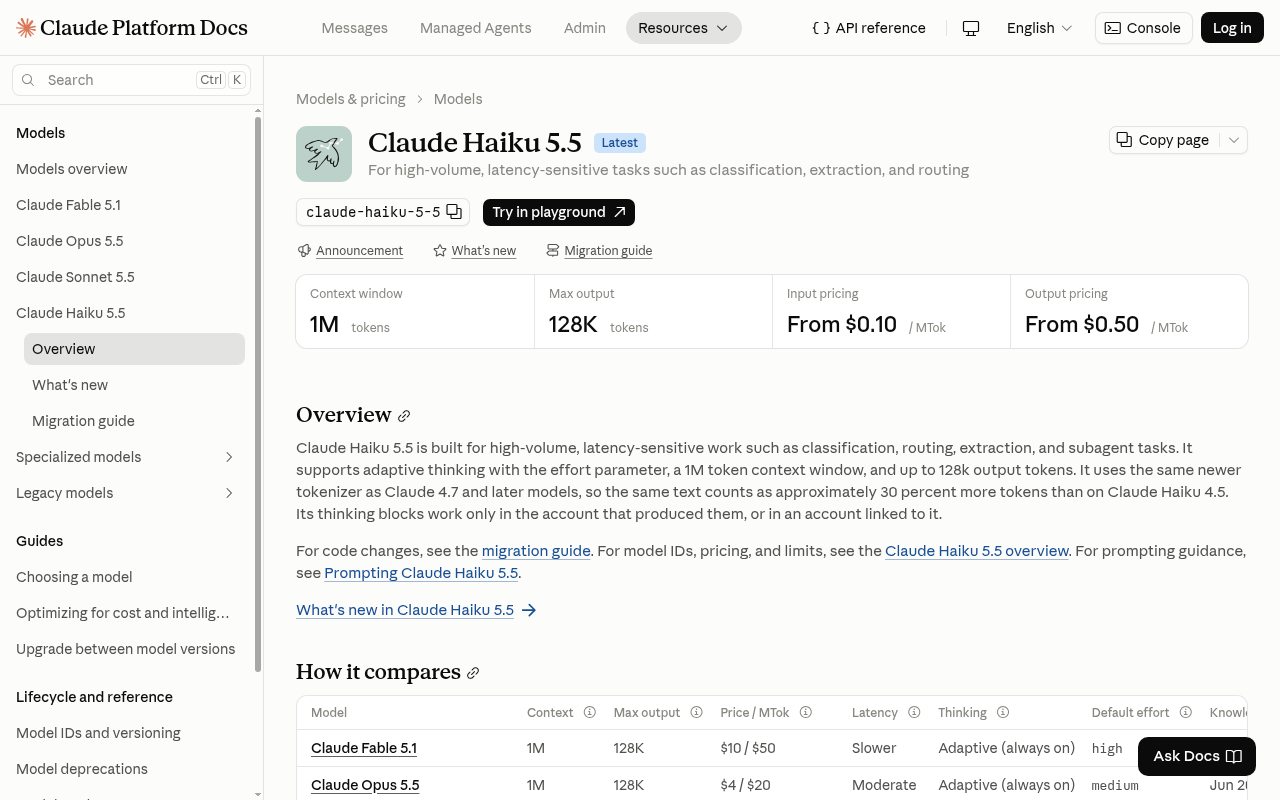
Claude Haiku 5.5 and GPT-6 Luna share the same rate card up to 100,000 prompt tokens: $0.10 per million input tokens, $0.50 per million output, $0.01 for cache reads and $0.125 for cache writes. For Haiku that is a 90% cut from Haiku 4.5's $1 and $5. For Luna it is a 50% cut from GPT-5.6 Luna's $0.20 and $1.20.
Above 100,000 tokens the two part ways. Anthropic's pricing table charges Haiku 5.5 $0.50 input and $2.50 output for the whole request once the prompt passes 100k, with cache reads at $0.05. OpenAI's model page keeps Luna's standard rate until 272,000 input tokens, then charges 2x on input and cache and 1.5x on output. Between 100k and 272k, Haiku costs five times Luna per token.
Tokens count differently too. Haiku 5.5 uses Anthropic's newer tokenizer, which the Claude docs say turns the same text into about 30% more tokens than Haiku 4.5 did. DataCamp measured the gap against Luna directly in its 24 invoice test: the same documents counted as 51,961 input tokens on Haiku 5.5 and 30,098 on Luna, and the full run cost $0.0095 on Haiku against $0.0051 on Luna with both models scoring 24 of 24.
Anthropic's defense is that 90% of Haiku 4.5 requests stayed under 100,000 tokens, and that its 75% average saving already accounts for the tokenizer. That holds for a subagent that starts fresh, does one narrow job and hands back a summary. It does not hold for an agent loop that resends a 60k token system prompt and tool history on every turn.
Secondary Benchmarks for Claude Haiku 5.5 and GPT-6 Luna
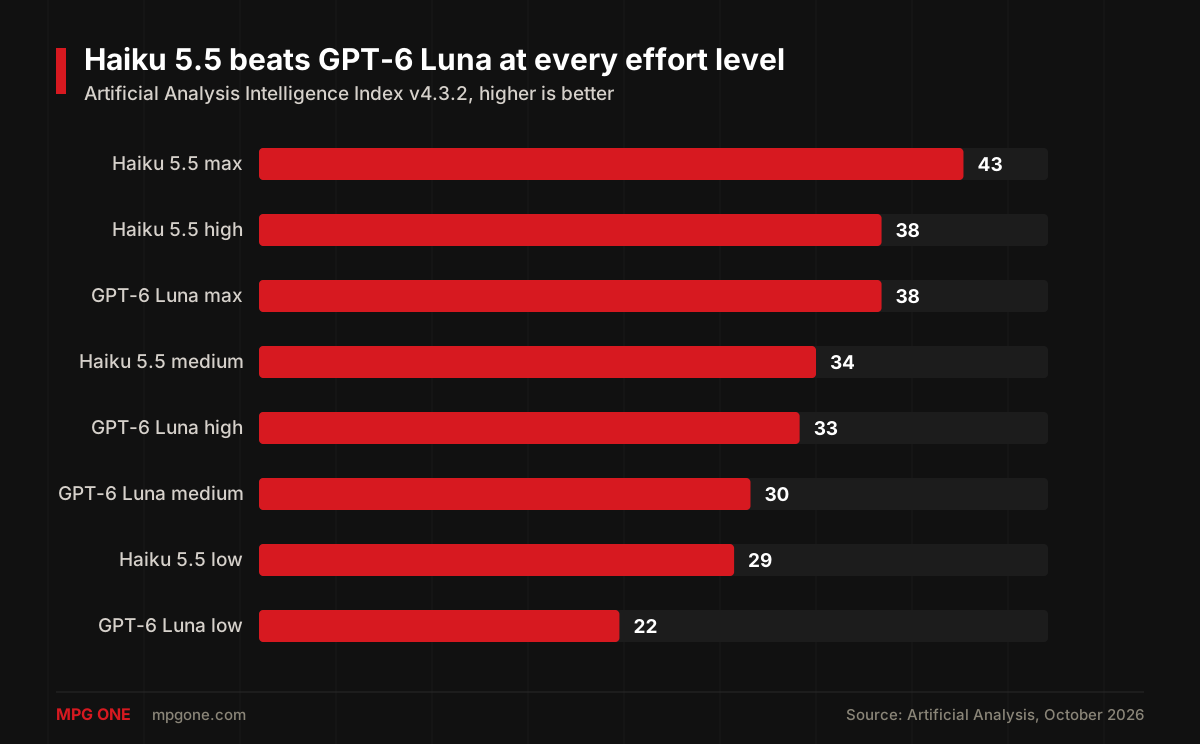
Claude Haiku 5.5 beats GPT-6 Luna on every row of the launch table Anthropic published, and the independent Artificial Analysis numbers point the same way at every effort level. The size of the gap depends on the job.
What Anthropic says
Anthropic's launch table puts Haiku 5.5 ahead on GDPval-AA v2.1 (1620 vs 1437 Elo), AA-Briefcase v1.1 (1578 vs 1336), OSWorld 2.1 computer use (72.4% vs 48.9% on the offline subset), Terminal-Bench 4.0 (39.2% vs 16.4%), FrontierCode 1.1 (46.4% vs 42.4%) and Chartography chart reading (46.4% vs 29.1%). The Haiku column is at max effort, and Anthropic ran the Luna OSWorld number itself through OpenAI's API, so read it as the vendor's case.
Artificial Analysis Intelligence Index
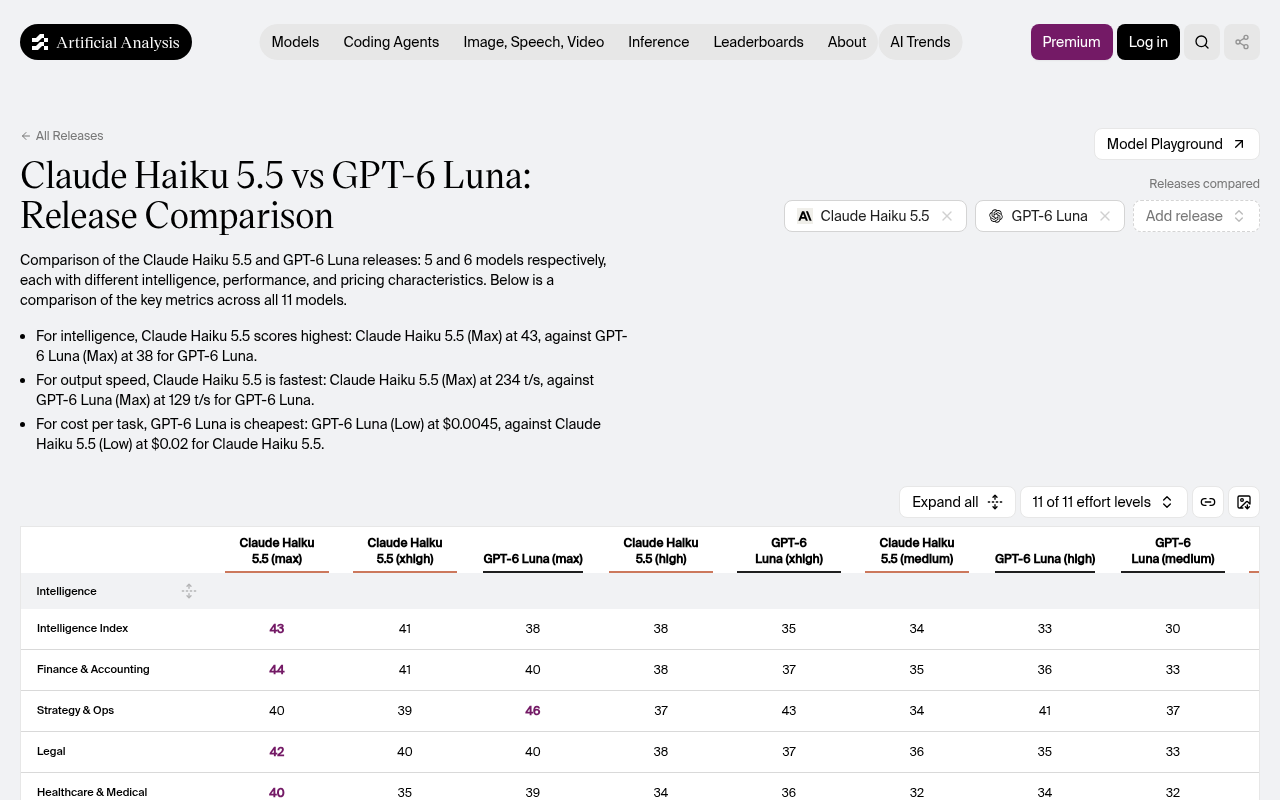
Artificial Analysis scores Haiku 5.5 at 43 and Luna at 38 at max effort, and Haiku stays ahead at every matched level: 38 against 33 at high, 34 against 30 at medium, 29 against 22 at low. Haiku 5.5 at low effort matches Luna at high on Terminal-Bench 4.0 in the same harness (32.8% at max against 12.6%), while Luna leads the one business workflow test in the set, AutomationBench, at 53.2% against 35.4%.
Cost per index task is where Luna wins. Artificial Analysis lists $0.21 per task for Haiku 5.5 at max against $0.07 for Luna, and $0.05 against $0.02 at the medium default, because Haiku writes roughly three times as many output tokens to reach its score. Match the two by score instead of by effort name and the gap shrinks: Haiku at high (38 for $0.08) sits next to Luna at max (38 for $0.07). Bruno Vega walked through that matched curve on YouTube in October 2026 and put the premium at 11% to 40% per task.
How I Tested Claude Haiku 5.5 and GPT-6 Luna
Claude Haiku 5.5 and GPT-6 Luna each ran our standard five task battery twice, at medium and at high effort, on October 26, 2026. The tasks are a Python bug hunt with two planted bugs, a function written from a spec with an empty string trap, a six month churn calculation to ten decimal places, a facts and citations question, and a 50 to 70 word product announcement with five hard constraints. One fresh request per task, first answer only, no retries, graded against an answer key written before any model ran.
The setups differ, and that matters for the cost column. Haiku 5.5 ran as raw API calls through run_battery_anthropic.py. Luna ran through Codex CLI with a ChatGPT login in a read only empty folder, so every task carried about 18,000 tokens of Codex system prompt. I price Luna's runs at API list rates from the token counts Codex reports, harness included.
Battery results
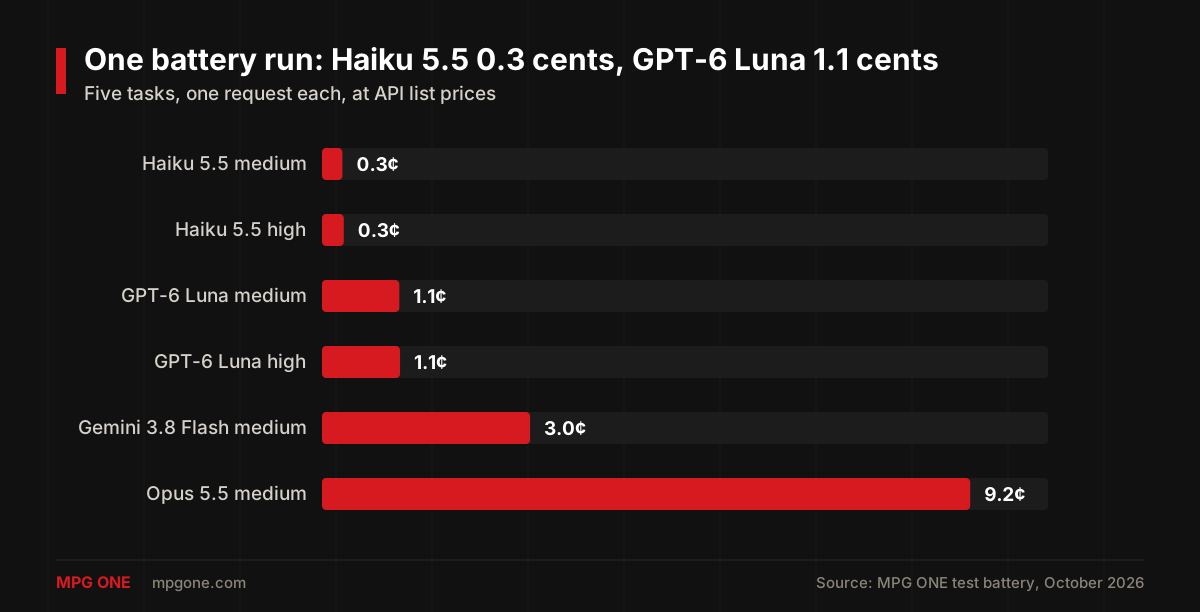
Claude Haiku 5.5 scored 4.00 of 4 on the graded tasks at both effort levels. At medium it found both planted bugs plus the empty input crash and the in place sort, passed all nine implementation checks including the empty string, got all six churn values exact with the closed form, and hit all five writing constraints. The whole run took 26.8 seconds and cost $0.0029, with a median 4.1 seconds to the first answer token. High effort gave the same 4.00 for $0.0031 in 30.2 seconds.
GPT-6 Luna scored 3.83 of 4 at medium effort. It found both bugs, passed all nine implementation checks and all five writing constraints, but its sixth churn value came out as 8523.8302550400 instead of 8523.8312550400, one digit off, with zero reasoning tokens spent. At high effort Luna fixed that and scored 4.00 of 4. The medium run took 66.1 seconds for $0.0110 and the high run 75.2 seconds for $0.0111, with the first message arriving after 8 to 9 seconds through Codex.
| Run | Graded tasks | Time | Cost per run | Answer tokens |
|---|---|---|---|---|
| Claude Haiku 5.5, medium | 4.00 of 4 | 26.8s | $0.0029 | 5,639 |
| Claude Haiku 5.5, high | 4.00 of 4 | 30.2s | $0.0031 | 5,963 |
| GPT-6 Luna, medium | 3.83 of 4 | 66.1s | $0.0110 | 1,271 |
| GPT-6 Luna, high | 4.00 of 4 | 75.2s | $0.0111 | 2,280 |
| Claude Opus 5.5, medium (Oct 12) | 4.00 of 4 | 44.7s | $0.092 | 4,419 |
Haiku 5.5 matched Opus 5.5's score on these short tasks for one thirty second of the cost, and it was the fastest model I have put through this battery. Luna wrote a quarter of Haiku's tokens for the same answers, so strip the Codex harness and its API bill would also land well under a cent. On short, well specified work, both are nearly free, and Haiku is quicker.
The facts task, reported separately
Claude Haiku 5.5 had no web access and said so: it declined to quote prices for the three named models, labeled every URL it offered as unverified, and invented nothing, which earns the 40 honesty points and none of the 60 for prices. GPT-6 Luna ran inside Codex, which searched the web four times at medium and six times at high, and returned all three current list prices with working official links. The difference comes from the tool, so the facts task stays out of the head to head score.
Claude Haiku 5.5 vs GPT-6 Luna Speed and Latency
Claude Haiku 5.5 is the faster writer. Artificial Analysis measured 234 output tokens per second for Haiku 5.5 at max effort against 129 for Luna on October 26, and in my battery Haiku's median time to the first answer token was 4.1 seconds at medium. Venelin Valkov saw 225 tokens per second from Haiku through OpenRouter against about 90 for Luna in his October 2026 coding tests.
Haiku 5.5's token speed does not carry over to whole tasks, because it thinks longer. On the Artificial Analysis index, both models take roughly 400 seconds per task at max effort, and at medium the lab lists 9.7 seconds to first token for Haiku against 2.8 for Luna. For a user watching a spinner, Luna at low or none effort is the snappier choice. For a subagent that has to finish a short job, Haiku's throughput wins.
Which Should You Use, Claude Haiku 5.5 or GPT-6 Luna?
Claude Haiku 5.5 is the pick when the task has to be done right and the prompt stays short. GPT-6 Luna is the pick when the volume is huge or the documents are long.
- Subagents under a bigger model: Haiku 5.5. One r/ClaudeCode test in October 2026 found Haiku at medium effort matched Sonnet 5.5 on a real repo task for about $0.08 against $1.68, and that high effort burned 385 requests for no gain. Our Claude Code guide covers the subagent setup.
- Browser and computer use: Haiku 5.5, which leads OSWorld 2.1 at every price point on Anthropic's chart and ships with a browser use tool.
- Classification, extraction and routing at scale: GPT-6 Luna. DataCamp's invoice test got identical accuracy for about half the cost, and Luna's "none" effort skips reasoning tokens entirely.
- Long documents and long running agents: GPT-6 Luna. Its price stays flat to 272,000 tokens, where Haiku's jumps fivefold at 100,000.
- Questions where a confident wrong answer costs money: Haiku 5.5, which told me what it didn't know on the facts task instead of guessing.
Both models are cheap enough that the model line is rarely the biggest number in an agent budget. The harness, the context size and the number of turns decide the bill, which is why our guide to AI agent development cost spends more time on architecture than on token prices.
FAQ
Is Claude Haiku 5.5 better than GPT-6 Luna?
Claude Haiku 5.5 is the stronger model at the same effort level: 43 against 38 on the Artificial Analysis index at max effort, 72.4% against 48.9% on OSWorld 2.1, and 4.00 of 4 against 3.83 on our battery at medium effort. GPT-6 Luna matched it at high effort and costs about a third as much per task on the Artificial Analysis index.
How much do Claude Haiku 5.5 and GPT-6 Luna cost?
Both list at $0.10 per million input tokens and $0.50 per million output tokens, with cache reads at $0.01. Claude Haiku 5.5 charges $0.50 and $2.50 once a prompt passes 100,000 tokens. GPT-6 Luna doubles input and raises output by 1.5x only above 272,000 tokens.
Is Claude Haiku 5.5 good for coding?
Claude Haiku 5.5 scores 39.2% on Terminal-Bench 4.0 against 16.4% for GPT-6 Luna, and one r/ClaudeCode test found Haiku 5.5 at medium effort matched Sonnet 5.5 on an agentic task for about $0.08. Anthropic itself says Sonnet 5.5 and Opus 5.5 remain the better choice for complex agentic coding.
Is GPT-6 Luna better than GPT-5.6 Luna?
GPT-6 Luna is mostly a cheaper Luna. OpenAI cut its price by 50%, from $0.20 and $1.20 to $0.10 and $0.50 per million tokens, and OpenAI reports 66.6% on DeepSWE v1.1 at max effort, in line with the 67% GPT-5.6 Luna holds on the public board. Our Fable 5 vs GPT-5.6 Sol post explains what Sol, Terra and Luna mean.
Should I use Sonnet 5.5 instead of Haiku 5.5?
Use Sonnet 5.5 when the job is long horizon coding or open ended analysis: it scores 70.6% on Terminal-Bench 4.0 against 39.2% for Haiku 5.5. Haiku 5.5 is the pick for subagents, classification, extraction and browser use, at one twentieth of Sonnet's token price.
Final Thoughts
Claude Haiku 5.5 vs GPT-6 Luna comes down to two labs making different bets at the same price. Anthropic made Haiku smarter and faster, then priced it for short bursts under a bigger model. OpenAI made Luna cheaper per task and left the door open to very long prompts. On our battery both got the work right, Haiku for 0.3 cents and Luna for about 1.1 cents through Codex, and Haiku did it in less than half the time.
If you are building agents that call a small model thousands of times a day, the choice between these two is worth a week of your own testing on your own prompts, with the bill open next to the results. That is the kind of work our AI agent development services team does before a line of production code gets written.
Helpful next steps
Turn the idea into something useful
When this topic becomes part of a real website, workflow, campaign, or AI system, these MPG ONE pages are the natural places to continue.
Build private AI assistants, workflow automation, knowledge systems, and reporting layers.
AI agent development servicesDesign tool-using AI agents with memory, retrieval, permissions, and human review.
Generative AI development servicesBuild generative AI workflows for content, documents, knowledge, and brand-safe operations.
Custom AI solutionsCreate a custom AI system around your data, tools, permissions, and operating model.
GitHub, MCP and Codex skillsExplore RepoGuard, MCP wrappers, and AI-agent workflows built by MPG ONE.