AI
Fable 5.2 vs Opus 5.5 vs Fable 5.1: Tested and Priced
Fable 5.2 vs Opus 5.5 vs Fable 5.1: all scored 4.40 of 5 in our test. Opus 5.5 cost $0.093 a run, Fable 5.2 $0.17, Fable 5.1 $0.21. See the verdict.

By Mohamed Ezz CEO & Founder Nov 9, 2026
Fable 5.2 vs Opus 5.5 is a tie on everyday tasks and a Fable 5.2 win on hard ones. All three Claude models scored 4.40 of 5 on our five task battery, where Opus 5.5 cost $0.093 a run, Fable 5.2 cost $0.17 and Fable 5.1 cost $0.21 at medium effort. On the Artificial Analysis Intelligence Index, Fable 5.2 scores 65, Opus 5.5 scores 59 and Fable 5.1 scores 49.
After nearly 20 years in AI development and digital marketing, I have watched every new flagship arrive with a table that says it wins everything, so I ran all three models myself on November 9, 2026, the day Anthropic released Fable 5.2. This post covers what the independent numbers say, what each model cost in our nine runs, and when Fable 5.2 is worth double the price of Opus 5.5.
My Main Points:
- Fable 5.2 costs $8 and $40 per million tokens, Opus 5.5 costs $4 and $20, and Fable 5.1 costs $10 and $50
- All nine battery runs scored 4.40 of 5: three models at medium, high and max effort
- Opus 5.5 was the cheapest at every effort level: $0.093 at medium against $0.17 for Fable 5.2 and $0.21 for Fable 5.1
- Fable 5.2 beat Fable 5.1 at medium and high, 15 to 18% cheaper and about 10 seconds faster, but cost three times as much at max: $1.78 against $0.59
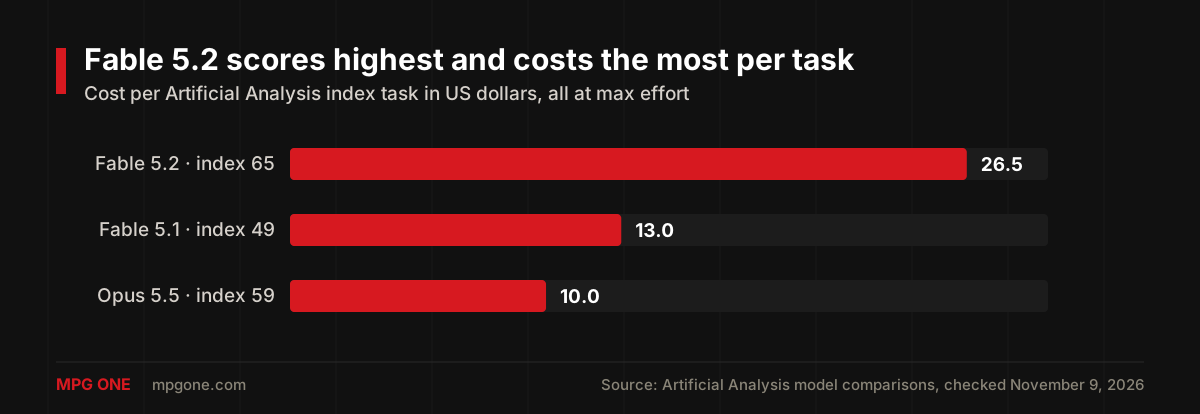
- Artificial Analysis scores them 65, 59 and 49 at max effort, at $26.54, $10.04 and $12.99 per task
- Opus 5.5 beats the older Fable 5.1 on score and on cost, and Anthropic now lists Fable 5.1 as legacy
For the matchup against OpenAI's flagship, see Fable 5.2 vs GPT-6 Astra, which uses the same battery.
Fable 5.2 vs Opus 5.5 vs Fable 5.1 at a Glance
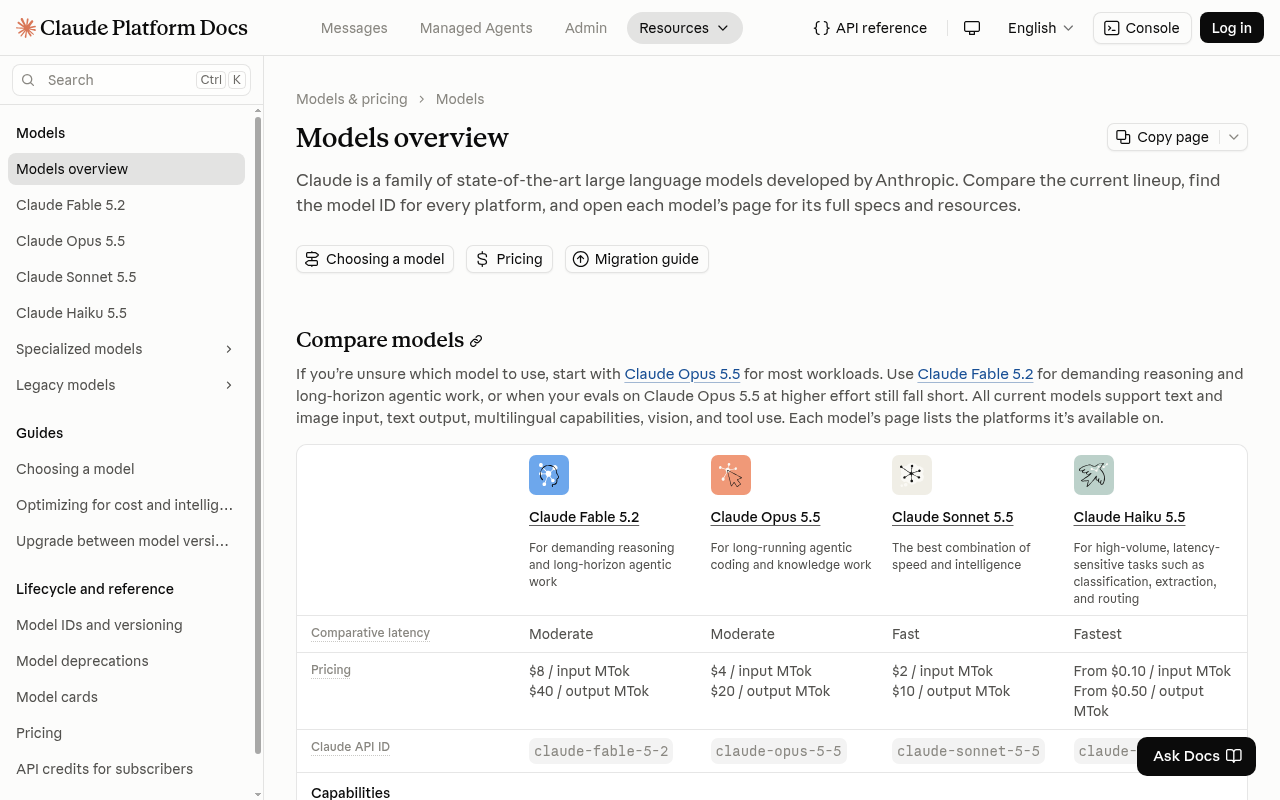
Fable 5.2, Opus 5.5 and Fable 5.1 share the same context window, output limit and knowledge cutoff, so price and default effort are the only spec differences. Anthropic released Fable 5.1 on September 1, 2026, Opus 5.5 on September 22, and Fable 5.2 on November 9. Fable 5.1 is still served, but its docs page now marks it as a legacy model.
| Fable 5.2 | Opus 5.5 | Fable 5.1 | |
|---|---|---|---|
| Released | November 9, 2026 | September 22, 2026 | September 1, 2026 |
| Status | Active (latest) | Active (latest) | Active (legacy) |
| API model id | claude-fable-5-2 | claude-opus-5-5 | claude-fable-5-1 |
| Input per 1M | $8 | $4 | $10 |
| Output per 1M | $40 | $20 | $50 |
| Cache read per 1M | $0.20 | $0.20 | $0.25 |
| Context window | 1M tokens | 1M tokens | 1M tokens |
| Max output | 128K tokens | 128K tokens | 128K tokens |
| Knowledge cutoff | June 2026 | June 2026 | June 2026 |
| Default effort in the API | high | medium | high |
| Thinking | Adaptive, always on | Adaptive, always on | Adaptive, always on |
The specs come from Anthropic's docs pages for Fable 5.2, Opus 5.5 and Fable 5.1. Both Fable models run at high effort in the API unless you set it, while Opus 5.5 runs at medium, so an unset effort costs more on Fable.
Fable 5.2, Opus 5.5 and Fable 5.1 on DeepSWE
Fable 5.2, Opus 5.5 and Fable 5.1 are all missing from the independent DeepSWE leaderboard as of November 9, 2026. The board was last updated on September 22, the day Opus 5.5 shipped, and it never added Fable 5.1. I normally lead with DeepSWE because its 113 tasks are newly written with hand built verifiers, so no model has seen the answers.
The board does show the previous generation of each line. Claude Opus 5 at max effort scores 74% (±4%) for $11.84 per task, and Claude Fable 5 at xhigh scores 70% (±3%) for $13.41. The error bars overlap, so the older Opus matched the older Fable on DeepSWE for less money. That is the same pattern the newer numbers show for Opus 5.5 against Fable 5.1, and I will update this section when the board adds the three current models.
Fable 5.2 vs Opus 5.5 on Artificial Analysis
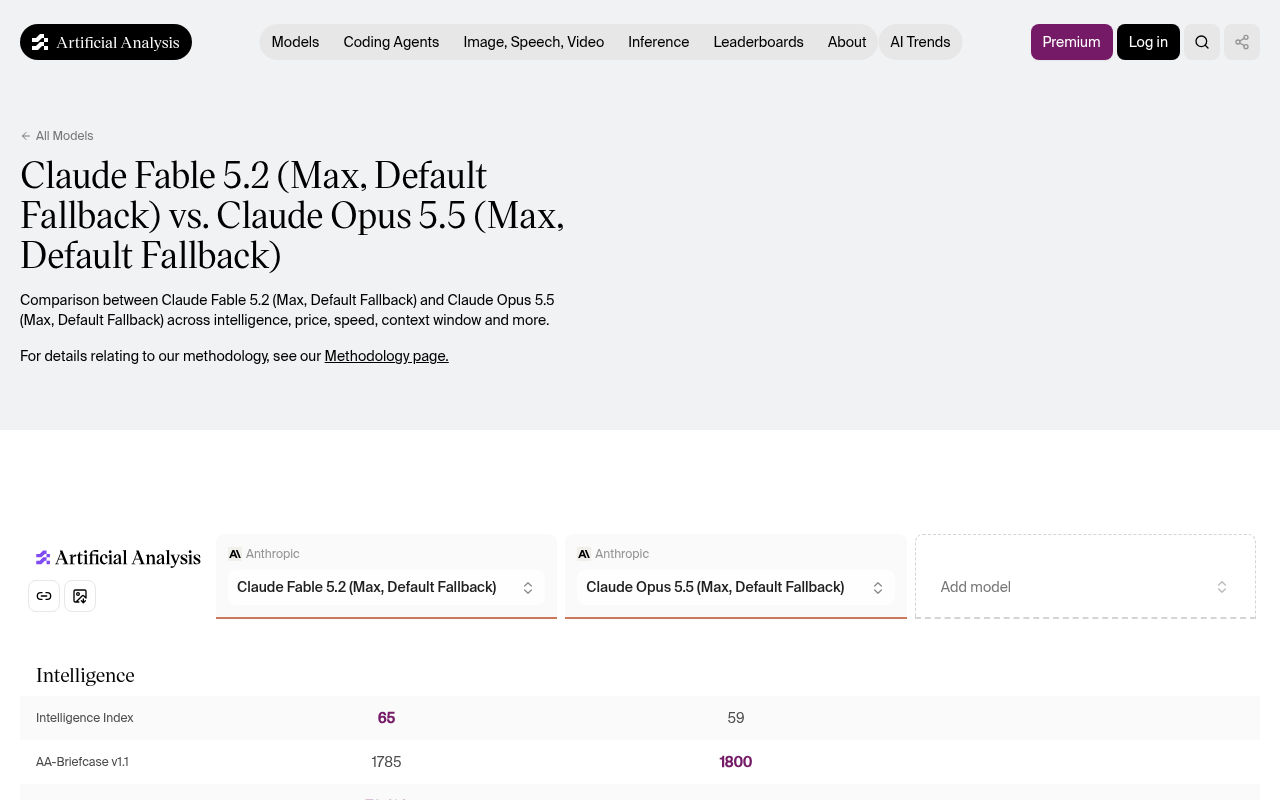
Fable 5.2 scores 65 on the Artificial Analysis Intelligence Index, Opus 5.5 scores 59 and Fable 5.1 scores 49, all at max effort. Fable 5.2's biggest leads over Opus 5.5 are on Terminal-Bench-Science 0.1, at 73.3% against 59.0%, and HLE-Diamond, at 80.2% against 67.9%. Coding is much closer: Fable 5.2 leads FrontierCode 2.0 at 48.8% against 46.4%, and the two tie on Terminal-Bench 4.0 at 59.6%.
Opus 5.5 wins two rows. It scores 1,800 Elo on AA-Briefcase v1.1, the knowledge work test, against 1,785 for Fable 5.2, and 26.2% on GDP.pdf against 24.2%. Every number on these pages was measured "with default fallback," meaning requests flagged by Anthropic's safety classifiers were answered by an older Claude model.
| Artificial Analysis, max effort | Fable 5.2 | Opus 5.5 | Fable 5.1 |
|---|---|---|---|
| Intelligence Index | 65 | 59 | 49 |
| FrontierCode 2.0 | 48.8% | 46.4% | 31.6% |
| Terminal-Bench 4.0 | 59.6% | 59.6% | 52.0% |
| Terminal-Bench-Science 0.1 | 73.3% | 59.0% | 43.3% |
| AA-Briefcase v1.1 (Elo) | 1,785 | 1,800 | 1,669 |
| GDP.pdf | 24.2% | 26.2% | 26.2% |
| Cost per index task | $26.54 | $10.04 | $12.99 |
| Output tokens per task | 274,000 | 173,000 | 118,000 |
| Time per task | 45.0 minutes | 25.1 minutes | 22.7 minutes |
Fable 5.2 pays for its 6 point lead over Opus 5.5 with 2.6 times the cost per task: $26.54 against $10.04. It wrote 274,000 output tokens per task where Opus 5.5 wrote 173,000, and it took 45.0 minutes per task against 25.1. Fable 5.1 costs $12.99 per task, more than Opus 5.5, for a score 10 points lower.
Fable 5.2 vs Fable 5.1: What Changed
Fable 5.2 is cheaper, faster and much stronger than Fable 5.1. The price fell 20%, from $10 and $50 per million tokens to $8 and $40, and Anthropic says Fable 5.2 generates output up to 30% faster. In our runs Fable 5.2 finished the battery at medium effort in 44.2 seconds against 55.6 seconds for Fable 5.1, which is about 21% faster.
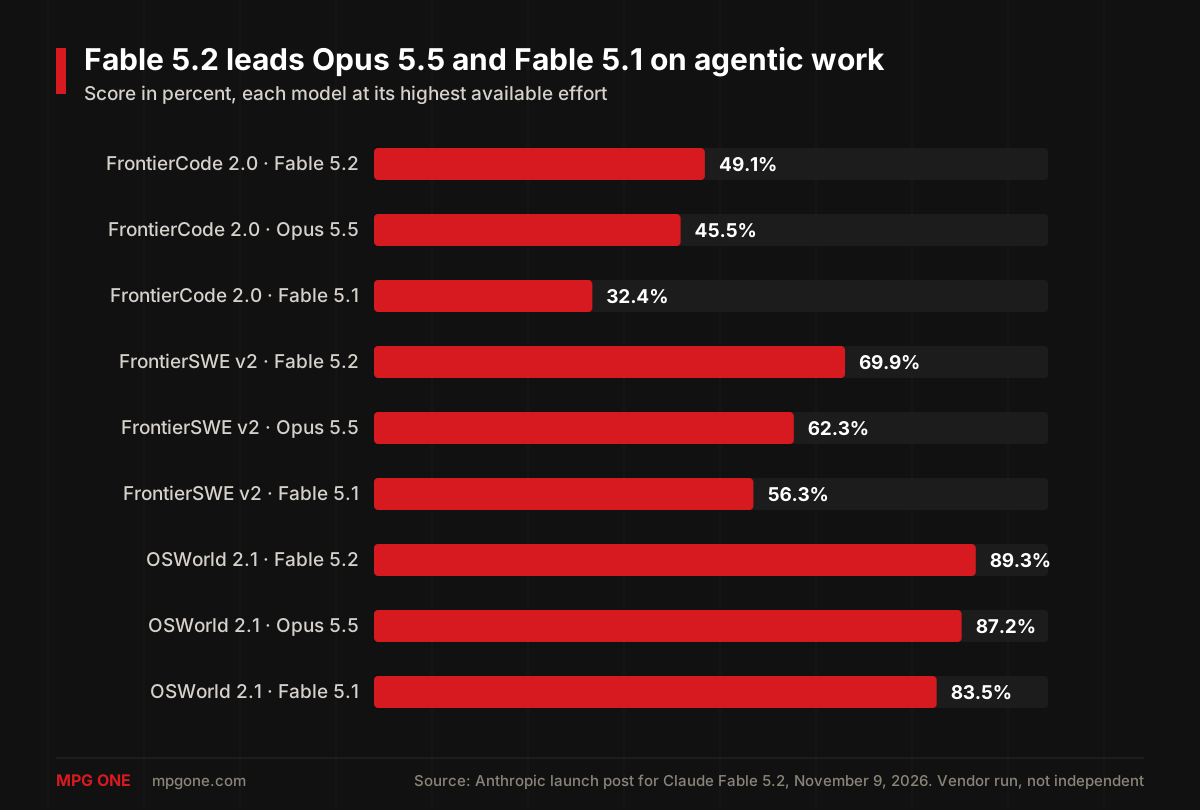
The benchmark gap between the two Fable versions is the largest in this comparison. Fable 5.2 gains 16 points on the Artificial Analysis index, 65 against 49, and 17.2 points on FrontierCode 2.0, 48.8% against 31.6%. Anthropic's launch table shows the same jump with its own runs: 49.1% against 32.4% on FrontierCode 2.0 and 69.9% against 56.3% on FrontierSWE v2.
Fable 5.2 also refuses less. Anthropic reports about 55% fewer blocked requests than Fable 5.1 in early testing, with about 60% fewer in cybersecurity and 40% fewer in biology. Both Fable models still fall back to an older Claude model when a request is blocked.
Fable 5.2 costs far more than Fable 5.1 at max effort. Fable 5.2 wrote 44,430 output tokens on our battery where Fable 5.1 wrote 11,691, so its run cost $1.78 against $0.59. Artificial Analysis saw the same thing at scale: 274,000 output tokens per task for Fable 5.2 against 118,000 for Fable 5.1, and $26.54 against $12.99.
Opus 5.5 vs Fable 5.1: The Cheaper Model Is Ahead
Opus 5.5 beats Fable 5.1 on score, price and cost per task, even though Fable was the more expensive line when both shipped in September 2026. Artificial Analysis scores Opus 5.5 at 59 and Fable 5.1 at 49 at max effort. Opus 5.5 leads on FrontierCode 2.0 at 46.4% against 31.6% and on Terminal-Bench 4.0 at 59.6% against 52.0%, and it ties Fable 5.1 on GDP.pdf at 26.2%.
Opus 5.5 lists at $4 and $20 per million tokens, 60% below Fable 5.1's $10 and $50. Per finished task the gap is smaller, $10.04 against $12.99 on the Artificial Analysis index, because Opus 5.5 writes more tokens at max effort. Anthropic's own table agrees with the ranking: Opus 5.5 scores 45.5% on FrontierCode 2.0 against 32.4% for Fable 5.1.
Our battery shows the same order on cost. Opus 5.5 ran it at medium effort for $0.093 and Fable 5.1 for $0.21, with the same 4.40 of 5. On BenchOne, our larger benchmark, Opus 5.5 and Fable 5.1 both score 96.6, at $1.91 and $4.82 a run. If you are still calling Fable 5.1, Opus 5.5 is the cheaper move and Fable 5.2 is the stronger one.
How I Tested Fable 5.2, Opus 5.5 and Fable 5.1
I ran Fable 5.2, Opus 5.5 and Fable 5.1 through our standard five task battery on November 9, 2026, each at medium, high and max effort. Every task gets one fresh request, I keep the first response, and there are no retries and no tools. All nine runs went through the Anthropic API on the same day, with output_config.effort set for each run.
- Bug hunt: a Python interval merge function with two planted bugs, one subtle
- Implementation: write a duration parser from a spec, graded by running it against 8 test cases, including an empty string trap
- Churn math: six monthly subscriber counts to 10 decimal places plus the closed form
- Facts and citations: state three 2026 API prices with official sources, or say you cannot
- Constrained writing: a 50 to 70 word announcement with five exact constraints, auto graded
Each number below comes from a single run, so small differences in time are within normal variation. I had tested Opus 5.5 on October 12 and reran it for this post. The new medium run cost $0.093 and took 43.2 seconds, against $0.092 and 44.7 seconds in October, so Opus 5.5 behaves the same on this battery as it did at launch.
Battery results
Fable 5.2, Opus 5.5 and Fable 5.1 scored 4.40 of 5 on all nine runs: 4 of 4 on the graded tasks plus 40 out of 100 on the facts task. Every run found both planted bugs and the empty input crash, passed all 8 parser test cases, produced the six exact subscriber counts with the closed form, and met all five writing constraints. On the facts task, no model gave a price it could not verify.
| Run | Score | Total time | Median time to first token | Output tokens | Cost at list price |
|---|---|---|---|---|---|
| Opus 5.5, medium | 4.40 of 5 | 43.2s | 4.3s | 4,477 | $0.093 |
| Opus 5.5, high | 4.40 of 5 | 46.7s | 5.1s | 5,012 | $0.10 |
| Opus 5.5, max | 4.40 of 5 | 409.0s | 64.5s | 46,903 | $0.94 |
| Fable 5.2, medium | 4.40 of 5 | 44.2s | 5.2s | 4,072 | $0.17 |
| Fable 5.2, high | 4.40 of 5 | 45.4s | 6.0s | 4,399 | $0.18 |
| Fable 5.2, max | 4.40 of 5 | 437.9s | 28.0s | 44,430 | $1.78 |
| Fable 5.1, medium | 4.40 of 5 | 55.6s | 5.3s | 3,961 | $0.21 |
| Fable 5.1, high | 4.40 of 5 | 55.2s | 6.7s | 4,154 | $0.22 |
| Fable 5.1, max | 4.40 of 5 | 142.6s | 15.4s | 11,691 | $0.59 |
Opus 5.5 was the cheapest model at medium and high effort, at $0.093 and $0.10 a run. Fable 5.2 cost $0.17 and $0.18 for the same score, and Fable 5.1 cost $0.21 and $0.22. The three models wrote a similar number of tokens at these levels, between 3,961 and 5,012, so the bills follow the price lists almost exactly.
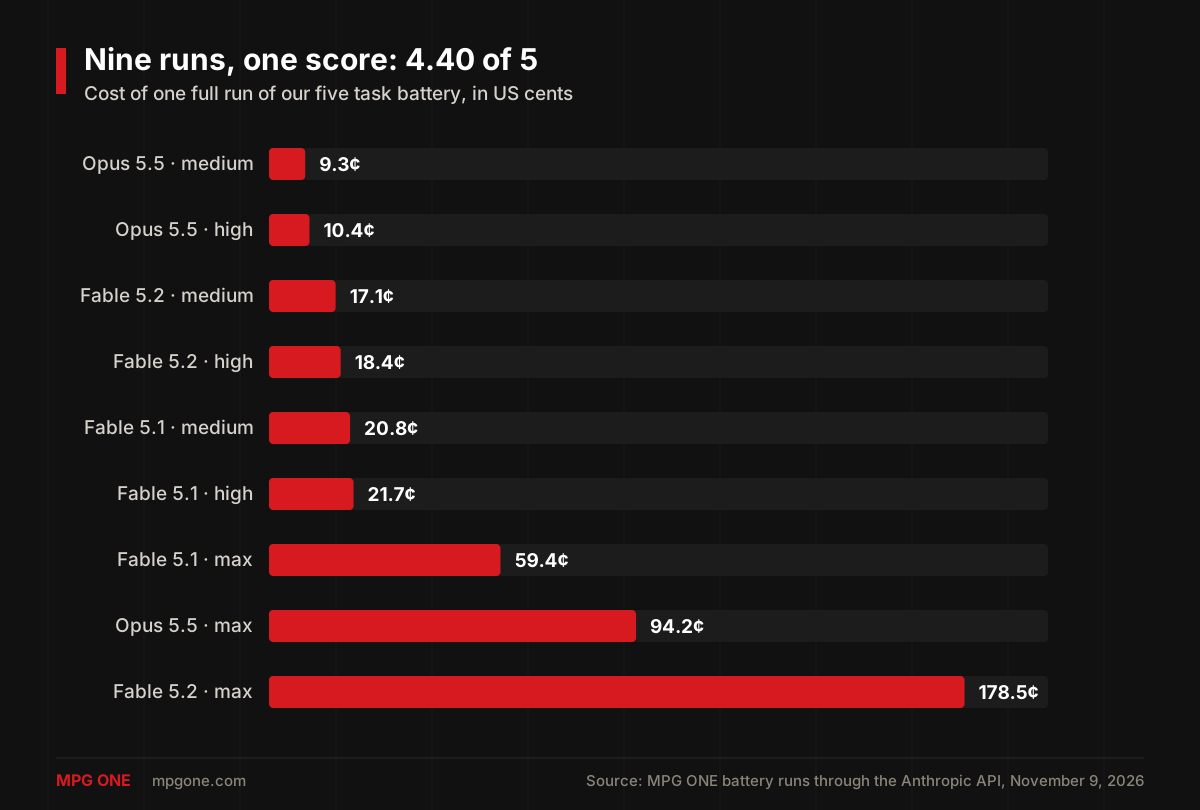
At max effort the order changed: Fable 5.2 cost $1.78 and took 437.9 seconds, Opus 5.5 cost $0.94 and took 409.0 seconds, and Fable 5.1 cost $0.59 and took 142.6 seconds. Fable 5.2 and Opus 5.5 each wrote about ten times as many tokens at max as at medium, while Fable 5.1 wrote about three times as many, and no grade changed on any of the three.
This battery is saturated at the top, so it cannot rank the three models on intelligence. It does show what each one charges and how long it takes to reach the same correct answers, and for that the Artificial Analysis numbers above are the better guide to hard work.
Fable 5.2 vs Opus 5.5 Pricing and Cost per Task
Opus 5.5 costs exactly half of Fable 5.2 on input and output: $4 against $8 per million input tokens and $20 against $40 per million output tokens. Fable 5.1 is the most expensive of the three at $10 and $50. Cache reads cost $0.20 per million tokens on both Fable 5.2 and Opus 5.5, and $0.25 on Fable 5.1.
| Price per 1M tokens | Fable 5.2 | Opus 5.5 | Fable 5.1 |
|---|---|---|---|
| Input | $8 | $4 | $10 |
| Output | $40 | $20 | $50 |
| Cache read | $0.20 | $0.20 | $0.25 |
| Cache write, 5 minutes | $10 | $5 | $12.50 |
| Cache write, 1 hour | $16 | $8 | $20 |
| Batch API | 50% off | 50% off | 50% off |
Cost per task depends on effort more than on the price list. At medium and high effort, Fable 5.2 cost about 1.8 times Opus 5.5 on our battery, close to the 2 times gap in list price. At max effort on the Artificial Analysis index the gap grows to 2.6 times, $26.54 against $10.04, because Fable 5.2 writes far more at max. Fable 5.2 also has an optional fast mode at $16 and $80 per million tokens that Anthropic says speeds up output by up to 2.5 times.
Anthropic argues that Fable 5.2 can be the cheaper model on hard tasks when you run it at a lower effort. Its launch post says Fable 5.2 at medium effort matches Opus 5.5's top score on the WANDR agentic search benchmark for about 40% of the cost per task. Those are vendor numbers, and our battery is too easy to confirm or reject them.
Fable 5.2 vs Opus 5.5 for Coding
Fable 5.2 leads Opus 5.5 on coding benchmarks by up to 8 points, depending on who ran the test. Artificial Analysis measures 48.8% against 46.4% on FrontierCode 2.0 and a tie at 59.6% on Terminal-Bench 4.0. Anthropic's own table shows wider gaps: 49.1% against 45.5% on FrontierCode 2.0 and 69.9% against 62.3% on FrontierSWE v2.
Anthropic's launch post says Fable 5.2 at high effort scored 45.3% on FrontierCode 2.0, level with Opus 5.5's best score of 45.5% at max effort, for roughly half the cost per task. If you already run Opus 5.5 at xhigh or max for hard coding work, Fable 5.2 at high is the configuration to test against it.
Fable 5.2 separates most clearly on very long projects. In Anthropic's proof formalization test, a team of about 1,000 Fable 5.2 agents finished formalizing Fermat's Last Theorem in 30 hours, while Opus 5.5 with the same setup had completed 26% after 18 hours and barely moved after that. For ordinary coding tasks our battery found no difference: both models fixed the same bugs and passed the same 8 parser tests at every effort level. The previous generation showed the same split in Opus 5 vs Fable 5.
Fable 5.2, Opus 5.5 or Fable 5.1: Which Claude Model Should You Use?
Use Opus 5.5 for daily work, Fable 5.2 for the hardest long projects, and move off Fable 5.1. Anthropic's docs give the same advice: start with Opus 5.5 for most workloads, and use Fable 5.2 when Opus 5.5 at higher effort still falls short.
- Everyday coding and knowledge work: Opus 5.5 at medium. It matched both Fable models on our battery for $0.093 a run and leads AA-Briefcase at 1,800 Elo.
- Long agentic projects and research: Fable 5.2 at high. It leads the Artificial Analysis index 65 to 59 and Terminal-Bench-Science by 14.3 points.
- Hard coding where Opus 5.5 at max stalls: Fable 5.2 at high, which Anthropic says matches Opus 5.5 at max on FrontierCode 2.0 for about half the cost.
- Still on Fable 5.1: switch. Fable 5.2 is 20% cheaper per token and 16 index points stronger, and Opus 5.5 is 60% cheaper and 10 points stronger.
- Any model at max effort: only when the task needs it. Max cost 10 times medium for Fable 5.2 and Opus 5.5 in our runs and changed no grade.
During launch week, Anthropic includes Fable for up to 50% of weekly usage limits on Pro plans and standard Team seats, so subscribers can try Fable 5.2 before paying API rates. For how Opus 5.5 compares with other vendors, see GPT-6.1 Sol vs Opus 5.5 and Gemini 4 Argon vs Opus 5.5.
FAQ
Is Fable 5.2 better than Opus 5.5?
On hard benchmarks, yes: Artificial Analysis scores Claude Fable 5.2 at 65 and Opus 5.5 at 59 on its Intelligence Index at max effort. On our five task battery both scored 4.40 of 5, and Opus 5.5 cost $0.093 a run against $0.17 for Fable 5.2, so Opus 5.5 is the better pick for everyday coding and knowledge work.
Is Fable 5.2 better than Fable 5.1?
Yes. Fable 5.2 scores 65 on the Artificial Analysis Intelligence Index against 49 for Fable 5.1, costs 20% less per token at $8 and $40 per million, and ran our battery at medium effort in 44 seconds against 56 seconds. Anthropic now lists Fable 5.1 as a legacy model.
Is Opus 5.5 better than Fable 5.1?
Yes, on both score and price. Artificial Analysis scores Opus 5.5 at 59 and Fable 5.1 at 49 at max effort, and Opus 5.5 costs $10.04 per index task against $12.99. Opus 5.5 lists at $4 and $20 per million tokens, 60% below Fable 5.1.
Is Fable 5.2 at high effort better than Opus 5.5 at xhigh?
Anthropic says Fable 5.2 at high effort scored 45.3% on FrontierCode 2.0, level with Opus 5.5's best score of 45.5% at max effort, for roughly half the cost per task. On our smaller battery both models scored 4.40 of 5 at high effort, and Opus 5.5 cost $0.10 against $0.18.
Should I upgrade from Fable 5.1 to Fable 5.2?
Yes, for almost every workload. Fable 5.2 is cheaper per token, faster, scores higher on every Artificial Analysis test except GDP.pdf, and blocks about 55% fewer requests. Keep it off max effort unless the task needs it: Fable 5.2 at max cost $1.78 on our battery against $0.59 for Fable 5.1.
Final Thoughts
Fable 5.2 vs Opus 5.5 comes down to how hard and how long your tasks are. Fable 5.2 has the highest Artificial Analysis index score of the three, and it replaced Fable 5.1 at a lower price. Opus 5.5 reached the same answers on our battery for about half the money, and it beats the older Fable 5.1 on score and on cost.
I would run Opus 5.5 at medium effort by default, test Fable 5.2 at high on the projects where Opus 5.5 stalls, and retire Fable 5.1. If you want help choosing the right model and effort level for your product, our AI development services team does this work every week.
Helpful next steps
Turn the idea into something useful
When this topic becomes part of a real website, workflow, campaign, or AI system, these MPG ONE pages are the natural places to continue.
Build private AI assistants, workflow automation, knowledge systems, and reporting layers.
Generative AI development servicesBuild generative AI workflows for content, documents, knowledge, and brand-safe operations.
AI agent development servicesDesign tool-using AI agents with memory, retrieval, permissions, and human review.
Custom AI solutionsCreate a custom AI system around your data, tools, permissions, and operating model.
GitHub, MCP and Codex skillsExplore RepoGuard, MCP wrappers, and AI-agent workflows built by MPG ONE.