AI
Gemini 4 Argon vs GPT-6.1 Sol: Tied Score, Sol Far Cheaper
Gemini 4 Argon vs GPT-6.1 Sol tested: both scored 4.40 of 5 and 50 on Artificial Analysis, but Sol costs $0.59 per task to Argon's $9.95. See the data.

By Mohamed Ezz CEO & Founder Nov 6, 2026 · Updated Nov 7, 2026
Gemini 4 Argon vs GPT-6.1 Sol is a tie on intelligence and a clear win for Sol on cost: Artificial Analysis scores both models at 50 at high effort, but Argon costs $9.95 per index task to Sol's $0.59. In our own five task battery both scored 4.40 of 5, and Sol's run cost $0.017 to Argon's $0.023.
After nearly 20 years in AI development and digital marketing, I trust a model's bill more than its launch table. Both models list at $2 and $10 per million tokens until November 30, 2026, so this comparison comes down to how many tokens each one burns to do the same work, and I ran both through our battery to measure it.
My Main Points:
- Gemini 4 Argon and GPT-6.1 Sol both list at $2 input and $10 output per million tokens until November 30, 2026. From December 1, Argon doubles to $4 and $20.
- Artificial Analysis scores both at 50 at high effort, but Argon writes 116k output tokens per task to Sol's 22.6k and costs $9.95 per task at list price to Sol's $0.59.
- Our battery on November 6, 2026: both scored 4.40 of 5. Sol cost $0.017 at medium and $0.027 at high; Argon cost $0.023 and $0.124.
- Argon wins 6 of 9 Artificial Analysis sub tests, including AutomationBench at 78% to 64%. Sol wins CritPt (69% to 53%), FrontierCode 2.0 and GDP.pdf.
- On the Vals Index v2.2, Argon ranks 4th at 69.24% and Sol 8th at 63.94%, at $13.37 and $3.61 per test.
- Argon takes video, audio and PDF input and has no long prompt surcharge. Sol takes text and images and charges double for input above 272K tokens.
This post uses the same battery as our Gemini 4 Argon vs Opus 5.5 and GPT-6.1 Sol vs Opus 5.5 tests, so you can line up all three models side by side.
Gemini 4 Argon vs GPT-6.1 Sol at a Glance
Gemini 4 Argon and GPT-6.1 Sol are reasoning models from Google and OpenAI with about a million tokens of context each, and they differ most in what they accept as input and how they price long prompts. OpenAI released GPT-6.1 Sol on September 29, 2026, and Google made Gemini 4 Argon available on October 13, 2026.
| Spec | Gemini 4 Argon | GPT-6.1 Sol |
|---|---|---|
| API model id | gemini-4-argon | gpt-6.1-sol |
| Available | Oct 13, 2026 | Sept 29, 2026 |
| Input and output price (per 1M tokens) | $2 and $10 until Nov 30; $4 and $20 from Dec 1 | $2 and $10 |
| Cached input | $0.10, then $0.20 from Dec 1 (implicit caching only) | $0.10 |
| Prompts above 272K tokens | Same rate at every length | 2x input and cache, 1.5x output for the whole request |
| Context window | 1M tokens, shared by input, thinking and output | 1,050,000 tokens |
| Output limit | 64K default; up to 1M with long decode | 128,000 tokens |
| Input types | Text, image, video, audio, PDF | Text and image |
| Reasoning control | thinking_level: low, medium (default), high | reasoning.effort: low, medium (default), high, xhigh, max |
| Where to use it | Gemini API paid tier, Gemini app (AI Pro and Ultra), Antigravity (Ultra) | OpenAI API, Codex with a ChatGPT login |
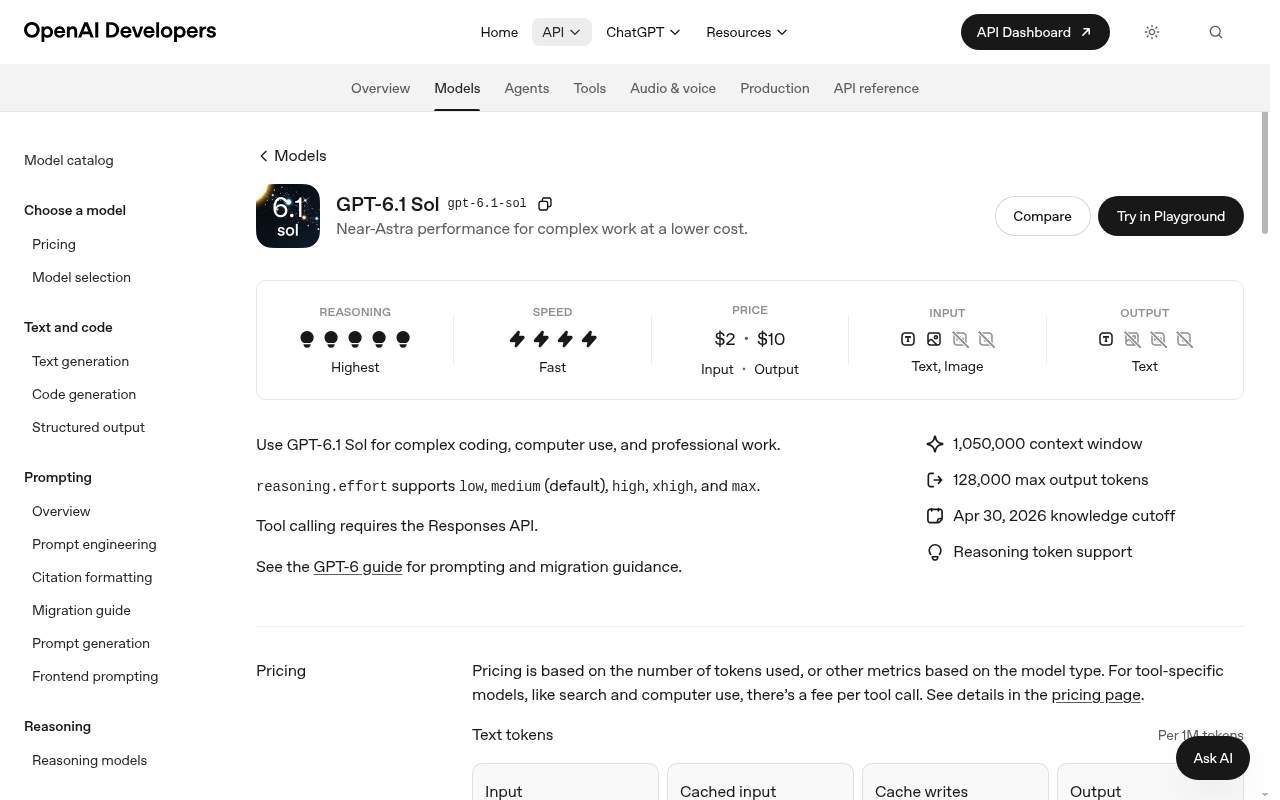
The prices come from Google's Gemini API pricing page and OpenAI's GPT-6.1 Sol model page. OpenAI also sells Sol at half price through Batch and Flex, and at 2x for Fast mode and 6x for Ultrafast mode. Sol's knowledge runs to April 30, 2026.
How I Tested Gemini 4 Argon and GPT-6.1 Sol
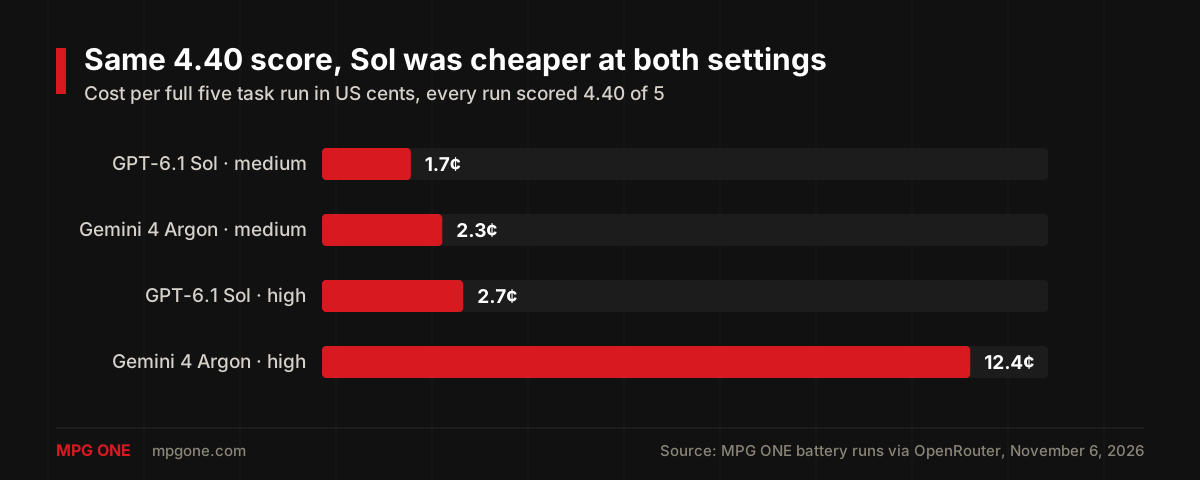
Gemini 4 Argon and GPT-6.1 Sol both scored 4.40 of 5 on our five task battery at medium and at high effort, and GPT-6.1 Sol was the cheaper and faster model at both settings. The gap was small at medium, $0.017 against $0.023, and wide at high, where Argon cost 4.7 times as much.
The battery is the one we use across our model tests, including Kimi K3.1 Pro vs Opus 5.5: five original tasks (a bug hunt in an interval merging function, an implementation from a spec with an empty string trap, a churn math problem, a facts and citations check, and a constrained writing brief), one fresh request per task, first response only, no retries, each task scored 0 to 100 and averaged to a score out of 5.
Both models ran on November 6, 2026 through OpenRouter with no tools. I pinned Argon to Google AI Studio and Sol to OpenAI's own endpoint, with fallbacks switched off, so each ran on its maker's servers at the $2 and $10 list price. Our own Gemini key is on the free tier, where Google's quota for gemini-4-argon is zero, which is why I did not call Google directly.
| Battery run | Score | Total time, 5 tasks | Median time to first token | Output tokens | Cost |
|---|---|---|---|---|---|
| GPT-6.1 Sol, medium | 4.40 of 5 | 34.5 s | 6.1 s | 1,582 | $0.017 |
| Gemini 4 Argon, medium | 4.40 of 5 | 46.4 s | 4.2 s | 2,117 | $0.023 |
| GPT-6.1 Sol, high | 4.40 of 5 | 53.1 s | 8.5 s | 2,536 | $0.027 |
| Gemini 4 Argon, high | 4.40 of 5 | 140.4 s | 23.9 s | 12,271 | $0.124 |
Sol's medium run cost 1.7 cents, Argon's medium run 2.3 cents, Sol at high 2.7 cents and Argon at high 12.4 cents. Raising Sol from medium to high added about 1 cent; raising Argon added 10 cents, because Argon at high wrote 12,271 output tokens to Sol's 2,536. From December 1, Argon's runs would cost twice as much again.
Both models found the two planted bugs, the end value that shrinks a merged interval and the strict comparison that keeps touching intervals apart, and both added a guard for empty input. Argon also called the in place sort a bug and switched to a sorted copy; Sol noted the in place sort and kept it, saying it is only a bug if the caller needs the list unchanged. Every run passed 8 of 8 implementation checks including the empty string trap, got the churn math exact with the closed form, and scored 100 on the writing brief.
The facts task asks for three API prices with no web access, and neither model guessed a number. Sol gave the cleanest answer in this round of tests: every price marked unverified, the official pricing pages listed as places to check and labeled as not evidence, and no claim about whether the models exist. Argon at medium refused the prices too, but stated that OpenAI has not released a model by that name and that Anthropic does not use the name Fable, which is wrong; at high it hedged and said the names could be newer than its training data. Both earned the same 40 out of 100.
This battery is now saturated: Gemini 4 Argon, GPT-6.1 Sol, Claude Opus 5.5, Claude Fable 5.1 and Kimi K3.1 Pro all score 4.40 on it. It measures cost and speed on short tasks well and quality poorly, so the quality comparison comes from the independent benchmarks and hands on tests below.
Update, November 7, 2026: this battery has since grown into BenchOne, our 12 task AI benchmark ranking with three runs per model. GPT-6.1 Sol scores 95.4 there for $0.53 a run and Gemini 4 Argon scores 91.7 for $0.71, so Sol stays ahead on the harder set too.
Gemini 4 Argon vs GPT-6.1 Sol Cost per Task
GPT-6.1 Sol costs far less per task than Gemini 4 Argon even though both charge $2 and $10 per million tokens until November 30, because Sol writes far fewer tokens to reach the same score. On the Artificial Analysis index, Argon at high writes 116k output tokens per task, 68.3k of them reasoning, against 22.6k for Sol at high, 10.1k of them reasoning.
Artificial Analysis prices Argon at its $4 and $20 list rate and measures $9.95 per task, against $0.59 for Sol at high; running the whole index cost $7,620 on Argon and $573 on Sol. Until November 30 the same Argon work costs about half, roughly $4.98 per task by my estimate, which is still about eight times Sol. Sol at max effort scores 55, five points above both high settings, for $1.27 per task.
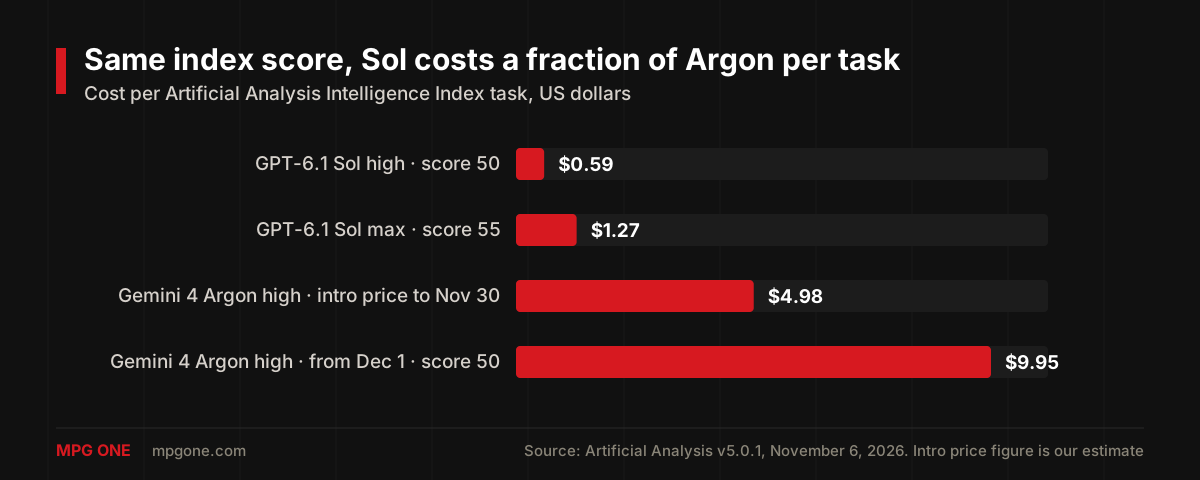
A Reddit post in r/codex on October 13 made the same point with the older index: "Sol 6.1 Max $0.79. Argon $1.99", at a similar score of 53. On version 5.0.1 the gap is wider: Sol at max now costs $1.27 per task against roughly $4.98 for Argon at the intro price and $9.95 at list. The Vals Index shows the same direction on its own tasks, at $13.37 per test for Argon and $3.61 for Sol.
Long prompts change the math in Argon's favor. OpenAI charges 2x input and cache and 1.5x output for any Sol request above 272K input tokens, on the whole request, while Google lists one Argon rate at every prompt length. If your workload sends whole codebases or long document sets in a single call, price those calls on both models before you choose.
Gemini 4 Argon vs GPT-6.1 Sol Benchmarks
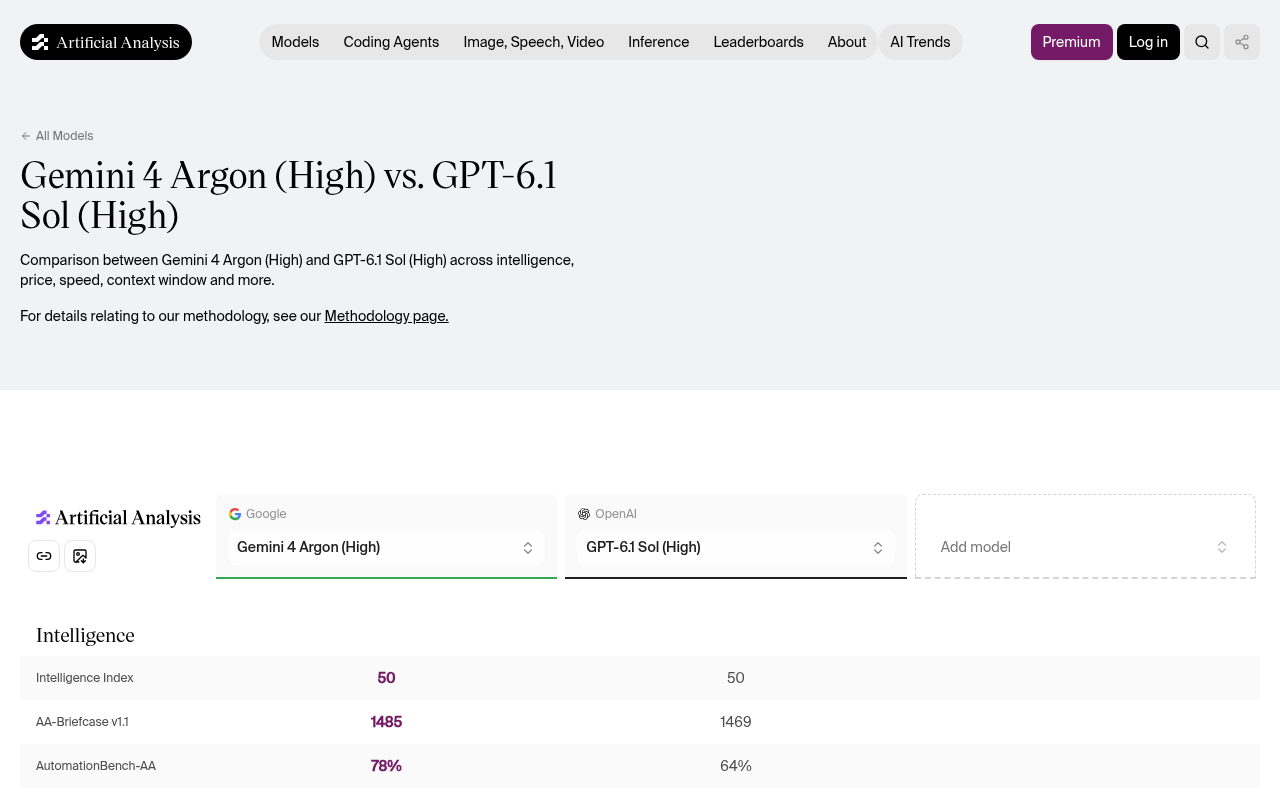
Gemini 4 Argon wins 6 of the 9 tests inside the Artificial Analysis Intelligence Index v5.0.1, and GPT-6.1 Sol wins the other 3, so the overall tie at 50 hides a real split by kind of work. Argon leads on agent and terminal work: AutomationBench, Zapier's business workflow test, 78% to 64%, and Terminal-Bench 4.0, 57% to 52%. Sol leads on science and hard code: the hard subset of CritPt v2, 69% to 53%, FrontierCode 2.0, 37% to 26%, and GDP.pdf, 32% to 22%.
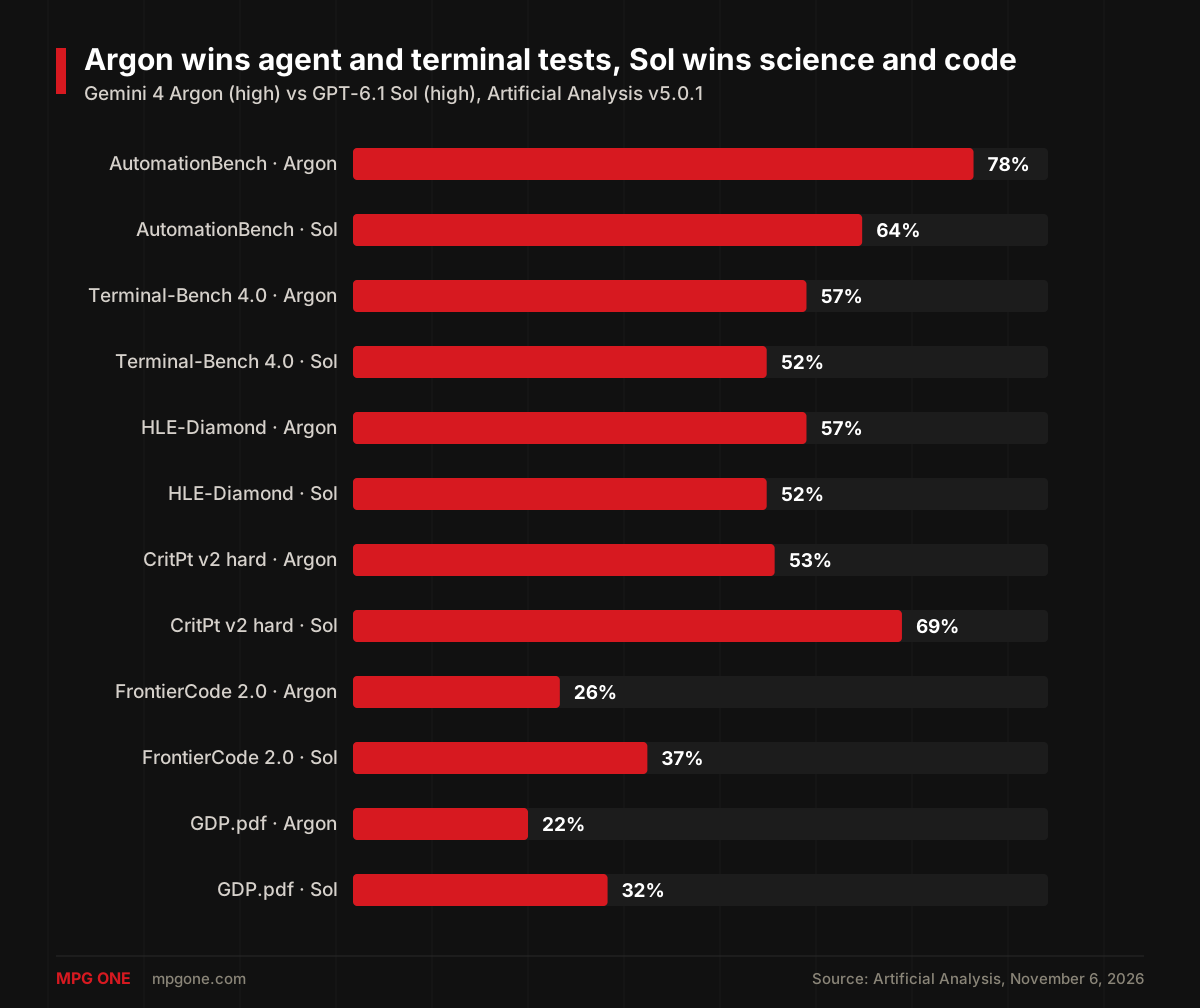
The remaining four sub tests also go to Argon: HLE-Diamond 57% to 52%, Terminal-Bench Science 53% to 46%, AA-Omniscience 46 to 41, and the AA-Briefcase knowledge work Elo 1485 to 1469, which is close to a tie. Sol's GDP.pdf lead stands out because Google lists PDF as an Argon input type and OpenAI lists only text and images for Sol, yet Sol scores ten points higher on answering questions from complex PDFs.
The Vals Index v2.2, updated November 5, 2026, weights coding, finance, legal and tax tasks, and it puts Argon 4th at 69.24% and Sol 8th at 63.94%, with both taking about 44 minutes per test. On DeepSWE, the coding benchmark with tasks written from scratch, Google reports 77.9% for Argon and OpenAI says Sol matches GPT-6 Astra, which Google's table puts at 74.1%. The public DeepSWE board was last updated September 22 and has neither model yet, so both figures are vendor claims.
Gemini 4 Argon vs GPT-6.1 Sol Speed and Latency
Gemini 4 Argon writes faster and GPT-6.1 Sol finishes short jobs sooner, because Sol has far less to write. Artificial Analysis measures 72 output tokens per second for Argon at high against 53 for Sol, a time to first answer token of 38.0 seconds against 42.9, and a mean end to end time of 115.6 seconds against 164.7. Sol at max waits 196.8 seconds before its first answer token.
In our battery Sol finished all five tasks in 34.5 seconds at medium against 46.4 for Argon, and in 53.1 seconds at high against 140.4. Argon started answering sooner at medium, 4.2 seconds to Sol's 6.1, and later at high, 23.9 seconds to Sol's 8.5. On long builds the results split: AsapGuide found Argon the slowest model in Antigravity, while The Useful Stack's Argon build finished in about 19 minutes to Sol's 21.
Hands On Tests of Gemini 4 Argon and GPT-6.1 Sol
Hands on testers who built the same apps with Gemini 4 Argon and GPT-6.1 Sol found Sol equal or better on most builds at a lower cost, while Argon finished first in one of them. Both tests below are one run per model with different tools for each, so read them as samples.
The Useful Stack: Minecraft from one prompt
The Useful Stack asked Argon, Sol and Claude Opus 5.5 to build a playable Minecraft clone in the browser from one prompt, in a video published October 15, 2026. All three built a working game that kept 60 frames per second and restored every block after a save and reload, so the host called it a tie. The split came on time and cost (3:02): Argon took about 19 minutes in Antigravity at high, where no cost is reported, Sol took 21 minutes at xhigh for an estimated 60 cents, and Opus 5.5 took 68 minutes for $18.85.
AsapGuide: three builds against Opus 5.5
AsapGuide ran Argon, Sol and Claude Opus 5.5 at high effort on three browser builds, each in its vendor's own app, in a video published October 18, 2026. Sol made the best pixel art converter and Argon's ranked last of the three (6:57). On a 3D flight simulator Sol's version had the longest draw distance and a clean map, Argon's was playable with map glitches, and Opus 5.5 won the round (12:39). On a music visualizer Argon and Sol tied behind Opus 5.5 (21:07).
The host found Argon consistently the slowest model because it kept thinking and testing its own work (23:20), and his verdict was that Sol offers similar and often better results at a fraction of Argon's price (24:38).
Which Should You Use, Gemini 4 Argon or GPT-6.1 Sol?
Use GPT-6.1 Sol as the default for most work, because it matches Gemini 4 Argon's overall score for a fraction of the cost, and pick Argon when the job needs its inputs, its long outputs or its agent strengths.
- High volume agents, coding bots and pipelines: Sol. $0.59 per Artificial Analysis task against $9.95, and cheaper in our battery at both settings.
- Business workflow agents across apps: Argon, 78% to 64% on AutomationBench.
- Terminal and command line agents: Argon by a small margin, 57% to 52% on Terminal-Bench 4.0.
- Science, math and hard code: Sol, 69% to 53% on CritPt and 37% to 26% on FrontierCode 2.0.
- Questions over PDFs: Sol scores higher on GDP.pdf, 32% to 22%, even though only Argon lists PDF as an input type.
- Video and audio input: Argon. Sol takes text and images only.
- Very long outputs: Argon, up to 1M output tokens with long decode against Sol's 128,000.
- Single prompts above 272K tokens: Argon, which has no long prompt surcharge.
Google's developer guide suggests Argon as an orchestrator for planning and review, with cheaper Gemini 3.8 Flash subagents doing the parallel work. That pattern keeps Argon's token use, and its bill, small. For the previous Sol generation against Anthropic's top model, see Fable 5 vs GPT-5.6 Sol.
FAQ
Is Gemini 4 Argon better than GPT-6.1 Sol?
On overall intelligence they tie: Artificial Analysis scores Gemini 4 Argon and GPT-6.1 Sol at 50 each at high effort. Argon wins 6 of the 9 sub tests and ranks 4th on the Vals Index at 69.24% to Sol's 8th place at 63.94%, while Sol does the same index work for a fraction of the cost.
Is GPT-6.1 Sol cheaper than Gemini 4 Argon?
Yes. Both list at $2 and $10 per million tokens until November 30, 2026, but GPT-6.1 Sol writes far fewer tokens: Artificial Analysis measures $0.59 per task for Sol against $9.95 for Gemini 4 Argon at its $4 and $20 list price. In our battery Sol's medium run cost $0.017 to Argon's $0.023.
Which is better for coding, Gemini 4 Argon or GPT-6.1 Sol?
It depends on the job. Gemini 4 Argon leads Terminal-Bench 4.0 at Artificial Analysis, 57% to 52%, and GPT-6.1 Sol leads FrontierCode 2.0, 37% to 26%. Both solved our bug hunt and parser tasks perfectly, and both built a playable Minecraft clone in The Useful Stack's test.
Which is faster, Gemini 4 Argon or GPT-6.1 Sol?
Gemini 4 Argon writes faster, 72 tokens per second to GPT-6.1 Sol's 53 at Artificial Analysis, with a mean end to end time of 115.6 seconds to Sol's 164.7. Sol finished our short battery sooner because it wrote fewer tokens: 34.5 seconds at medium against 46.4 for Argon.
Gemini 4 Argon vs GPT-6.1 Sol vs Opus 5.5, which is best?
Claude Opus 5.5 scores highest on Artificial Analysis at 59, against 50 for both Gemini 4 Argon and GPT-6.1 Sol at high effort. Per task it costs $10.04, close to Argon's $9.95 and far above Sol's $0.59. All three scored 4.40 of 5 in our battery.
Final Thoughts
Gemini 4 Argon vs GPT-6.1 Sol is a tie on score and a clear win for Sol on cost. Both reach 50 on Artificial Analysis and 4.40 of 5 in our battery, and Sol gets there with about a fifth of Argon's output tokens, which makes it 17 times cheaper per index task at list price and about 8 times cheaper during Argon's intro offer. Argon still wins more sub tests, ranks higher on the Vals Index and handles video, audio, very long outputs and long prompts, so it earns its place on agent workflows and multimodal jobs. Check the price again on December 1, when Argon's token rates double and the gap with Sol grows.
If you are choosing a model for an agent that will run thousands of tasks a day, the token count per task will shape your bill more than the price per token. Our AI agent development services team tests candidate models on your own workload before the build starts.
Helpful next steps
Turn the idea into something useful
When this topic becomes part of a real website, workflow, campaign, or AI system, these MPG ONE pages are the natural places to continue.
Build private AI assistants, workflow automation, knowledge systems, and reporting layers.
Generative AI development servicesBuild generative AI workflows for content, documents, knowledge, and brand-safe operations.
AI agent development servicesDesign tool-using AI agents with memory, retrieval, permissions, and human review.
Custom AI solutionsCreate a custom AI system around your data, tools, permissions, and operating model.
GitHub, MCP and Codex skillsExplore RepoGuard, MCP wrappers, and AI-agent workflows built by MPG ONE.