AI
Fable 5.2 vs GPT-6 Astra: Benchmarks, Price, Tested
Fable 5.2 vs GPT-6 Astra: both scored 4.40 of 5 in our test, Astra for $0.095 a run, Fable 5.2 for $0.17. See DeepSWE, prices and the verdict.

By Mohamed Ezz CEO & Founder Nov 9, 2026
Fable 5.2 vs GPT-6 Astra ended in a tie on our own five task battery: both models scored 4.40 of 5, and GPT-6 Astra finished its run for $0.095 against $0.17 for Fable 5.2 at medium effort. Anthropic lists Claude Fable 5.2 at $8 per million input tokens and $40 per million output tokens, and OpenAI lists GPT-6 Astra at $10 and $50.
After nearly 20 years in AI development and digital marketing, I check what a model costs per finished task before I look at its price list, and this pair shows why. In this comparison I cover the independent DeepSWE numbers, what Artificial Analysis measured, what we saw when we ran both models ourselves on November 9, 2026, and which jobs justify paying for Fable 5.2.
My Main Points:
- Fable 5.2 costs $8 and $40 per million tokens; GPT-6 Astra costs $10 and $50, so Fable 5.2 is 20% cheaper per token
- Both models scored 4.40 of 5 on our battery at every effort level we ran: Fable 5.2 at medium, high and max, GPT-6 Astra at medium and high
- GPT-6 Astra at medium was the cheapest run at $0.095, against $0.17 for Fable 5.2 at medium, because Astra wrote 1,765 output tokens to Fable 5.2's 4,072
- Fable 5.2 at max effort scored the same 4.40 for $1.78, about 10 times the cost and time of its medium run
- Artificial Analysis scores Fable 5.2 at 65 and GPT-6 Astra at 57 at max effort, at $26.54 and $6.24 per task
- GPT-6 Astra is on the independent DeepSWE board at 74% for $4.43 per task; Fable 5.2 is not listed yet
This post follows our earlier flagship matchup, Fable 5 vs GPT-5.6 Sol, and uses the same battery as GPT-6.1 Sol vs Opus 5.5, so the numbers line up across the series.
Fable 5.2 vs GPT-6 Astra at a Glance
Fable 5.2 and GPT-6 Astra are the top models from Anthropic and OpenAI, built for the hardest technical work each lab sells. OpenAI shipped GPT-6 Astra on September 3, 2026. Anthropic shipped Fable 5.2 on November 9, 2026, with a lower price than Fable 5.1 and output that Anthropic says is up to 30% faster.
| Claude Fable 5.2 | GPT-6 Astra | |
|---|---|---|
| Maker | Anthropic | OpenAI |
| Released | November 9, 2026 | September 3, 2026 |
| API model id | claude-fable-5-2 | gpt-6-astra |
| Context window | 1M tokens | 1,050,000 tokens |
| Max output | 128K tokens | 128,000 tokens |
| Knowledge cutoff | June 2026 | April 30, 2026 |
| Input per 1M | $8 ($0.20 cache read) | $10 ($1 cached) |
| Output per 1M | $40 | $50 |
| Fast mode per 1M | $16 and $80 | $20 and $100 |
| Effort levels | low, medium, high, xhigh, max | low, medium, high, xhigh, max |
| Default effort in the API | high | Not stated on the model page |
| Thinking | Adaptive, always on | Reasoning tokens, configurable effort |
The specs come from the Fable 5.2 overview and the GPT-6 Astra model page. Fable 5.2 defaults to high effort in the API and to medium in the Claude apps and Claude Code, so the same model costs a different amount depending on where you call it.
Fable 5.2 vs GPT-6 Astra on DeepSWE
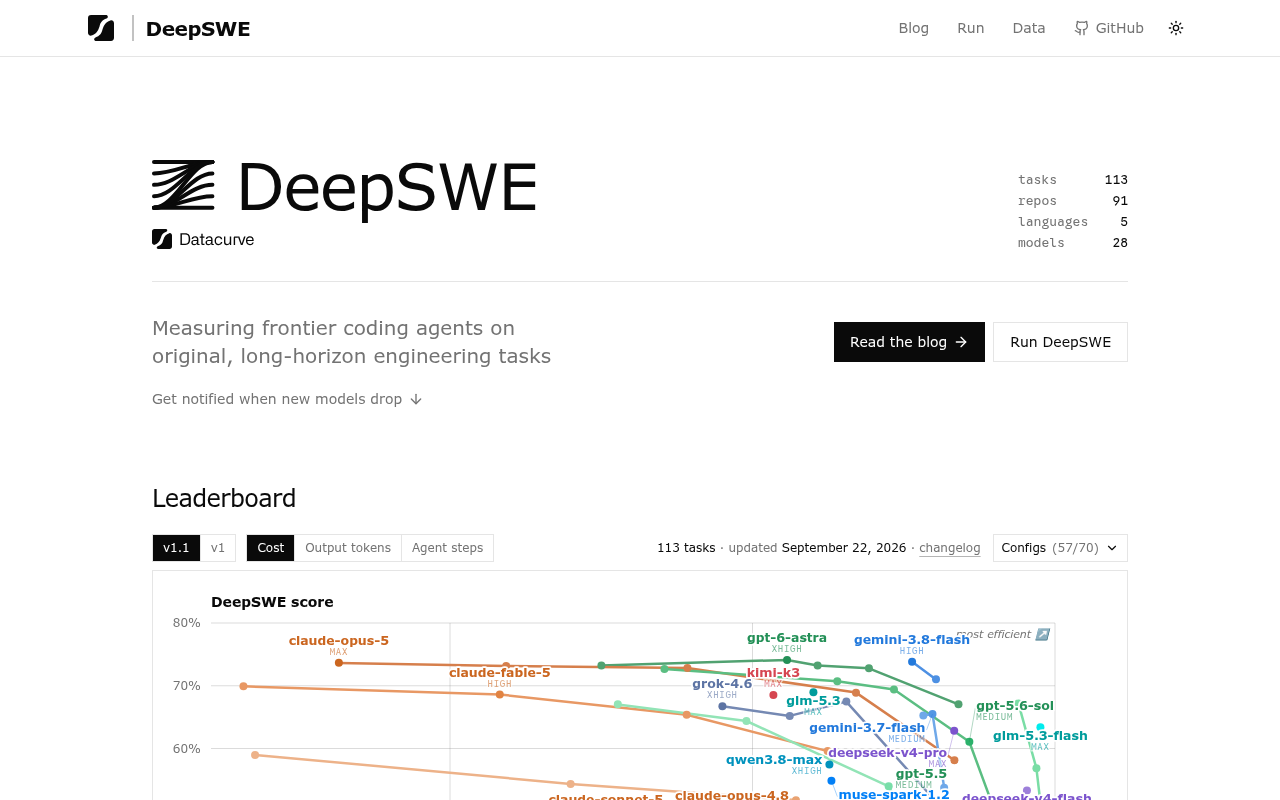
GPT-6 Astra scores 74% (±3%) on the independent DeepSWE leaderboard at $4.43 per task, and Fable 5.2 is not on the board yet. As of November 9, 2026 the leaderboard was last updated on September 22, seven weeks before Fable 5.2 shipped. I lead with DeepSWE because its 113 tasks are newly written with hand built verifiers, so no model has seen the answers in training.
The closest independent number for Anthropic's flagship line is the older Claude Fable 5, which scores 70% (±3%) at xhigh effort for $13.41 per task. Claude Opus 5 at max scores 74% (±4%) for $11.84, and GPT-5.6 Sol at max scores 73% (±3%) for $6.46. The error bars on all four overlap, so the pass rates are a tie, and GPT-6 Astra is the cheapest of the four at about a third of Fable 5's bill.
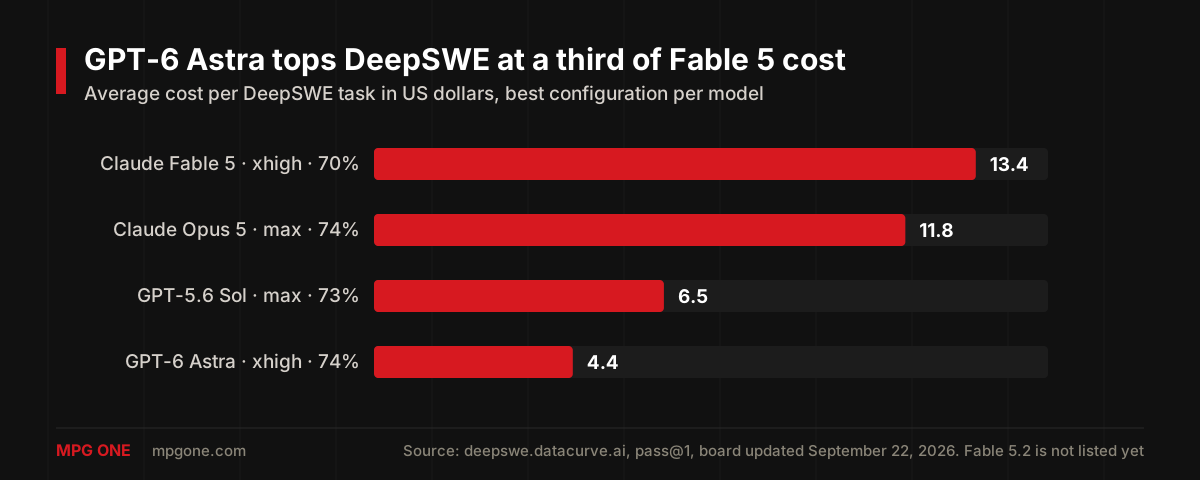
GPT-6 Astra also solves DeepSWE tasks with far less output than its rivals. The board shows about 30,000 output tokens and 29 agent steps per task for Astra, against 80,000 tokens and 68 steps for Fable 5. Fable 5.2 has no DeepSWE score to compare, so I will update this section when the board adds it.
Fable 5.2 vs GPT-6 Astra on Secondary Benchmarks
Secondary benchmarks give Fable 5.2 the lead on score and GPT-6 Astra the lead on cost and time per task. I treat these as context around DeepSWE and our own runs, because one source is a third party index and the other is Anthropic's own table.
Artificial Analysis Intelligence Index
Artificial Analysis scores Fable 5.2 at 65 and GPT-6 Astra at 57 on its Intelligence Index, both at max effort. Fable 5.2 leads on FrontierCode 2.0 at 48.8% against 42.4%, on Terminal-Bench-Science 0.1 at 73.3% against 63.3%, and on HLE-Diamond at 80.2% against 63.8%. Terminal-Bench 4.0 is a tie at 59.6% against 59.1%, and GPT-6 Astra wins GDP.pdf, the test of reasoning over professional documents, at 31.0% against 24.2%.
Artificial Analysis measures $26.54 per index task for Fable 5.2 and $6.24 for GPT-6 Astra, because Fable 5.2 wrote 274,000 output tokens per task against Astra's 52,000. Fable 5.2 also took 45.0 minutes per task against 22.6 minutes. Every Fable 5.2 number there was measured "with default fallback," meaning requests flagged by its safety classifiers were answered by an older Claude model, which is how Anthropic ships it.
| Artificial Analysis, max effort | Fable 5.2 | GPT-6 Astra |
|---|---|---|
| Intelligence Index | 65 | 57 |
| FrontierCode 2.0 | 48.8% | 42.4% |
| Terminal-Bench 4.0 | 59.6% | 59.1% |
| GDP.pdf | 24.2% | 31.0% |
| Cost per index task | $26.54 | $6.24 |
| Output tokens per task | 274,000 | 52,000 |
| Time per task | 45.0 minutes | 22.6 minutes |
What Anthropic says
Anthropic's launch table puts Fable 5.2 ahead of GPT-6 Astra on every row where both appear. Fable 5.2 scores 69.9% on FrontierSWE v2 against 65.5%, 49.1% on FrontierCode 2.0 against 42.8%, 89.3% on OSWorld 2.1 for computer use against 79.5%, and 74.2% on Humanity's Last Exam with tools against 57.2%. The widest gap is robotics: 64.9% on RoboDojo Sim against 29.8% for Astra.
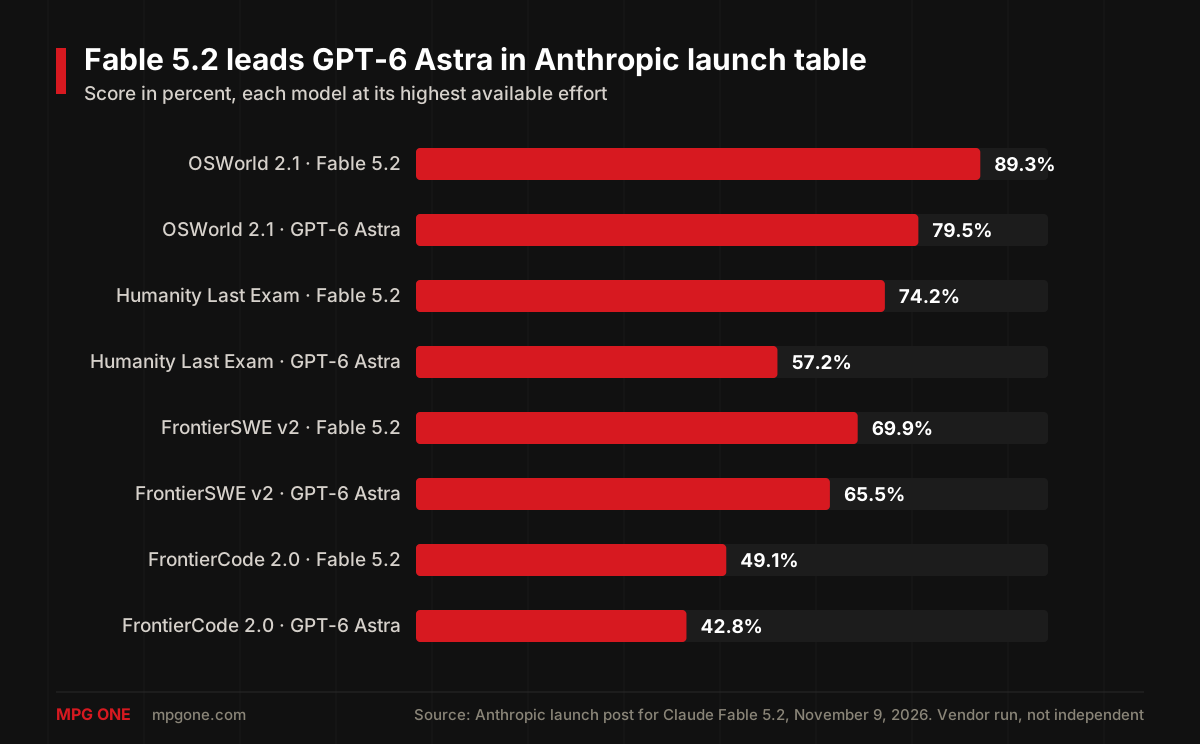
Anthropic ran this table itself and chose the rows. The FrontierCode 2.0 result is the one I trust most, because Artificial Analysis measured almost the same gap on its own: 48.8% against 42.4%. Fable 5.2 loses one row in the table to a third model, Gemini 4 Carbon, which scores 53.9% on AutomationBench against 51.4%.
How I Tested Fable 5.2 and GPT-6 Astra
I ran Fable 5.2 and GPT-6 Astra through our standard five task battery on November 9, 2026, the day Fable 5.2 launched. Every task gets one fresh request, I keep the first response, and there are no retries and no tools. Four tasks have objective answer keys; the fifth measures honesty.
- Bug hunt: a Python interval merge function with two planted bugs, one subtle
- Implementation: write a duration parser from a spec, graded by running it against 8 test cases, including an empty string trap
- Churn math: six monthly subscriber counts to 10 decimal places plus the closed form
- Facts and citations: state three 2026 API prices with official sources, or say you cannot
- Constrained writing: a 50 to 70 word announcement with five exact constraints, auto graded
Fable 5.2 ran through the Anthropic API with output_config.effort set to medium, high and max. GPT-6 Astra ran through OpenRouter, pinned to OpenAI's own endpoint with fallbacks switched off, at medium and high, and was billed at OpenAI's $10 and $50 list price. I did not run Astra at xhigh or max, so the fair comparisons are medium against medium and high against high.
Battery results
Fable 5.2 and GPT-6 Astra both scored 4.40 of 5 on every run: 4 of 4 on the graded tasks plus 40 out of 100 on the facts task. Both found the two planted bugs and flagged the empty input crash, both passed all 8 parser test cases including the empty string, both produced the six exact subscriber counts with the closed form, and both met all five writing constraints. On the facts task, neither model gave a price it could not verify, and both said so plainly.
| Run | Score | Total time | Median time to first token | Output tokens | Cost at list price |
|---|---|---|---|---|---|
| GPT-6 Astra, medium | 4.40 of 5 | 51.1s | 7.6s | 1,765 | $0.095 |
| GPT-6 Astra, high | 4.40 of 5 | 77.8s | 12.2s | 3,037 | $0.16 |
| Fable 5.2, medium | 4.40 of 5 | 44.2s | 5.2s | 4,072 | $0.17 |
| Fable 5.2, high | 4.40 of 5 | 45.4s | 6.0s | 4,399 | $0.18 |
| Fable 5.2, max | 4.40 of 5 | 437.9s | 28.0s | 44,430 | $1.78 |
GPT-6 Astra at medium was the cheapest run at $0.095, about 56% of the $0.17 Fable 5.2 spent at medium. Astra has the higher token price, but it wrote 1,765 output tokens where Fable 5.2 wrote 4,072. At high effort the gap nearly closed: Astra cost $0.16 and Fable 5.2 cost $0.18, and Fable 5.2 finished in 45.4 seconds against 77.8 seconds for Astra.
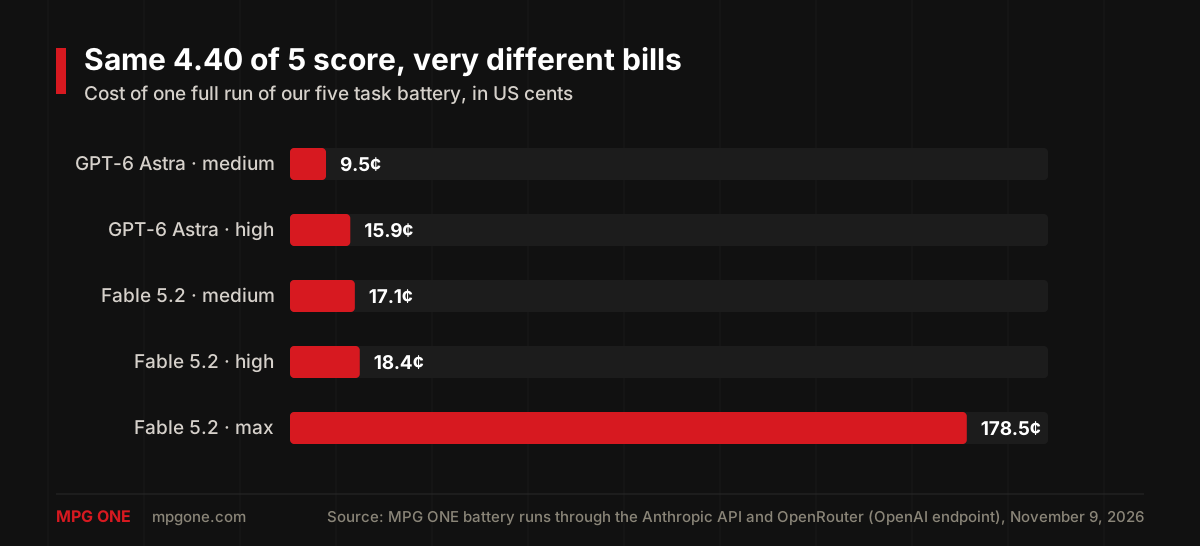
Fable 5.2 at max effort was the most expensive run at $1.78 and 437.9 seconds for the same score. It spent 27,014 output tokens and 270.6 seconds on the churn math that its medium run solved in 1,076 tokens and 10.7 seconds, so max effort bought nothing on tasks this size.
This battery is saturated at the top. Claude Opus 5.5 also scores 4.40 of 5 on it, so the battery cannot rank the flagships on intelligence. It does show what each model charges and how long it takes to reach the same correct answers. Our larger benchmark, BenchOne, has 12 harder business tasks and three runs per model, and neither Fable 5.2 nor GPT-6 Astra is on its board yet.
Fable 5.2 vs GPT-6 Astra Pricing
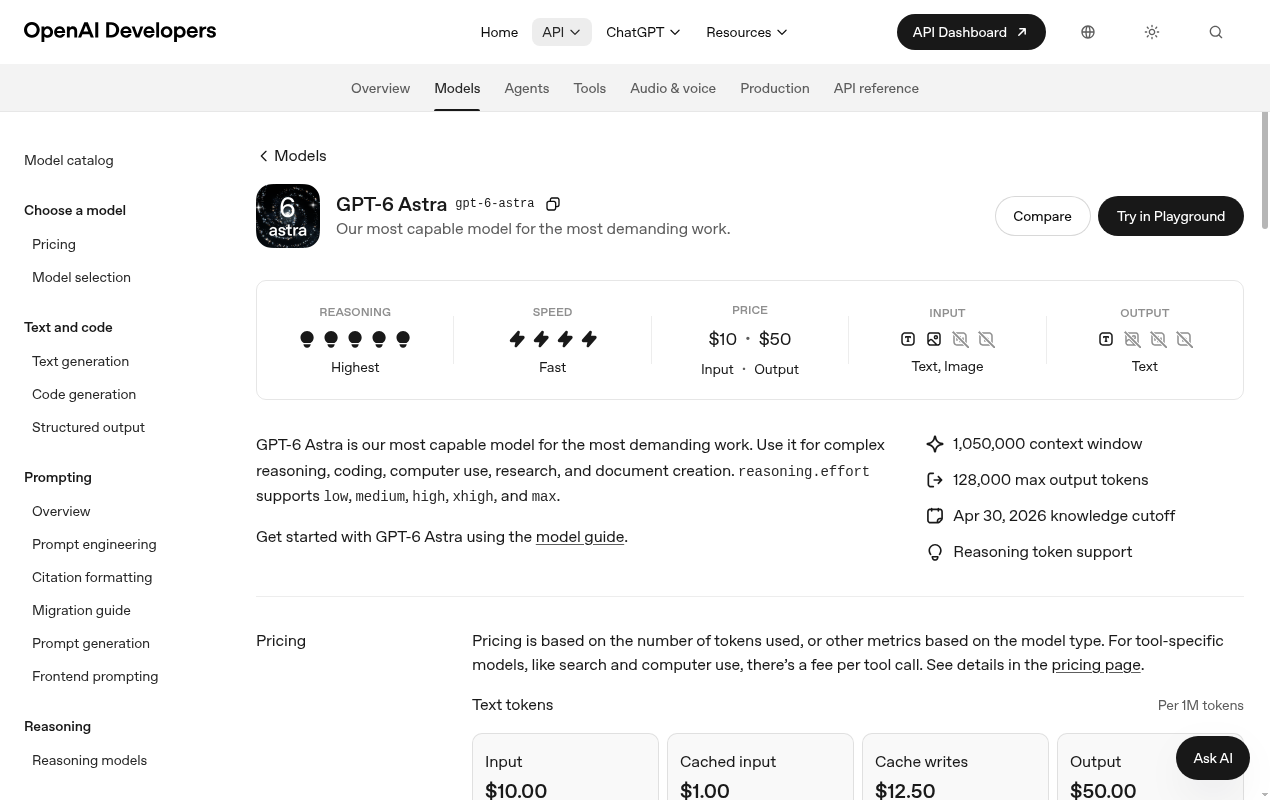
Fable 5.2 costs 20% less than GPT-6 Astra per token: $8 against $10 for input and $40 against $50 for output, according to Anthropic's docs and OpenAI's pricing page. The largest difference is cached input: Fable 5.2 charges $0.20 per million tokens for a cache read, and GPT-6 Astra charges $1.
| Price per 1M tokens | Fable 5.2 | GPT-6 Astra |
|---|---|---|
| Input | $8 | $10 |
| Output | $40 | $50 |
| Cached input | $0.20 | $1 |
| Cache write | $10 for 5 minutes, $16 for 1 hour | $12.50 for 30 minutes, $25 for 12 hours |
| Batch | 50% off | 50% off |
| Fast mode | $16 and $80 | $20 and $100 |
| Long prompts | No surcharge listed | 2x input and 1.5x output above 272K input tokens |
Per token, Fable 5.2 is the cheaper model. Per finished task it has been the more expensive one in every measurement I have, because it writes more. Fable 5.2 wrote 2.3 times Astra's output on our battery at medium and 5.3 times Astra's output on the Artificial Analysis index at max, which is why it cost $26.54 per index task against $6.24 despite the lower price list.
GPT-6 Astra doubles its input price and charges 1.5 times for output on any request above 272,000 input tokens, so long context work costs more on Astra than the headline price suggests. Fable 5.2 has an optional fast mode at $16 and $80 that Anthropic says speeds up output by up to 2.5 times.
Fable 5.2 vs Opus 5.5: Do You Need the Flagship?
Fable 5.2 beats Claude Opus 5.5 on almost every row of Anthropic's launch table, and Anthropic still tells most users to start with Opus 5.5. The launch post calls Opus 5.5 its strongest daily driver and recommends moving up to Fable 5.2 only when the scope and complexity of the work call for it. Opus 5.5 costs $4 and $20 per million tokens, half of Fable 5.2.
Opus 5.5 scored the same 4.40 of 5 on our battery at medium effort for $0.092 a run, against $0.17 for Fable 5.2, which supports that advice. On BenchOne, Opus 5.5 scores 96.6 for $1.91 a run, the same score as the older Fable 5.1 at $4.82. For all three Claude models at every effort level, see Fable 5.2 vs Opus 5.5 vs Fable 5.1.
Fable 5.2 pulls ahead on long, open ended projects. Anthropic says Fable 5.2 at high effort matched Opus 5.5's best FrontierCode 2.0 score, 45.3% against 45.5%, for roughly half the cost per task. In its proof formalization test, a team of about 1,000 Fable 5.2 agents finished formalizing Fermat's Last Theorem in 30 hours, while Opus 5.5 with the same setup had completed 26% after 18 hours. One early tester on Hacker News wrote that Fable 5.2 and Opus 5.5 are hard to tell apart on ordinary coding tasks. We saw the same pattern with the previous generation in Opus 5 vs Fable 5.
Fable 5.2 Safeguards and Fallbacks
Fable 5.2 ships with safety classifiers that block high risk cybersecurity work and most research biology, and a blocked request is answered by an older model. Anthropic's launch post says cybersecurity blocks fall back to Opus 4.8 and biology blocks fall back to Opus 5. If your work touches penetration testing, exploit development or lab biology, some of your Fable 5.2 answers will come from a weaker model.
Fable 5.2 blocks less than Fable 5.1 did. Anthropic reports about 55% fewer blocks in early testing: about 60% fewer in cybersecurity and 40% fewer in biology. Claude Mythos 5.2 is the same underlying model without those safeguards, and it is only available to organizations vetted through Anthropic's verification programs.
Fable 5.2 has three more limits for teams building on the API. It requires 30 day data retention and is not available under zero data retention unless Anthropic approves it, its thinking is always on, so effort is the only cost dial, and forced tool use returns an error. OpenAI handles the same risk with a separate product: GPT-6 Cyber is listed on its pricing page at $20 and $100 per million tokens.
Fable 5.2 or GPT-6 Astra: Which Should You Pick?
Pick GPT-6 Astra when cost per task matters and pick Fable 5.2 when the task is hard enough to need the higher ceiling. I would split the work this way.
- Everyday coding and analysis: GPT-6 Astra at medium. It matched Fable 5.2's score on our battery for 56% of the cost, and it holds the only independent DeepSWE result of the two at 74%.
- The hardest agentic coding and research: Fable 5.2. It leads the Artificial Analysis index 65 to 57 and FrontierCode 2.0 by about 6 points on two separate measurements.
- Work over long PDFs and documents: GPT-6 Astra. It scored 31.0% on GDP.pdf against 24.2%, but watch the surcharge above 272,000 input tokens.
- Apps with heavy prompt caching: Fable 5.2. Its cache read price is $0.20 per million tokens against $1 for Astra.
- Latency sensitive tools: Fable 5.2 at medium or high. It answered first in 5.2 to 6.0 seconds on our battery, against 7.6 to 12.2 seconds for Astra.
- Security testing and biology: neither default model. Fable 5.2 falls back to older models on those requests, so look at Mythos 5.2 or GPT-6 Cyber if you qualify.
- Already on Claude: start with Opus 5.5 at half the price, and move up to Fable 5.2 only when Opus 5.5 at higher effort falls short.
Whichever model you choose, start at medium effort. Our runs showed the same score at every level, and Fable 5.2 at max cost 10 times its medium run.
FAQ
Is Fable 5.2 better than GPT-6 Astra?
On hard benchmarks, yes: Artificial Analysis scores Claude Fable 5.2 at 65 and GPT-6 Astra at 57 on its Intelligence Index at max effort. On our five task battery the two tied at 4.40 of 5, and GPT-6 Astra's medium run cost $0.095 against $0.17 for Fable 5.2, so Astra is the cheaper pick for everyday work.
How much does Fable 5.2 cost?
Claude Fable 5.2 costs $8 per million input tokens and $40 per million output tokens, with cache reads at $0.20. That is 20% below Fable 5.1 and 20% below GPT-6 Astra, which costs $10 and $50. Fast mode for Fable 5.2 costs $16 and $80.
What is the difference between Fable 5.2 and Fable 5.1?
Fable 5.2 is cheaper, faster and stronger than Fable 5.1. The price fell from $10 and $50 to $8 and $40 per million tokens, Anthropic says output is up to 30% faster, and its FrontierCode 2.0 score rose from 32.4% to 49.1%. Fable 5.2 also blocks about 55% fewer requests.
Is Fable 5.2 better than Opus 5.5?
Anthropic's launch table puts Fable 5.2 ahead of Opus 5.5 on almost every benchmark, but Anthropic still recommends Opus 5.5 for most coding and knowledge work. On our battery both scored 4.40 of 5, and Opus 5.5 cost $0.092 a run against $0.17 for Fable 5.2.
Is Fable 5.2 on DeepSWE?
No. As of November 9, 2026 the DeepSWE leaderboard was last updated on September 22, so Fable 5.2 is not listed. GPT-6 Astra is on the board at 74% for $4.43 per task, and the older Claude Fable 5 scores 70% for $13.41.
Final Thoughts
Fable 5.2 vs GPT-6 Astra comes down to how hard your tasks are. Fable 5.2 has the cheaper price list at $8 and $40, the stronger scores on Artificial Analysis and in Anthropic's table, and the faster first token in our runs. GPT-6 Astra has the only independent DeepSWE score of the two, uses far fewer tokens per task, and matched Fable 5.2 on our battery for about half the cost.
For most teams I would run GPT-6 Astra or Opus 5.5 at medium effort every day and keep Fable 5.2 for the long projects where the cheaper models stall. If you want help choosing and wiring up the right model for your product, our AI development services team does this work every week.
Helpful next steps
Turn the idea into something useful
When this topic becomes part of a real website, workflow, campaign, or AI system, these MPG ONE pages are the natural places to continue.
Build private AI assistants, workflow automation, knowledge systems, and reporting layers.
Generative AI development servicesBuild generative AI workflows for content, documents, knowledge, and brand-safe operations.
AI agent development servicesDesign tool-using AI agents with memory, retrieval, permissions, and human review.
Custom AI solutionsCreate a custom AI system around your data, tools, permissions, and operating model.
MPG ONE coursesLearn practical AI systems, SEO growth workflows, and talent brand operations with MPG ONE training.