AI
Mistral Large 4 vs Opus 5.5: 5x Cheaper per Task, Tested
Mistral Large 4 vs Opus 5.5: $0.70/$2.10 vs $4/$20 per million tokens, 26 vs 58 on Artificial Analysis, a tie on our battery. See where each wins.

By Mohamed Ezz CEO & Founder Nov 2, 2026 · Updated Nov 7, 2026
Mistral Large 4 vs Opus 5.5 comes down to price against depth: Mistral's open weight model costs $0.70 and $2.10 per million tokens against $4 and $20 for Claude Opus 5.5, and scores 26 against 58 on the Artificial Analysis Intelligence Index. On our own five task battery the two models tied at four out of four, and Mistral did it for 3.7 cents against 9.2 cents.
After nearly 20 years in AI development and digital marketing, I have watched plenty of teams buy the cheap open model and then quietly route the hard jobs back to the expensive one. In this comparison I will show you what our battery found when both models got the same five prompts, where Mistral Large 4 sits on DeepSWE, what the independent index says about each effort level, what the price gap turns into once thinking tokens are counted, and who should pick which model.
My Main Points:
- Mistral Large 4 at medium effort passed all four graded battery tasks for $0.037 in 153 seconds; Claude Opus 5.5 at medium passed the same four for $0.092 in 45 seconds.
- Per token, Mistral Large 4 is 5.7x cheaper on input and 9.5x cheaper on output. Per task, Artificial Analysis measures $2.06 against $10.04, about 5x, because Mistral thinks longer.
- Artificial Analysis scores Opus 5.5 at 58 and Mistral Large 4 at 26, and Opus 5.5 at low effort ($0.98 per task) is cheaper than Mistral at medium ($1.41).
- The DeepSWE public board, still dated September 22, has neither model. Mistral reports 61.7% for its preview, below every frontier row on the board.
- Mistral Large 4 is open weight under a modified MIT license, 1.05 trillion parameters with 52 billion active, and the only one of the two you can run on your own hardware.
In this guide I will keep the same structure as our GPT-6.1 Sol vs Opus 5.5 and Gemini 4 Argon vs Opus 5.5 tests, so you can read the three side by side.
Mistral Large 4 vs Opus 5.5 at a Glance
Mistral Large 4 and Claude Opus 5.5 launched two weeks apart and aim at the same buyer: a team that wants one model for coding, agents and knowledge work. Anthropic shipped Opus 5.5 on September 22, 2026 as a closed API model. Mistral opened a public preview of Large 4 on October 6, then released the weights and cut the price in half on October 29.
| Item | Mistral Large 4 | Claude Opus 5.5 |
|---|---|---|
| Release | Preview Oct 6, 2026; weights Oct 29, 2026 | Sept 22, 2026 |
| Access | Open weights (Hugging Face), Mistral API, OpenRouter, Azure Foundry, NVIDIA endpoints | Anthropic API, Bedrock, Vertex, Azure, Claude apps |
| Size | 1.05T total, 52B active, mixture of experts | Not disclosed |
| Context | 1M tokens | 1M tokens |
| Input modalities | Text and image | Text and image |
| Reasoning settings | low, medium, high (default high) | low, medium, high, xhigh, max (default medium) |
| Price per 1M tokens | $0.70 in, $0.07 cached, $2.10 out | $4 in, $0.20 cached, $20 out |
| License | Mistral Ecosystem Open Weight License (modified MIT) | Proprietary |
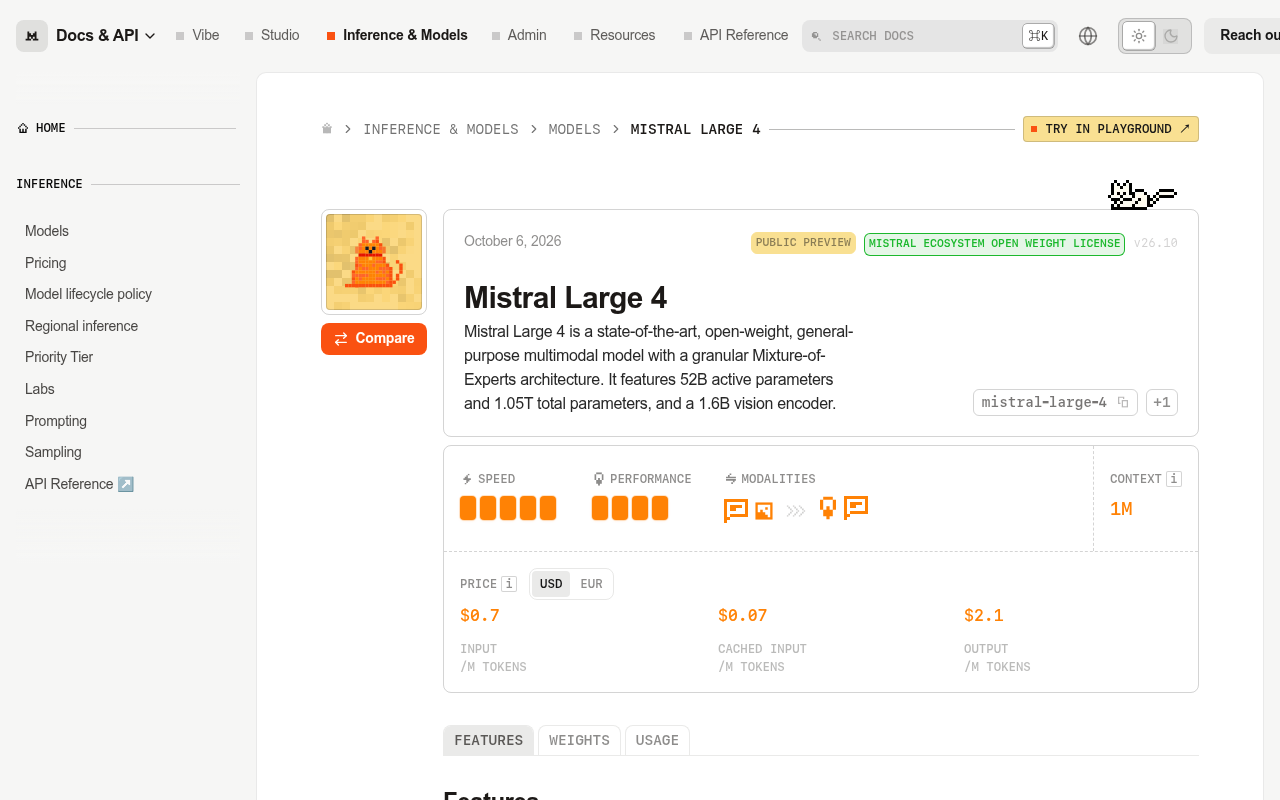
Two details from the Mistral docs change how you call it. Large 4 accepts only three reasoning levels and rejects "none", "xhigh" and "max", and Mistral recommends high as the starting point. Opus 5.5 defaults to medium and, per Anthropic's model page, can no longer run with thinking switched off.
How I Tested Mistral Large 4 and Opus 5.5
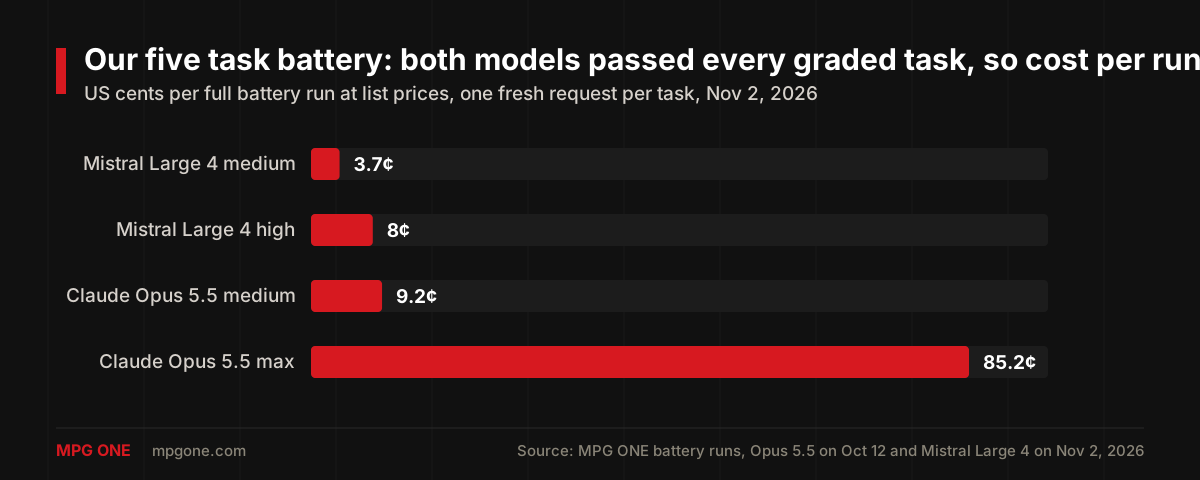
Mistral Large 4 and Claude Opus 5.5 both passed all four graded tasks in our battery at every setting we ran, so the test separated them on cost, speed and token use rather than on correctness. We ran Mistral Large 4 on November 2, 2026 at medium and high effort through Mistral's own API, and Opus 5.5 on October 12 at medium and max through Anthropic's API. Each task is one fresh request with no tools, no retries and the first answer graded.
The five tasks are the same ones every model on this site gets: a bug hunt in a Python interval merger with two planted bugs, a duration parser with an empty string trap, a six month churn calculation to ten decimal places with a closed form, a facts task that asks for three API prices and citations with no web access, and a 50 to 70 word product announcement with five hard constraints. Task five is graded by script; I grade the other four against a fixed answer key.
| Run | Graded tasks passed | Total time | Median time to first answer | Output tokens | Cost |
|---|---|---|---|---|---|
| Mistral Large 4 medium | 4 of 4 | 153.2 s | 30.0 s | 17,560 | $0.037 |
| Mistral Large 4 high | 4 of 4 | 231.4 s | 42.6 s | 37,835 | $0.080 |
| Claude Opus 5.5 medium | 4 of 4 | 44.7 s | 4.6 s | 4,419 | $0.092 |
| Claude Opus 5.5 max | 4 of 4 | 380.6 s | 52.5 s | 42,385 | $0.85 |
Mistral Large 4 at medium cost $0.037 for the full run against $0.092 for Opus 5.5 at medium, a 2.5x gap rather than the 9.5x the output price suggests, because Mistral produced 17,560 output tokens against 4,419 for Opus. At the top settings the gap widens to 10.6x, $0.080 against $0.85, because Opus 5.5 at max thinks for minutes on short prompts. Speed went the other way: Opus 5.5 at medium answered in a median 4.6 seconds and finished all five tasks in 45 seconds, while Mistral at medium took 30 seconds before its first visible word and 153 seconds in total.
On the bug hunt, Mistral Large 4 found the truncation bug and the touching intervals bug at both settings, added the empty input guard, and at high effort also flagged the in place sort as a side effect. On the duration parser, the medium run used a regular expression with an explicit check that at least one group matched, which is the exact trap in that task, and the high run wrote a hand rolled parser that enforces the h, m, s order. The churn table matched the answer key to all ten decimals and both runs gave the closed form 6250 + 3750 × 0.92ⁿ. The product announcement passed all five constraints twice.
The facts task is reported separately because no model can win it without web access. Mistral Large 4 said it did not recognize GPT-5.6 Sol, Claude Fable 5 or Grok 4.5, refused to give prices, and flagged even its pricing page URLs as unverified. That is the honest behavior the task rewards, and it is the same answer Opus 5.5 and Haiku 5.5 gave, so none of the three fabricated a number.
Our battery is five bounded prompts, and frontier models have saturated it since the summer, so it tells you that Mistral Large 4 is a competent model at everyday tasks and what a run costs; it does not measure the long horizon agentic work where the benchmarks below pull the two models apart.
Update, November 7, 2026: this battery has since grown into our BenchOne benchmark, with 12 harder business tasks and three runs per model. Opus 5.5 scores 96.6 there and Mistral Large 4 scores 89.8, losing most of its points on long exact math.
Mistral Large 4 vs Opus 5.5 on DeepSWE
Mistral Large 4 and Claude Opus 5.5 are both missing from the public DeepSWE leaderboard, which was last updated on September 22, 2026, so the only DeepSWE number for either model is a vendor claim. Mistral's October 6 announcement reports 61.7% on DeepSWE v1.1 for the preview, with no error bar and no cost per run. Anthropic has published no DeepSWE figure for Opus 5.5.
DeepSWE is the benchmark I lead with because its 113 tasks are written from scratch across 91 repositories, so no model has seen the solutions in training, and because every public row carries a confidence interval and a cost. On that board the top three, GPT-6 Astra at xhigh, Gemini 3.8 Flash at high and Claude Opus 5 at max, all sit at 74% with error bars of ±1 to ±4 points, Kimi K3 and GLM-5.3 at max sit at 69%, and the cheapest frontier row, GPT-5.6 Luna at max, scores 67% for $0.61 per task.
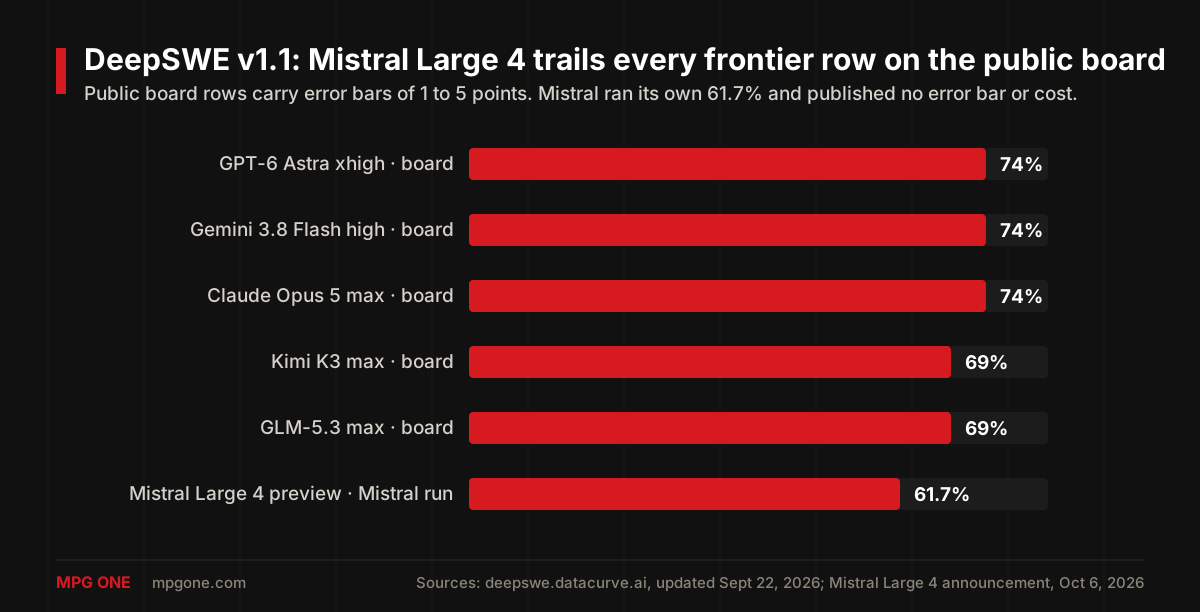
Mistral's 61.7% would land 12 points below the frontier rows and about 7 below the best open weight rows if Datacurve reproduces it. Three weeks of extra reinforcement learning went into the October 29 release and Mistral says Terminal-Bench 4.0 rose 13 points in that time, so the released model may score higher than the preview did. Opus 5.5 should land near or above Opus 5's 74%. I will update this section when either model appears on the board.
Mistral Large 4 vs Opus 5.5 Benchmarks
Claude Opus 5.5 beats Mistral Large 4 on every sub test of the Artificial Analysis Intelligence Index, and the gap is widest on the hard reasoning and agentic rows. Artificial Analysis runs the same nine evaluations on every model with its own harness, which is why I trust it over the two vendors' own charts for a head to head.
| Artificial Analysis, Nov 2, 2026 | Opus 5.5 max | Opus 5.5 medium | Mistral Large 4 high | Mistral Large 4 medium |
|---|---|---|---|---|
| Intelligence Index v5 | 58 | 48 | 26 | 23 |
| Terminal-Bench 4.0 (agentic coding) | 59.6% | 52.5% | 24.7% | 23.2% |
| FrontierCode 2.0 (mergeable code) | 46.4% | 33.1% | 15.0% | 13.3% |
| AutomationBench (SaaS workflows) | 69.5% | 61.2% | 57.8% | 52.8% |
| AA-Briefcase (knowledge work, Elo) | 1,801 | 1,622 | 1,350 | 1,188 |
| HLE-Diamond (reasoning) | 67.9% | 51.4% | 17.3% | 13.9% |
| AA-Omniscience (knowledge, net score) | 48 | 40 | 5 | 3 |
| GDP.pdf (document reasoning) | 26.2% | 25.6% | 17.6% | 16.8% |
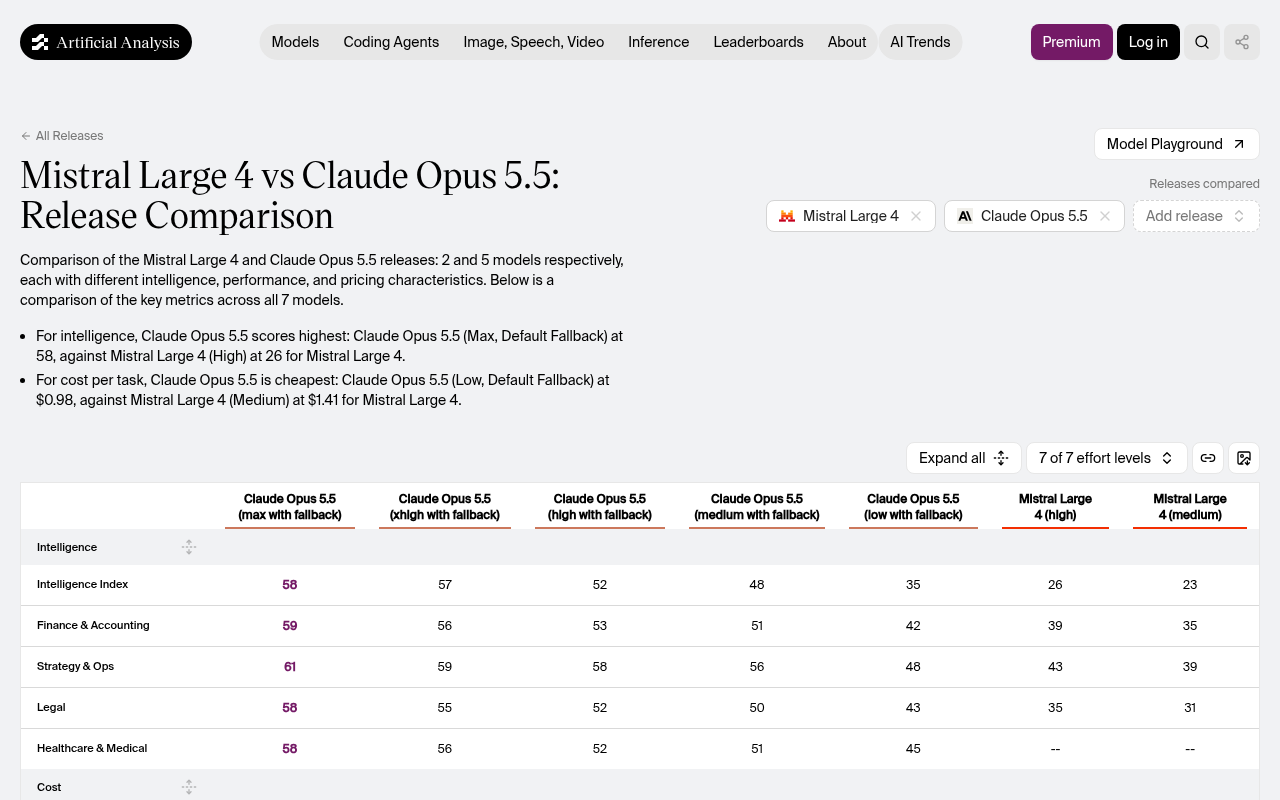
Mistral's October 29 post claims 41% on Terminal-Bench 4.0 for the released model inside its own agent harness, up from 28% at preview, while Artificial Analysis measures 24.7% at high effort with its standard harness. Both can be true at once, because agent harnesses move scores by double digits. In Mistral's own tables Large 4 leads open weight models on Cognition's FrontierCode 2.0 at 19.7% and ties GLM-5.3 at 48% on the Coding Agent Index while using 47% fewer tokens.
In Surge Code's blind pairwise test, graders preferred Mistral Large 4's code over GLM-5.3 and Kimi K3 64% of the time and over DeepSeek V4.1 Flash 56% of the time, and preferred Claude Opus 5.5's code over Mistral's 78% of the time. Mistral put that losing number in its own release post, which I respect.
Where Mistral Large 4 wins outright is defensive security. Mistral reports 51% on the Artificial Analysis Cyber Index, which asks a model to find, reproduce and patch real vulnerabilities, and 82% on the reproduce and patch subtest in its October 6 post, where The Decoder notes that Opus 5.5 and GPT-6 Astra score near zero because they refuse the task. Mistral also measures a 96.6% refusal rate on malicious cyber prompts, so the model is not simply unfiltered.
Mistral Large 4 vs Opus 5.5 Pricing and Cost per Task
Mistral Large 4 costs $0.70 per million input tokens, $0.07 for cached input and $2.10 per million output tokens on Mistral's price list, against $4, $0.20 and $20 for Claude Opus 5.5. That is 5.7x cheaper on input and 9.5x cheaper on output. The October 29 rate card halved the preview list price of $1.36 and $4.18, and Mistral calls this the standard price rather than a promotion.
Cost per task is a smaller gap because Mistral Large 4 reasons at length. Artificial Analysis measured $2.06 per Intelligence Index task for Mistral Large 4 at high and $1.41 at medium, against $10.04 for Opus 5.5 at max, $3.46 at high, $2.45 at medium and $0.98 at low. So the headline 5x saving holds when you compare each model's top setting, and Opus 5.5 at low effort, which still scores 35 on the index against Mistral's 26, costs less per task than Mistral at medium.
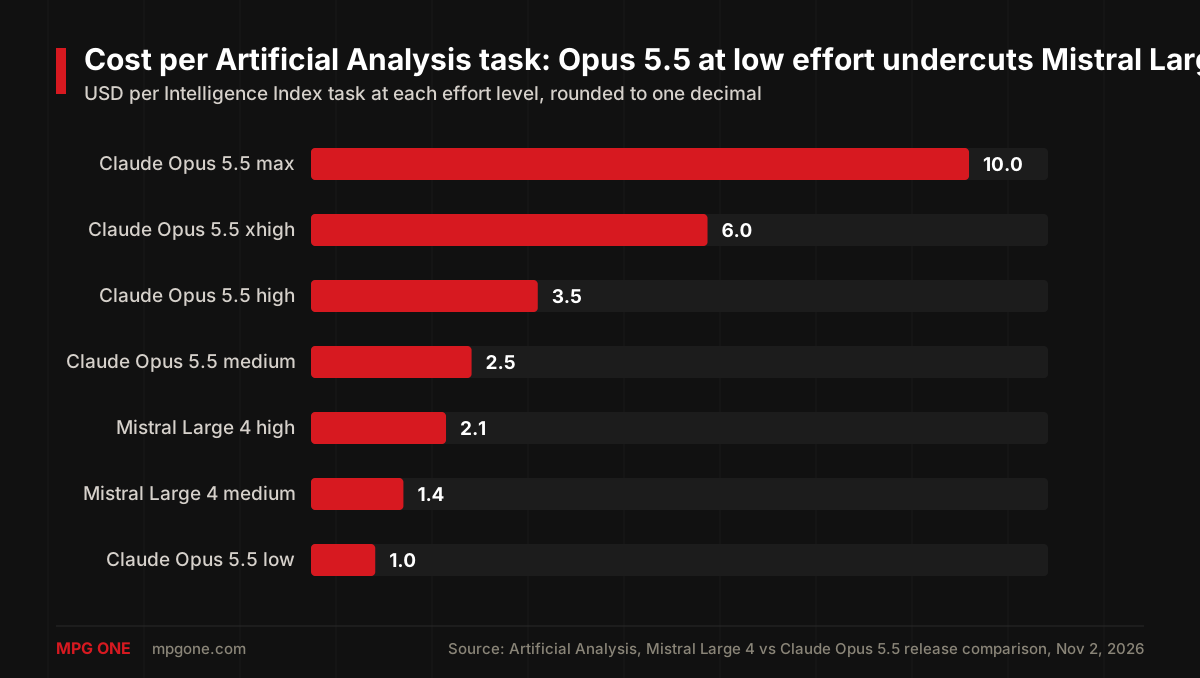
Our battery told the same story in miniature: 3.7 cents against 9.2 cents at default settings, with Mistral generating four times the output tokens. For a production agent that runs thousands of calls a day, measure tokens per task on your own prompts before you trust the price card. Mistral's 1 million token context and 90% cache discount help here, and so does the fact that you can serve the weights yourself and pay for GPUs instead of tokens.
Open Weights, Self Hosting and Sovereignty
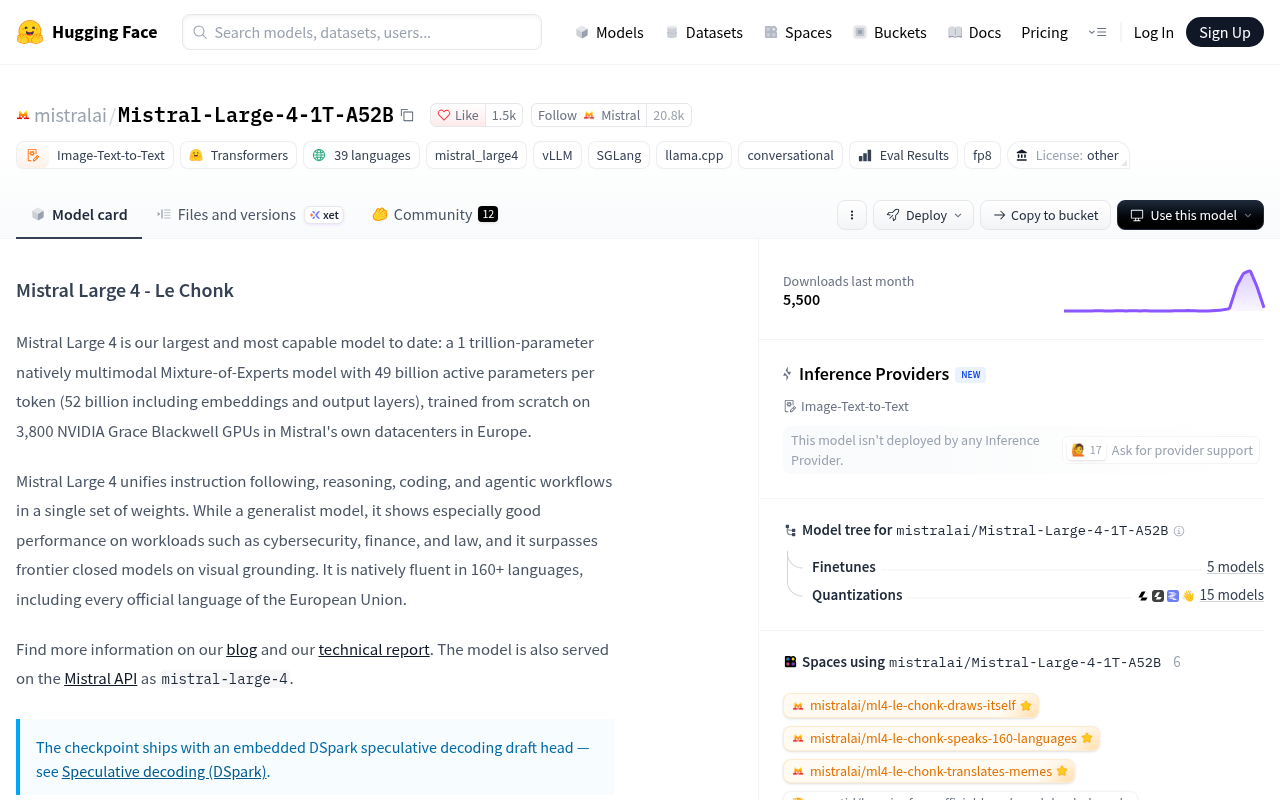
Mistral Large 4 is the only one of the two models you can download, and that changes who it is for more than any benchmark does. The weights sit on Hugging Face under the Mistral Ecosystem Open Weight License, a modified MIT license that allows use, fine tuning and commercial products, with one condition: a business that sells access to the model itself as a service needs a separate commercial license.
Self hosting a 1 trillion parameter model needs a rack of GPUs. The full checkpoint is about 1 TB, Mistral's own vLLM recipe uses eight way tensor parallelism, and the cheap path for most teams is a hosted copy on Azure Foundry, NVIDIA endpoints, OpenRouter or Mistral's EU inference. The win is control: you choose the region, you keep the model version when the vendor moves on, and you can tune it on your own data. That is the argument we make in our private AI guide, and Mistral Large 4 is the first open model at this size that is trained outside China, which matters to the European banks and agencies Mistral lists as customers.
Claude Opus 5.5 offers none of that, and for many teams it does not need to. Anthropic serves it from its own API and from Amazon Bedrock, Google Vertex and Microsoft Azure, and the model is on every Claude plan, so a team already paying for Claude Code gets Opus 5.5 without an API bill.
What Independent Tests of Mistral Large 4 and Opus 5.5 Found
Independent hands on tests of Mistral Large 4 against Opus 5.5 split along the same line as the benchmarks: Opus writes the better code when both finish, and Mistral finishes for less. Two YouTube tests from October are worth your time, one from the preview period and one after the October 29 release.
Amine AI gave both models the same one shot brief on October 30: a single file 3D Earth with about 5,000 satellites and debris objects, color coded and clickable with a time slider, no tools and no retries. Mistral Large 4 thought for about seven and a half minutes, finished in eight and a half, cost under 10 cents and produced a page that worked. Opus 5.5 thought for 11 minutes, hit the 64,000 token output limit, and after 19 and a half minutes and $2.39 handed over a page with one missing pair of brackets that did not run. The reviewer adds that once he fixed the brackets, the Opus page was the nicer one.
MG's October 7 test ran the preview model inside Claude Code against Opus 5.5 on a sales report cleaning task, and the preview failed where Opus finished 32 tasks in 19 seconds. That test predates the release version, and Mistral says the extra training since then cut output tokens by 30% and raised Terminal-Bench by 13 points, so I weight it less. Both testers landed where our battery did: Mistral costs less and takes longer to answer, and the quality gap shows up on the long tasks.
Which Should You Use, Mistral Large 4 or Opus 5.5?
Pick Mistral Large 4 when you need to own the model or when the work is high volume and bounded, and pick Claude Opus 5.5 when the work is hard and the cost of a wrong answer is higher than the cost of the tokens. The decision list I use with clients:
- Self hosting, EU data residency or a fixed model version: Mistral Large 4. Opus 5.5 cannot do any of these.
- Defensive security work: Mistral Large 4. It reproduces and patches vulnerabilities that Opus 5.5 refuses to touch, and still refuses 96.6% of malicious requests.
- Bulk agent calls with short, well specified tasks: Mistral Large 4 at medium, where our battery cost 3.7 cents against 9.2 cents. Measure your own tokens per task first, because Mistral's long thinking eats part of the discount.
- Hard coding and long horizon agent work: Claude Opus 5.5. The 59.6% against 24.7% Terminal-Bench gap and the 78% blind preference for Opus code are too large to argue with.
- Knowledge work and document reasoning: Claude Opus 5.5, by 1,801 to 1,350 Elo on AA-Briefcase and 48 to 5 on the knowledge test.
- Cheapest acceptable answer from a closed vendor: Opus 5.5 at low effort costs $0.98 per task and still scores 35, above Mistral at any setting. Haiku 5.5 goes cheaper still.
If the comparison you need is open weight against open weight, Kimi K3 and GLM-5.3 score higher than Mistral Large 4 on DeepSWE and Terminal-Bench in third party tables, and Mistral answers with a lower token price, fewer tokens per task and a training lineage outside China.
FAQ
Is Mistral Large 4 better than Claude Opus 5.5?
Not on independent scores. Artificial Analysis rates Claude Opus 5.5 at 58 and Mistral Large 4 at 26 on its Intelligence Index, and Opus 5.5 leads every sub test, including Terminal-Bench 4.0 at 59.6% against 24.7%. Mistral Large 4 wins on price, on open weights you can self host, and on defensive security tasks that Opus 5.5 refuses.
How much does Mistral Large 4 cost compared to Opus 5.5?
Mistral Large 4 costs $0.70 per million input tokens and $2.10 per million output tokens, against $4 and $20 for Claude Opus 5.5. Per task the gap is smaller because Mistral thinks longer: Artificial Analysis measured $2.06 per task for Mistral Large 4 at high effort and $10.04 for Opus 5.5 at max, and our own battery run cost 3.7 cents against 9.2 cents at the default settings.
Is Mistral Large 4 good for coding?
Mistral Large 4 is the strongest open weight model for coding on Mistral's own October 29 charts, with 41% on Terminal-Bench 4.0 and a 19.7% lead score on FrontierCode 2.0, and it passed all four graded tasks in our battery. Against Claude Opus 5.5 it still loses: in Mistral's blind Surge Code test, graders picked the Opus 5.5 answer 78% of the time.
Is Mistral Large 4 open source?
Mistral Large 4 is open weight, released on October 29, 2026 under the Mistral Ecosystem Open Weight License, a modified MIT license. You can download, fine tune and commercialize it; only companies that sell access to the model itself as a service need a separate license. The full checkpoint is about 1 TB.
Mistral Large 4 vs GLM 5.3, which is better?
GLM 5.3 and Mistral Large 4 tie at about 48% on the Artificial Analysis Coding Agent Index, and Mistral uses 47% fewer tokens per task to get there. GLM 5.3 scores higher on DeepSWE v1.1 and Terminal-Bench 4.0 in third party tables, while Mistral Large 4 is cheaper per token at $0.70 and $2.10 and is the choice when you need a model trained outside China.
Final Thoughts
Mistral Large 4 vs Opus 5.5 is a tie on bounded work and a clear Opus 5.5 win on hard work, with a price gap of 5x per task at the top settings and 2.5x on our battery at the defaults. Mistral's product is the weights: a trillion parameter model you can host, tune and keep, trained in Europe, that handles security work the closed models refuse. Opus 5.5's product is the extra 32 points on the index when the task is long and the answer has to be right. I will update the DeepSWE section when Datacurve scores either model.
If you are deciding between a hosted frontier model and an open model you run yourself, that is a question we work through with clients every month as part of our custom AI solutions work, from the token math to the deployment.
Helpful next steps
Turn the idea into something useful
When this topic becomes part of a real website, workflow, campaign, or AI system, these MPG ONE pages are the natural places to continue.
Build private AI assistants, workflow automation, knowledge systems, and reporting layers.
AI agent development servicesDesign tool-using AI agents with memory, retrieval, permissions, and human review.
Generative AI development servicesBuild generative AI workflows for content, documents, knowledge, and brand-safe operations.
Custom AI solutionsCreate a custom AI system around your data, tools, permissions, and operating model.
MPG ONE coursesLearn practical AI systems, SEO growth workflows, and talent brand operations with MPG ONE training.